JAKARTA — People around the world have used peatlands since ancient times for agricultural lands. But the Indonesian government realizes that efforts should be continually pursued to keep reminding the general public to apply sustainable practices in using the peatlands as part of local ecosystems.
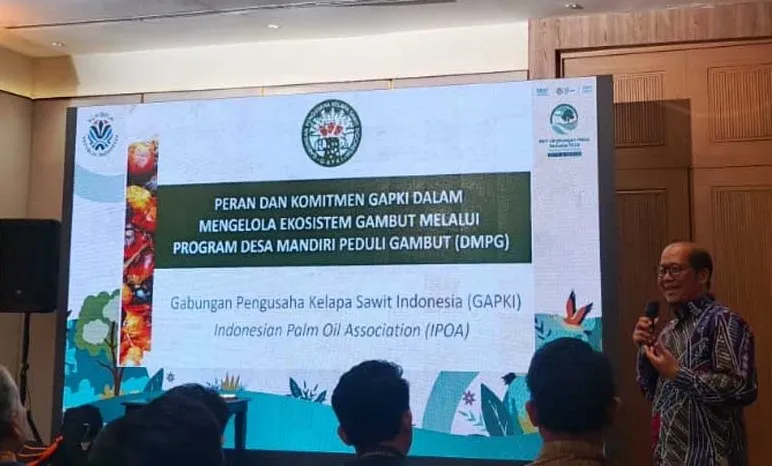
Due to the importance of peatlands in absorbing carbon, the government has issued regulations which require economic empowerment for the public should be based on sustainable practices and strike a balance between economic interest, environmental interests and social interests.
It is within such framework that the Indonesian Palm Oil Association (GAPKI) expresses its strong commitment to support the program of independent and peat-caring villages.
(DMPG), which is implemented by the ministry of environment and forestry (KLHK). The program has become a real example of collaboration to preserve environment based on the empowerment of local communities’ economies.
“Through economic empowerment, the local people can do farming along the year without opening new land areas by the method of burning,” Bandung Sahari, Head of GAPKI’s Sustainability Division said during the Global Environment Day Expo in Jakarta Convention Centre on Monday (24/6/2025).
Bandung said that the implementation of DMPG program has proven that collaborations combined with education, economic activities, and sustainable environmental management can pay off in concrete results. Besides preventing the damage of ecosystems, the program can also open opportunities for increasing the public income.
“We can talk about peatlands, but on the other side the public ask “What can we eat tomorrow?’ Then the solution should be by considering the aspects of economy, social and other real needs of the public,” said Bandung.
Many member companies of GAPKI have taken steps of preservation and empowerment of the local communities around the peatland areas, through various initiatives:
- Research collaboration and joint conservation with the Indonesian Peatland Association (HGI)
- Formation of more than 700 Fire-Caring Groups (KPA) to prevent and anticipate forest and land fires
- Development of productive businesses, such as:
- Smoked fish production
- Traditional fishing trainings
- Honey bee cultivation
- Planting watermelon with an integrated water management system in Hulu Sungai Selatan regency, South Kalimantan.
Director of Peat Ecosystem Protection and Management (PPEG) at the Ministry of Environment and Forestry (KLHK), Edy Nugroho Santoso, said that currently Indonesia has a total area of peatland at 24.66 million hectares based on the Decree of the Minister of Environment and Forestry concerning the National Peat Hydrological Unit Map in 2017.
Edy added that the DMPG program is not only focused on the economy, but also on fire prevention. “Of the 332 DMPG villages, only 3 villages saw cases of fires. It has proven that such approach is effective and successful. We invite business players to accelerate its implementation,” said Edy.
The Ministry of Environment and Forestry designed the DMPG program with three main focuses:
- Rewetting – Water management and land rewetting through the construction of canal barriers
- Revegetation – Replanting with endemic plants having economic value
- Revitalization – Increasing the social and economic capacity of the surrounding communities
According to Edy, this program is also beneficial for companies because it can reduce firefighting costs and avoid potential legal sanctions.
“Currently, there are 400 companies that are preparing to compile peat ecosystem restoration documents. Later, GAPKI will become a strategic partner in assisting its implementation,” he concluded. (*)