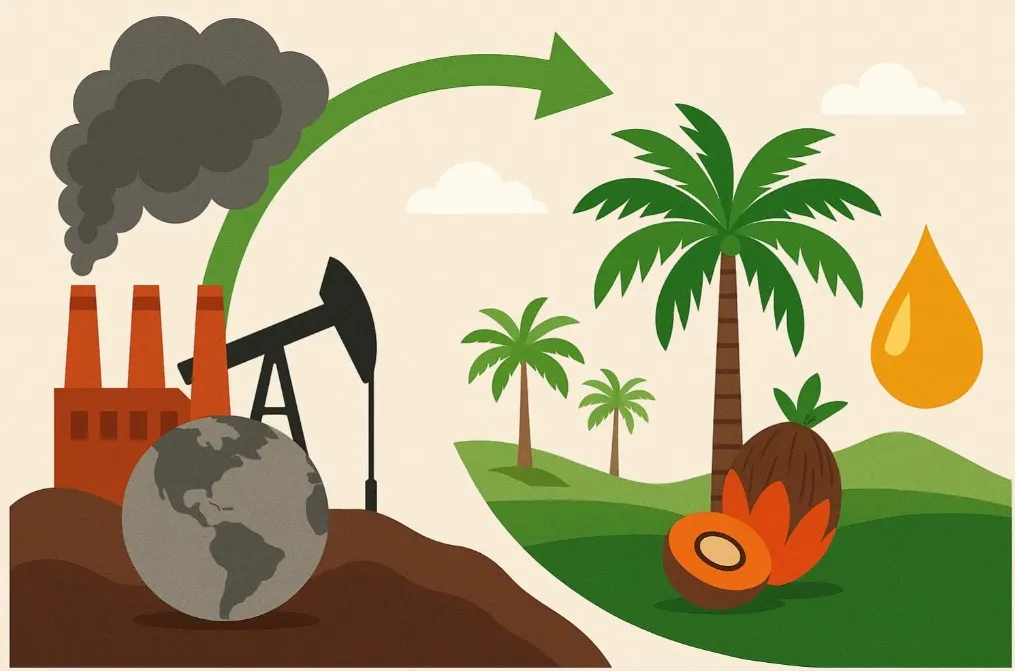
One of negative issues often attributed to palm oil industries is an accusation that oil palm plantations are the main contributors to the global greenhouse gas (GHG) emissions. But actually, if the accusation is verified with objective data, it is baseless and not true.

Conversely, the oil palm plantations have big potential to become part of the solutions to the problem of global climate change. Many studies, including the empirical study by IEA (2016) and Olivier et al. (2022), show that the energy sector (fossil fuels) is the main contributor to the global GHG emission, not agriculture and even not oil palm. Data from the World Resources Institute (WRI, 2021) show that energy sector contributes around 73.2% of total GHG emission in the world. It includes burning of fossil fuels for transportation, industries, and construction.
Conversely, the sectors of agriculture, forestry, and land use (AFOLU), which is often used to blame palm oil , only contribute 18.4% of total global GHG emission. Even if the AFOLU is broken down into its sub-sectors, then the largest contributors to GHG emission are as follows:
- Emission from livestock wastes (manure) – 5.8%
- From agriculture lands – 4.1%
- From land burning – 3.8%
- Deforestation (forest land) – 2.2%
- Crop yields – 1.4%
The facts show that oil palm plantations are not significant contributor to such emissions. It means that accusing palm oil as the main contributor of GHG emission is completely baseless or just a myth, which can be easily debunked with scientific data.
What is interesting is the fact that palm oil is not only without causing problems with climate change, but it also has the potential to save the earth through the following real contributions:
- Most productive, and most efficient in land use. Oil palm produces 4–10 times higher than other oil crops per hectare per year if compared to other vegetable oils, especially soybean, sunflower, or rapeseed. It means, oil palm reduces impacts to lands and forests.
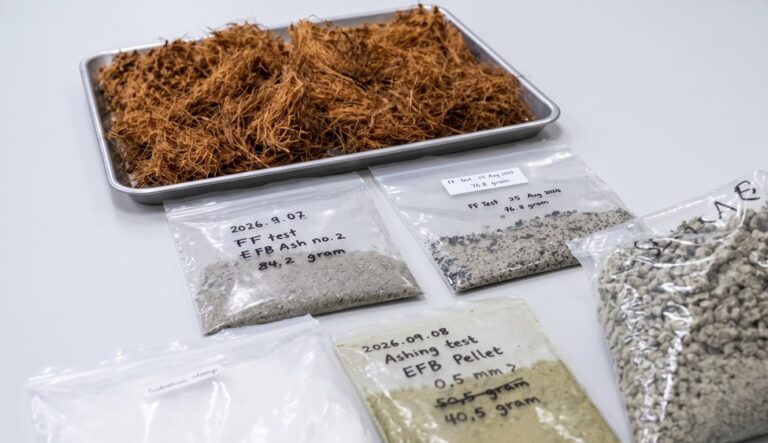
- Wastes from oil palm can be processed into green energy. Liquid and solid wastes from the production of palm oil can be processed into biogas and biomass as renewable energy to replace the fossil fuels.
- As raw material to produce ecofriendly and low emission biodiesel (such as B35, B40 and B50 in Indonesia), which has proven to be effective to reduce emissions from transportation sector, known as the main contributor of global GHG emission.
- Oil palm plantations are potential to absorb carbon emissions. Such potential can be even higher and lasts for long term, depending on the land use, if the palm plantations are developed on bare lands or degraded lands.
It is now time for the world to see oil palm more objectively as it is and not as a scapegoat. Having green potential to help sustain the environment, the oil palm should be accepted as part of the solutions to reduce carbon emissions and save the planet. With sustainable governance, technology innovation, and sustainability certification, the oil palm plantations can be also the source of green energy in the future.
When it comes to talking about climate change, one should not hastily blame palm oil. By considering its green potentials more deeply and thoroughly, especially by comparing it with other vegetable oils, one will find out that the oil palm has been actually acting as a hero working in silence. (*)
Olivier JGJ, Schure KM, Peters JAHW. 2022. Trends in Global CO2 and Total Greenhouse Gas Emissions: 2021 Summary Report. International Energy Agency (IEA). 2016. Emissions from Fuel Combustion. https://doi.org/10.1787/co2_fuel-2016-en. World Resources Institute (WRI). 2021. GHG Emissions by Sector and Gas. https://www.wri.org. Oil World. 2021. Oil World Annual. Wicke et al. 2011. Exploring land use changes and the role of palm oil production in Indonesia and Malaysia. Environmental Research Letters.