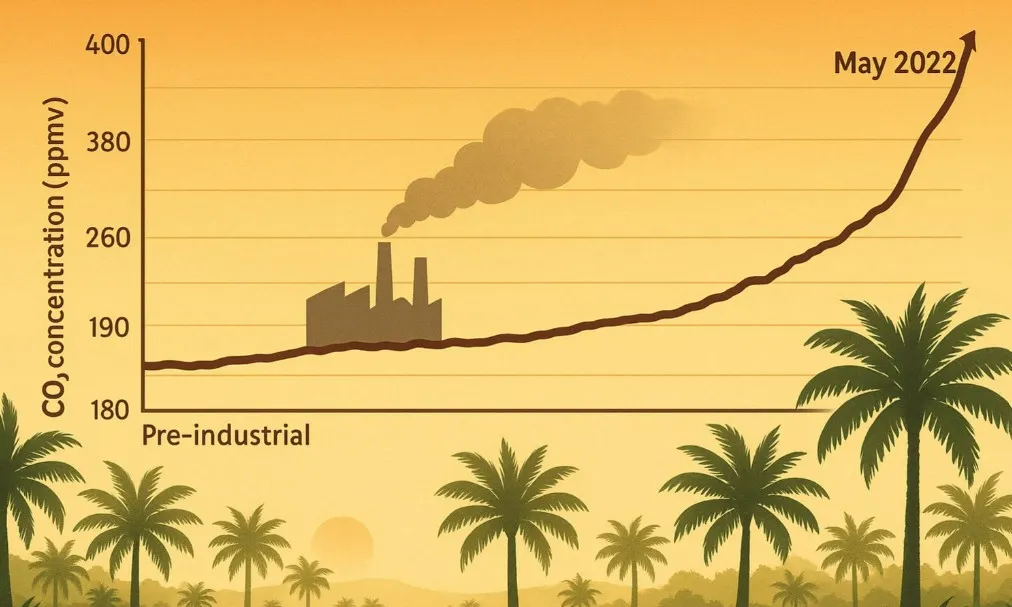
The increase of greenhouse gas (GHG) concentration in the atmosphere has drawn serious attention of the global community. Latest data shows that since the pre-industrial era until now, the concentration of CO₂ in the atmosphere had significantly surged from around 180-280 ppmv during the pre-industrial era up to 407 ppmv in 2018, and continually increased until May 2022.

As shown in the latest graphic (Source: IEA, 2019), the CO₂ concentration had increased very sharply, especially after industrial revolution. It was directly proportional to the increase in economic activities and industrialization in many countries.
The paradigm of Environment Kuznet Curve (EKC) shows that at initial development stage of a country, the greenhouse gas emission tends to increase along with the intensity of economic activities and income increase. But at certain level of income, the emission could decrease due to the application clean technology and rising awareness on environmental conservation.
Based on historical data, there was no strong correlation between the increase of GHG concentration and the expansion of oil palm plantations.
The oil palm plantations had only started developing significantly after 1900s and at that time were only in small areas compared to other agricultural sectors. Even data shows that the oil palm plantations are not the main contributor of global GHG emission.
The significant increase of GHG concentration in atmosphere was more influenced by industrial revolution and global economic activities in general, and not specifically by the development of oil palm plantations. Therefore, the solution to mitigate the climate change should be more focused on the management of industries as a whole and innovation of green technology. (*)
Acaravki A, Alkalin G. 2017. Environmental-Economic Growth Nexus: A Comparative Analysis Developed and Developing Countries. International Journal Energy Economics and Policy
Auci S, Trovato G. 2011. The Environment Kuznet Curve with ini European countries and Sectors; Greenhouse Emission, Production function and Technology
International Energy Agency. 2019. Emission from Fuel Combustion.
Olivier JGJ, Schure KM, Peters JAHW. 2022. Trends in Global CO2 and Total Greenhouse Gas Emissions: 2021 Summary Report.