DENPASAR, Bali – Indonesia and the European Union (EU) concluded a free trade agreement after almost a decade of negotiations by signing the Indonesia–EU Comprehensive Economic Partnership Agreement (IEU-CEPA) in Bali on Tuesday (23/09/2025).
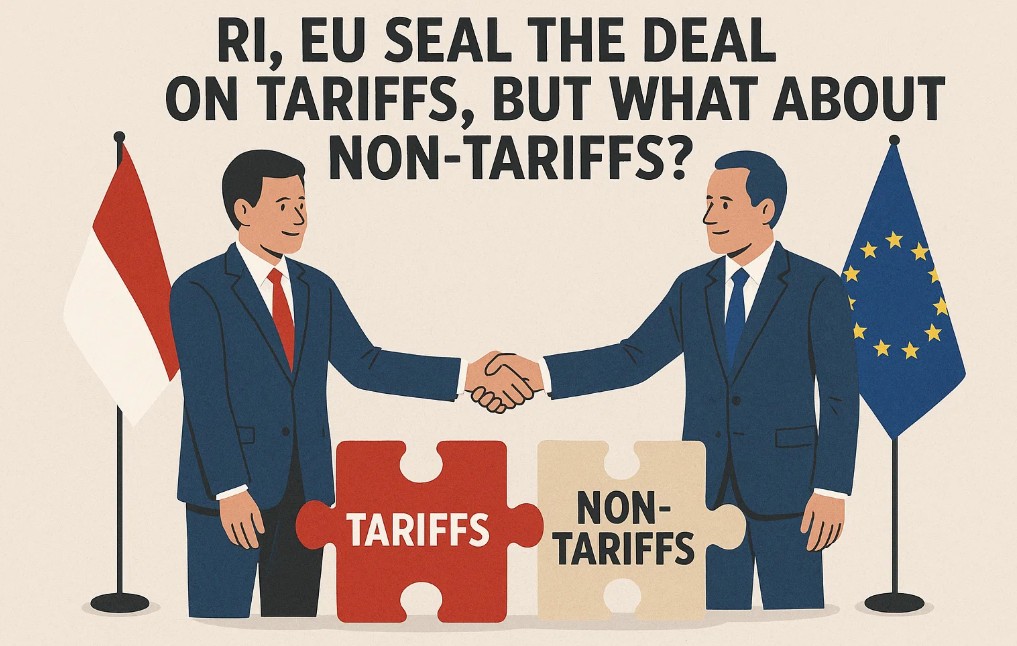
Economic Coordinating Minister Airlangga Hartarto said that under the new trade pact, both Indonesia and the European Union will eliminate more than 98 percent of tariff lines and 99 percent of the total value of imports. When the agreement is implemented in January 2027, Indonesian products will immediately enjoy a zero (0) percent tariff on 90.40 percent of the European Union market. Further tariff reductions will follow gradually.
“With the trade agreement, we expect Indonesia’s exports to EU will increase by 2.5 times during the next five years. The trade increase will be followed by the increase of public welfare at around US$2.8 billion,” he said.
Key commodities such as labor-intensive products (footwear, textiles, garments), palm oil, fisheries, as well as the renewable energy sector and electric vehicles will receive more equitable preferential treatment.
From Indonesia’s side, it will eliminate import duties on industrial products from the European Union that are currently subject to high tariffs. For instance, the tariff for cars manufactured in the EU will be reduced from 50 to 0 percent over a period of 5 years.
Subsequently, some tariffs on machinery and electrical equipment, as well as pharmaceutical products currently subject to up to 15 percent, will be exempted from import duties when the agreement comes into effect. Additionally, tariffs on chemicals reaching 25 percent will also be exempted from duties.
Non-tariff Measures
Mohammad Faisal, Executive Director of the Center of Reform on Economics (CORE) Indonesia, argued on Wednesday (September 24, 2025) that Indonesia cannot solely focus on tariff-based convenience. The biggest barriers to entry to the European Union are actually non-tariff measures (NTMs), and their high standards.
Therefore, if signed, he suggested that the European Union must provide concrete cooperation, including assistance or technical assistance, to Indonesia. This way, Indonesia can achieve EU standards. This effort must be carried out extensively, as non-conforming products (NTMs) are numerous and the standards gap is very large.
“NTM is the most rigid in the world, even compared to the United States or other countries, let alone developing countries. So, Indonesia would be very naive if it only hoped to increase export penetration by lowering tariffs,” he said.
In contrast, NTM in Indonesia is significantly lower compared to the European Union. Furthermore, trade standards in Indonesia are also easier to achieve than those in the European Union. If Indonesia lowers import tariffs, market penetration of European Union products into Indonesia will undoubtedly become much easier. Moreover, this is especially true if the European Union introduces goods with higher added value.
“From the import side, Indonesia is likely to be more easily inundated, thus increasing competition with local products. Not to mention products from China. Furthermore, the USA is also requesting that our NTM be lowered,” said Faisal.
According to Faisal, the situation has the potential to add complexity to the issues of industry and job creation domestically. CORE Indonesia assesses that the Indonesian Government needs to be more cautious in calculating the IEU-CEPA and should not rush into signing.
The negotiation process for IEU-CEPA has been ongoing for nearly 10 years, hindered by various issues such as nickel, palm oil, and disputes at the WTO. The relationship between the two parties has been strained due to the European Union’s deforestation regulations, which aim to combat deforestation, particularly for land clearing for palm oil and coffee cultivation. Indonesia has become one of the most vocal critics of these regulations.
Researchers from the economics department of the Centre for Strategic and International Studies (CSIS) Indonesia, Dandy Rafitrandi, hold a different perspective. Dandy observes that the impetus for resolving negotiations only emerged after the tariff policies of former USA President Donald Trump, which made both parties feel the need to seek alternative markets.
Although the final text is not yet available and full implementation is expected to begin in 2027, this agreement could be positive as it provides certainty in direction for Indonesia’s private sector to plan for expansion, particularly in labor-intensive industries such as footwear and textiles.
The sectors had previously been affected by USA tariff policies, but with the presence of IEU-CEPA, new prospects in the European Union market are expected. This provides hope that companies will not reduce capacity or conduct layoffs, but rather prepare to increase production for export.
For palm oil, the European Union, which initially rejected it, is now beginning to soften its stance with a “facilitation” scheme while still requiring certain standards, such as those related to deforestation regulations. The presence of IEU-CEPA is also expected to create a more structured dialogue platform between Indonesia and the European Union to address regulatory changes.
RI’s Next Homework
Meanwhile, the industry representatives have cautioned that non-tariff barriers still remain. Eddy Martono, Chairman of the Indonesian Palm Oil Association (GAPKI), said that the EU Deforestation Regulation (EUDR) is potential to limit the trade agreement’s impact. “There is still homework to be done, namely the EUDR which must also be resolved immediately because it will be implemented later this year,” he told Reuters.
The broader significance of the CEPA extends beyond trade flows. The agreement introduces new regulatory measures, including an investment court system and licensing reforms, designed to improve transparency and investor confidence. Indonesia has also committed to aligning with the OECD Anti-Bribery Convention, supporting its aspirations to join the OECD.
Dr. Edi Prio Pambudi, Indonesia’s Chief Negotiator, described the CEPA as a “living document,” stating: “That’s why we have to change our standard, especially at the standard in the policy, the standard of the implementation of the policy, the standard of the SOP. Indonesia needs standards because behind the trade competition is always the standard competition.”
European Trade Commissioner Maroš Šefčovič welcomed the agreement, saying it would encourage further investment by European firms in Indonesia, particularly in strategic sectors such as electric vehicles, electronics, and pharmaceuticals.
“By the end of 2023, European investment stocks in Indonesia exceeded 25 billion euros. … Our agreement will foster even greater investment flows,” Šefčovič said.
Trade between Indonesia and the EU reached USD 30.1 billion in 2024, according to Indonesia’s economic ministry. Officials on both sides expect this figure to double within five years of the CEPA’s implementation. (bst)