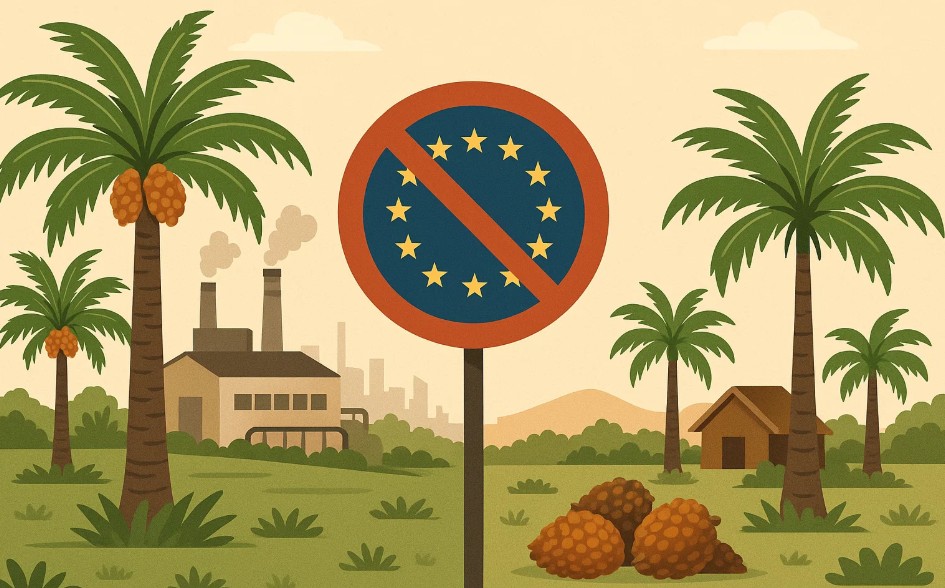
JAKARTA – The Indonesian Palm Oil Association (GAPKI) has urged the European Union (EU) to differentiate treatment of smallholders from big companies in implementing the European Union Deforestation regulation (EUDR).
The GAPKI’s request came after Indonesia and EU signed the Indonesia-European Union Comprehensive Economic Partnership Agreement (IEU-CEPA).
GAPKI Chairman Eddy Martono said that the implementation of EUDR for smallholders is not fair as their scale of plantation ownerships is very limited.
“We urge EU to exclude smallholders from the regulation. They should not be equated with big companies,” Eddy said on Saturday (27/9/2025).
Eddy said that generally the smallholders only manage palm plantations at around 5.0 to 10 hectares. “It is impossible for them to develop their own palm mills. So they have to rely on the big companies to sell their harvest,” he said.
According to him, such condition makes the smallholders vulnerable to the impacts of EUDR implementation if they are not exempted.
He said that although the European Commission has again decided to delay for the second time the implementation of EUDR for another one year until 2026, such non-tariff barrier needs to be resolved soon. “It should be tackled soon. Otherwise, the potential benefits provided by the
IEU-CEPA cannot be optimized in the palm oil sector of Indonesia,” he concluded.
Governance Improvement
Commenting on the second delay of EUDR implementation for another one year until 2026, GAPKI Chairman Eddy Martono said that the delay will give more time for the government and palm oil industry players to pursue negotiations with the EU to temporarily exempt the smallholders while continually improving the governance of palm oil industries in the country.
“The second delay will give more time for palm oil industry players and smallholders to further improve the governance of the industry. Smallholders, especially the independent ones, can take it as an opportunity to resolve their legality issues and ensure that their production meet the international regulations and standards,” he said.
He said that one of the main challenges in Indonesia is concerned with the legal status of smallholders’ land areas. “Many smallholders sent their fresh fruit bunches to palm companies without any clarity on the special moratorium set by the government. This makes them vulnerable to the export limitation if their land areas are categorized as resulted from the deforestation as stipulated in the EUDR,” he said.
The presidential instruction (Inpres) No. 5/2019, which stops the licencing of new plantations, has become one of the bases for assessing Indonesia in preparing preventive steps. The Inpres is in line with the deadline set by EUDR regarding the use of land areas and deforestation.
According to Eddy, big palm oil companies are relatively prepared to deal with the EUDR implementation as the government has been implementing the moratorium of palm oil licenses for palm expansion since 2011. (*)