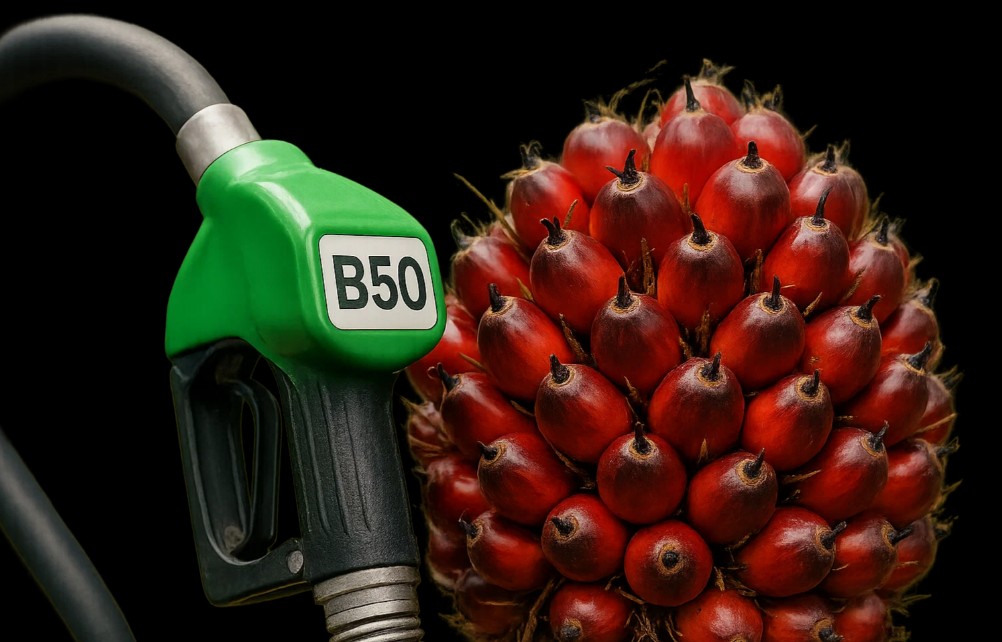
JAKARTA – The Indonesian government has stated that the implementation of the mandatory program of biodiesel 50 percent (B50), as an upgrading of the ongoing B40 program, is still projected to start in 2026, but in the second semester of the year instead of early in the year as initially planned. It is mainly aimed at negating the country’s dependence on import of fossil diesel fuel.
Energy and Mineral Resources (ESDM) Bahlil Lahadalia said the decision to implement the B50 program had been approved recently by President Prabowo Subianto during a limited cabinet meeting.
“Based on the direction of President, Insya Allah (God willing), we’ll implement the B50 program in 2026. It means that we’ll no longer need to import diesel fuel,” Bahlil said when addressing the Investor Daily Summit, in Jakarta Convention Center (JCC), on Thursday (9/10/2025).
“Now, we’re entering the fourth stage of its trial. This year it had been tested in trains, heavy equipments, ships, and cars. If it has been declared clear and clean, Insya Allah, we’ll be launching it during the second semester 2026,” he said.
According to Bahlil, the biodiesel policy is a continuation of the mandatory program of biodiesel that has been implemented since 2016. The government started B10, B20, and now ongoing B40, with the composition of crude palm oil (CPO) and methanol blending.
“With the implementation of B40 alone, our import of diesel fuel already decreased to around 4.9 million barrels per year, or around 10 percent of the total national consumption of diesel fuel,” said Bahlil.
He pointed out that the use of CPO as blending material of biodiesel production has created a multiplier effect for Indonesian economy. Besides reducing deficit of energy trade balance, the biodiesel program has also increased the welfare of oil palm smallholders.
“If we can maximize the use of CPO, then the smallholders will enjoy added value from their production,” he said.
Currently, the Indonesian consumption of diesel fuel reached 39 – 40 million barrels per year. “With the implementation of B50, the government estimates that the country’s dependence on diesel fuel import will be annihilated totally, so that we can save our foreign exchange,” he said.
Bahlil said the B50 policy is part of President Prabowo’s direction to realize the national energy sovereignty. The government wants that all of local needs of energy can be fulfilled from the local resources.
“This is part of our big strategy to strengthen our national economy, so that it cannot be easily affected by the price fluctuations at the global market,” he said.
Reduction of emissions
Besides reducing import, the biodiesel program has also supported the government in realizing the target of reducing carbon emissions and accelerating transition toward clean energy. According to Bahlil, the biodiesel is a realistic solution amid the limitation of electric vehicle technology and infrastructure of renewable energy.
“The B50 is not just a matter of economic efficiency, but also a concrete step toward full-scale use of sustainable energy,” he said.
The government has ensured that all of B50 trial process on vehicles , heavy equipments and others will be completed before its full application in 2026. That way, Indonesia is expected to become the country with the highest implementation of biodiesel in the world, following Brazil and the USA.
“This is a bold decision that is pro-people and for the sake of self-sufficiency in the country,” concluded Bahlil.
Big Impacts to economy
Previously, Deputy Minister of Energy and Mineral Resources, Yuliot Tanjung said the biodiesel policy is part of the national strategy to reduce carbon emissions caused by the use of fossil fuels.
He noted that the success of implementing the B40 program so far in 2025 had brought big impacts to the national economy. “The use of B40 had allowed us to save around US$9.3 billion or around IDR147.5 trillion. Besides, its contribution for local added value reached Rp20.98 trillion, and had also created job opportunities for up to two million workers,” he said.
Meanwhile, the KESDM’s Director General of Renewable Energy and Energy Conservation (EBTKE), Eniya Listiani Dewi added that the B50 program needs a road test of 6–8 months before being formally launched.
According to her, the target of its implementation is not necessarily at the beginning of next year. “Based on direction from ESDM Minister, most likely it will be not on 01 January next year. We’ll be waiting for the result of road test before deciding on its formal schedule of launching,” she said.
With the consistency of implementing the biodiesel program, the government hopes that the B50 program will be able to strengthen the national energy resilience, reduce the import of fossil diesel fuel, and accelerate transition toward clean energy in Indonesia. (*)
Cnnindonesia.com. https://www.cnnindonesia.com/ekonomi/20251009153014-85-1282802/pemerintah-terapkan-b50-tahun-depan-demi-setop-impor-solar. Pemerintah Terapkan B50 Tahun Depan Demi Setop Impor Solar. 09 Okt 2025