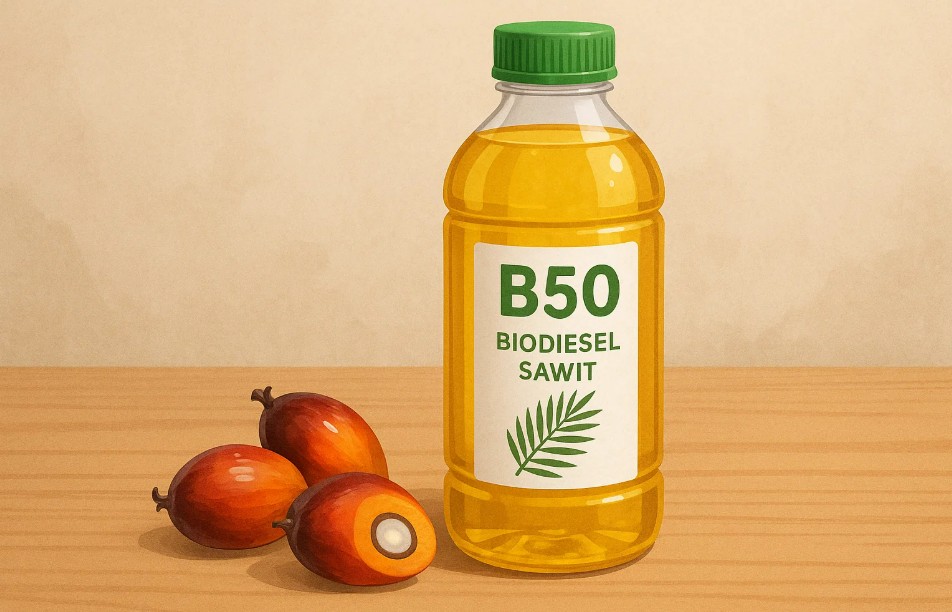
JAKARTA – Experts have warned that the government’s plan to upgrade the mandatory program of biodiesel from the current biodiesel 40 percent (B40) to B50 in 2026 will bring negative impacts to the national economy of Indonesia, especially to its palm industry itself.
Prof. Bayu Krisnamurthi of Bogor University of Agriculture (IPB University) and a team of researchers of the University of Indonesia’s (UI) Pranata Pembangunan (Pranata UI) said that policy without being supported by right calculation is potential to harm the country’s palm oil sector, which plays a very significant role in the national economy.
“During the last few years, Indonesia has not only seen a stagnant production of palm oil, but also stagnant investment as a result of policy uncertainty,” Bayu said during a Focus Group Discussion (FGD) in Jakarta on Friday (17/10/2025).
Based on the study of the Pranata UI, the upgrading of B40 to B50 is potential to increase subsidy, reduce exports, and raise the price of cooking oil. The study also shows that if the mandatory program of biodiesel is upgraded from the current B40 to B50, then the need of crude palm oil (CPO) for production of biodiesel will jump to 59 million tons per year, while the production in 2025 is only projected to reach 49.5 million tons.
“The discrepancy is potential to disturb the domestic supply and reduce exports of palm oil products. It will be a death knell for Indonesian palm oil industries,” said Bayu, who is former deputy minister of trade and former deputy minister of agriculture during the administration of President Susilo Bambang Yudhoyono (SBY).
According to him, a simulation has shown that the B50 program is potential to save foreign exchange from termination of diesel fuel import at Rp172.35 trillion, but potential to lose foreign exchange as a result of decline of CPO export at Rp190.5 trillion.
The condition can weaken the country’s trade balance and stability of rupiah, especially because the price of Indonesia’s CPO has been higher than that of other vegetable oils, pushing other importing countries like India to turn to other rival vegetable oils. It can also raise the domestic prices, including the prices of cooking oil and fresh fruit bunches (FFB). The price of cooking oil is estimated to rise up to 9.0 percent and FFB price will rise by around Rp618 per kilogram due to the increase of demand for biodiesel production,” he said.
“We need a balance between the target of energy, exports, and the welfare of smallholders. Indonesia’s palm oil industries are incredibly strong, it’s impossible to lose competition, unless we ourselves make it lose,” said Bayu.
The biggest impact is expected to hit the independent smallholders. Pranata UI recommended that all stakeholders consider the capacity of national palm oil production, export competitiveness, and the welfare of smallholders.
The Business Competition Supervisory Board’s (KPPU) Commissioner and Palm Oil Researcher, Dr. Eugenia Mardanugraha added that the upgrading of biodiesel mandatory program will push up the global price of CPO, which will in turn erode the competitiveness of palm oil against other vegetable oils.
“The price of CPO that is often higher than the prices of rival vegetable oils, even up to more than US$100 per ton, will weaken the position of palm oil as the cheapest vegetable oil in the world,” he said.
According to him, the increase of biodiesel portion amid the global trend toward the technology of non-combustion automotive and engine power plants is questionable.
Bayu doubted the urgency of this policy and underlined the importance of biodiesel policy that is more adaptive and based on data. “Indonesia risks to lose some of its trading profit and global price control due to policy that ignores the international market dynamics,” he said. (*)
Adapted from: tempo.co