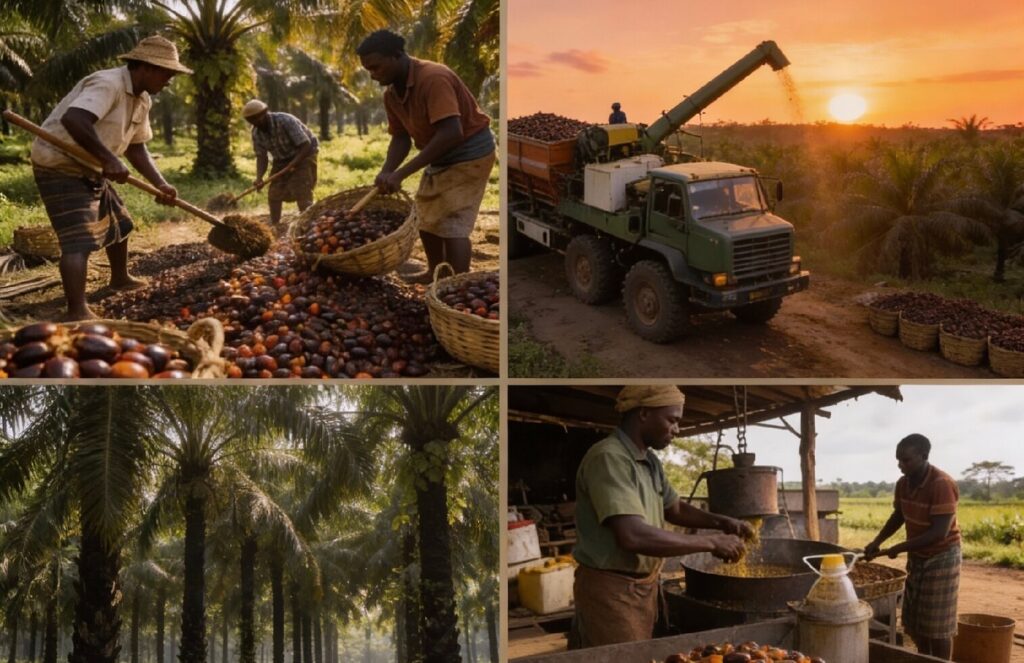
Palm oil plays a strategic role in the economic structure of tropical developing countries like Indonesia, Nigeria, and Colombia. Besides serving as a source of foreign exchange and job opportunities, the plantation commodity also directly contributes to poverty reduction and food security in tropical regions. Those developing countries’ dependence on palm oil reflects the dynamics of economic development in developing countries, where natural resource-based commodities are often a key instrument for driving socio-economic growth and stability.
However, the role of palm oil is often perceived negatively in global discourse, particularly regarding environmental issues. Such perception often overlooks the energy efficiency and productivity of palm oil compared to other vegetable oil commodities. With much higher productivity of oil palm per hectare per year compared to other oil crops—such as rapeseed and sunflower oil, the oil palm has the potential to reduce pressure on land expansion if managed through sustainable agricultural practices and effective governance.
In this context, the primary issue lies not with the commodity itself, but with the process of production and the policies that govern it. The issue of greenhouse gas (GHG) emissions is often cited as a major criticism against the palm oil industry.
However, the argument requires deeper analysis. Oil palm has a relatively high capacity of carbon sequestration, potentially absorbing CO2 from the atmosphere during its growth cycle. Therefore, the environmental impact of oil palm depends heavily on the context of how it is cultivated, whether it is developed through the conversion of primary forests or through the optimization of degraded lands.
This analysis suggests that oil palm can serve as an important instrument of economic development for tropical developing countries, provided it is supported by appropriate environmental policies and land management strategies.
With proper governance, oil palm should not be viewed as a threat to sustainable development, but rather as a strategic opportunity to pursue the economic progress of those tropical developing countries. (*)
Pehnelt, G., & Vietze, C. (2011). Recalculating default values for palm oil (No. 2011, 037). Jena Economic Research Papers. https://www.econstor.eu/handle/10419/56845
Sipayung, T. (2023). https://palmoilina.asia/jurnal-kelapa-sawit/kelapa-sawit-dan-emisi/
Tan, K. T., Lee, K. T., Mohamed, A. R., & Bhatia, S. (2009). Palm oil: Addressing issues and towards sustainable development. Renewable and sustainable energy reviews, 13(2), 420-427. https://www.econstor.eu/bitstream/10419/32579/1/614469007.pdf