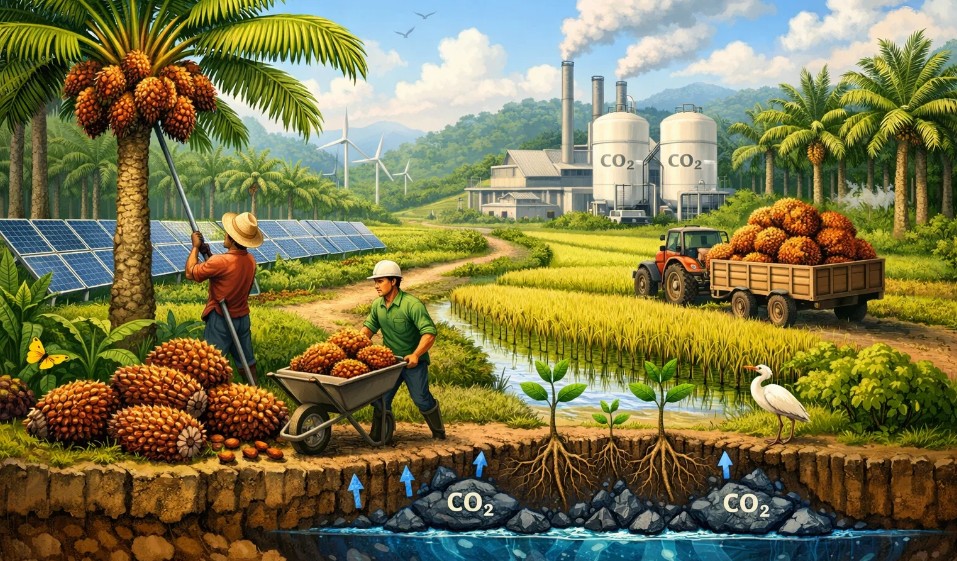
BOGOR – The Bogor University of Agriculture (IPB University) Alumni Association (HATI) initiated a multi-stakeholder forum to develop carbon projects in the sectors of agriculture and plantations. The initiative is considered a potential opportunity of new economy and a tool for transformation toward productive agriculture that is adaptive to climate change.
“As the climate change is getting worse, Indonesia’s agricultural sector is now at a historical crossroads: it will either become a victim of climate change or become a champion of mitigation through credible and equitable carbon projects,” said the HATI Chairman Agustinus Toko Susetio in an official statement on Tuesday (03/03/2026).
The statement was the central theme of the seminar titled “Carbon Project Development in the Agricultural Sector,” held at the Auditorium of the Faculty of Economics and Management (FEM), IPB University Dramaga, Bogor, on Saturday (28/02/2026). This event was part of a series of activities toward the convening of the 2026 National Seminar.
Agustinus stated that the event served as a platform for cross-sector consolidation, bringing together academics, national development planners, research institutions, global carbon market players, and project developers.
“The goal is to formulate a direction for the development of agricultural carbon projects that are credible, have integrity, and support farmer welfare,” he said.
The event was opened by Director of Career Development, Entrepreneurship, and Alumni Relations of IPB University, Puji Mudiana, who represented IPB University Rector Alim Setiawan Slamet. Accompanying him was the Head of the Department of Soil Science and Land Resources at IPB University, Dyah Tjahyandari Suryaningtyas.
Puji emphasized the strategic role of universities in ensuring that the transition toward green economy is science-based and provides tangible benefits to society. He highlighted the importance of a scientific foundation, particularly soil science, in the development of agricultural carbon projects.
The seminar featured Prayudi Syamsuri, Deputy Chairperson of the IPB Alumni Association and Expert Staff to the Minister for Connectivity Management at the Coordinating Ministry for Food Affairs of the Republic of Indonesia, as the keynote speaker. Also in attendance were representatives from the Ministry of National Development Planning/Bappenas, the National Agency for Research and Innovation (BRIN), carbon market players, and developers of natural solution-based projects.
Instrument of food resilience
The discussion emphasized the potential of agricultural carbon projects as a strategic instrument to bridge the national efforts of emissions reduction and food security agendas. However, their implementation must be supported by scientific integrity, credible measurement, reporting, and verification (MRV) system, transparent governance, and a fair benefit-sharing mechanism for smallholder farmers.
Furthermore, the global carbon market demands additionality and high credibility. Therefore, Indonesia needs to ensure the readiness of policies, technology, and institutional aggregation among farmers to ensure the agricultural carbon projects are truly bankable and internationally competitive.
Suria Darma Tarigan, Professor of the Department of Soil Science and Land Resources, IPB University, emphasized that soil is a long-term carbon sink that must be measured and reported using credible scientific methodologies.
Meanwhile, other speakers highlighted crucial issues such as the cost of MRV, the risk of land conversion, the potential for double counting, and the importance of strengthening farmer institutions for the sustainability of carbon projects.
The forum concluded that Indonesia has significant potential in developing agricultural carbon projects. However, success can only be achieved if the projects are science-based, have high integrity, transparent, and guarantee social protection for farmers as the primary actors.
HATI stated that the activity is the first step towards the 2026 National Seminar, which is expected to produce more structured and implementable recommendations of policy. (*)
Sawitindonesia.com. https://sawitindonesia.com/proyek-karbon-di-sektor-pertanian-menjadi-peluang-ekonomi-baru/. Proyek Karbon di Sektor Pertanian Menjadi Peluang Ekonomi Baru. 4 Maret 2026