BANDUNG – A team of researchers from Bandung Institute of Technology (ITB) has developed a new technology to convert empty palm fruit bunches (EFBs) into environmentally friendly plastic raw materials.
The innovation has opened up opportunities to utilize the approximately 34 million tons of the palm oil waste produced annually from Indonesia’s oil palm plantations.
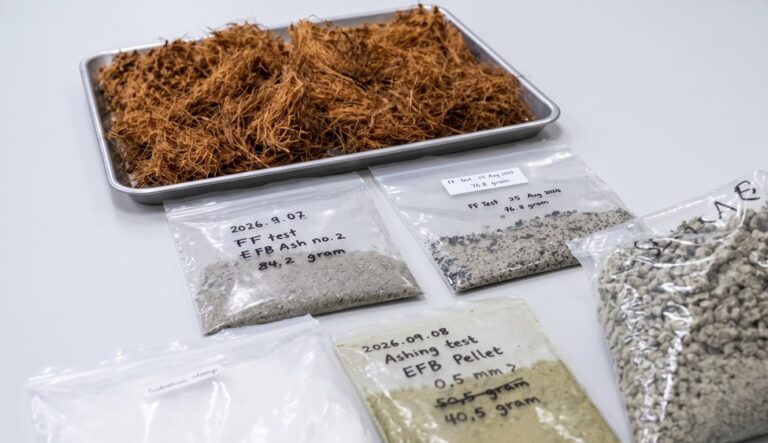
Conducted by a team from the Institute for Research and Community Service (LPPM) of ITB, the research utilizes empty oil palm bunches (EFBs), which are so far underutilized and considered as useless waste.
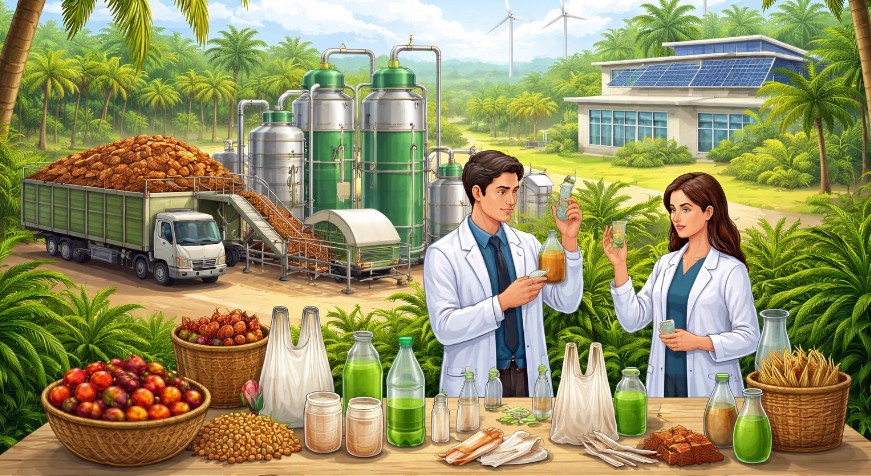
The newly-developed technology converts oil palm biomass into bio-aromatics and bio-BTX, which are essential chemicals for the production of plastics, polyesters, and various industrial materials.
Indonesia produces approximately 34 million tons of empty palm fruit bunches annually from its total 16.8 million hectares of oil palm plantations, mainly in Sumatra, Kalimantan and Sulawesi.
Until now, such waste is not yet optimally utilized, and mostly used for making compost in the plantations.
In fact, the empty palm fruit bunches contain important components such as:
Cellulose: 24–45 percent
Hemicellulose: 21–34 percent
Lignin: 14–30 percent
The lignin content can be processed into high-value aromatic compounds, which are needed by the chemical industries.
Green alternative To plastics
Currently, most plastic raw materials are still derived from petroleum. As a result, the plastics industry is highly dependent on fossil fuels as the source of raw materials.
The technology developed by ITB offers a more environmentally friendly alternative by utilizing palm oil biomass as a raw material.
Through a conversion process using a zeolite-based catalyst, the lignin fraction from empty palm fruit bunches can be converted into chemical compounds such as benzene, toluene, and xylene (BTX), which are used in the polymer industry.
Efficiency 30 times higher
Led by Dr. CB Rasrendra, the ITB research team successfully designed a special zeolite-based catalyst capable of significantly increasing bio-BTX production yields.
With the formulation, production yields can be increased up to 30-fold compared to using conventional catalysts.
In the initial stages, the research team has succeeded in:
- Developing a laboratory-scale production system
- Producing approximately 100 milliliters of crude bio-BTX
- Preparing a patent draft for the process technology
Supporting down-streaming program
This technology also supports the government’s ongoing down-streaming program for the palm oil industry. Empty palm fruit bunches (EFBs), previously considered worthless, can now be processed into high-value industrial raw materials.
The resulting products can be directly used by existing industries, such as plastic and polyester material manufacturers.
Through this innovation, palm oil waste is no longer viewed as a waste from plantation production, but as a strategic source of raw materials for future industries. (*)
Sawitku.id. https://www.sawitku.id/sawitku/81416944642/peneliti-itb-ubah-34-juta-ton-limbah-sawit-jadi-bahan-baku-plastik-ramah-lingkungan. Peneliti ITB Ubah 34 Juta Ton Limbah Sawit Jadi Bahan Baku Plastik Ramah Lingkungan. 3 April 2026