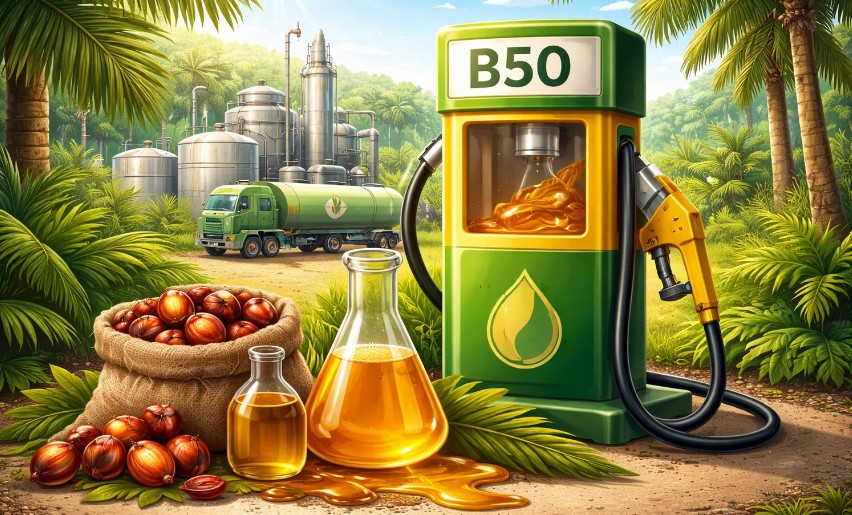
JAKARTA – The government reported that the trials of biodiesel 50 percent (B50) had shown positive results and is ready for national implementation. The program, which uses a 50 percent palm oil and 50 percent diesel fuel blend, is scheduled to take effect on July 1, 2026.
Minister of Energy and Mineral Resources, Bahlil Lahadalia, stated that the B50 trial has been underway for almost six months and has yielded quite good results.
“Thanks God, as of today the trial has been quite good,” Bahlil said at the office building of the ministry of energy and mineral resources office in Jakarta on Monday.
According to Bahlil, the B50 trial was conducted on various types of vehicles and means of transportation, including heavy equipment, ships, trains, trucks, and other vehicles.
The trial is still ongoing, but the government is targeting to get final results before its scheduled start on 01 July, 2026.
Bahlil emphasized that biodiesel development is part of the government’s strategy to reduce dependence on imported energy.
He believes that global geopolitical tensions, including conflicts in the Middle East, demonstrate the vulnerability of countries dependent on energy imports.
Impacts of biodiesel program
Indonesia is currently implementing the B40 mandatory program, which is the mixture of 40 percent palm oil-based biodiesel and 60 percent conventional diesel fuel.
According to data from the Ministry of Energy and Mineral Resources, the B40 policy is capable of:
Reducing diesel imports by approximately 3.3 million kiloliters
Reducing emissions by up to 38.88 million tons of CO2 equivalent
During January–December 2025, domestic biodiesel utilization reached 14.2 million kiloliters, or approximately 105.2 percent of the national target.
President Prabowo Subianto is targeting the implementation of B50 to strengthen national energy security.
Meanwhile, Coordinating Minister for Economic Affairs Airlangga Hartarto stated that the B50 policy could save up to IDR 48 trillion in energy subsidies.
Furthermore, the implementation of B50 is also estimated to reduce fossil fuel use by approximately 4 million kiloliters per year.
The government is optimistic that this policy will strengthen Indonesia’s position in utilizing palm-based energy while reducing dependence on fuel imports.
CPO production increase
Agriculture Minister Andi Amran Sulaiman stated that Indonesia’s CPO production has increased significantly. Previously, CPO production was around 26 million tons, but it has now risen to around 32 million tons.
The increase in production of around 6 million tons was driven by high prices of CPO at the global market. This has encouraged farmers to improve plantation maintenance, which then has increased productivity.
With this additional production, the government believes that diverting 3.5 million tons of CPO to biodiesel will not disrupt exports. Both are considered capable of growing simultaneously.
According to Amran, this policy also has a positive impact on oil palm farmers because commodity prices have the potential to remain stable.
Furthermore, the production and processing of CPO into biodiesel is believed to increase economic activity in palm oil-producing regions.
Upstream Iprovement
University of Indonesia’s (UI) researcher Dr. Eugenia Mardanugraha assessed that the implementation of the B50 mandatory program in the second half of 2026 needs to be accompanied by the increase of palm oil production in the upstream sector.
“Palm oil productivity must be increased to keep up with rising demand, both for domestic consumption–including biodiesel, and exports. Without increased productivity, pressures on CPO supply will increase and potentially create an imbalance between domestic and global demand,” Eugenia said in a statement in Jakarta on Tuesday.
According to Eugenia, the government policy should be directed at fundamental improvements in the upstream sector, such as replanting, improving seed quality, more efficient cultivation practices, and supporting farmers.
“This way, increased demand due to energy policies can be offset by increased production, so that energy security and the stability of the palm oil industry can operate in a balanced and sustainable manner,” she said.
By improving the upstream sector to increase productivity and raw material supply, the industry is ready to fulfill rising local demand, especially for foods and energy, and exports.
“Such condition will create a potential for crowding out, where CPO allocations will compete with export interests and domestic needs,” he said.
According to Eugenia, under such condition, if the B50 policy is pushed into implementation in the near future, the most likely adjustment will be a reduction in CPO export volume. This is because prioritizing domestic demand, particularly for the biodiesel program, will consume a larger portion of national production.
Furthermore, volatile price fluctuations, both for crude oil and CPO, add to the complexity of decision-making.
Furthermore, Eugenia explained that the implementation of B50 will significantly increase domestic CPO demand, necessitating adjustments to the effectiveness of the Domestic Market Obligation (DMO) policy. (*)
Sawitku.id. https://www.sawitku.id/nasional/81416959406/uji-coba-b50-memuaskan-bahlil-optimistis-program-b50-segera-diterapkan-nasional. Uji Coba B50 Memuaskan, Bahlil Optimistis Program B50 Segera Diterapkan Nasional. 7 April 2026