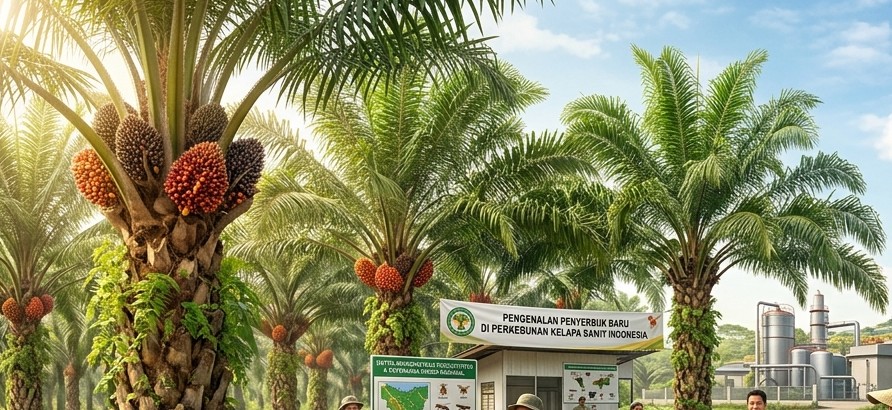
A question has been circulating among the public: Why Indonesian oil palm plantations need new introduction of pollinator insects?
The question arose after the government and palm oil industry players declared their readiness to launch a new round of pollinating insect releases in palm oil-producing regions, following a 45-year hiatus. For the first stage, 200,000 adult pollinating insects from Tanzania will be distributed to 11 palm oil-producing provinces.
Agus Eko Prasetyo, a researcher from the Indonesian Palm Oil Research Center (PPKS), answered the above question by outlining the conditions facing Indonesian oil palm plantations. He stated that low fruit set has begun to occur in palm oil-producing provinces over the past decade. Five factors contribute to successful fruit set: plant material, pollinating agents (insects), climate, land conditions, and agronomic practices.
“Pollinating insects in Indonesia have gone through 1,000 generations and have been present in Indonesia for 45 years,” said Agus Eko, who is also the Head of Technical Team of the Elaeidobius Introduction Research.
The first introduction of pollinating insects took place in 1982. Elaeidobius kamerunicus was the first species of pollinating insects brought to Indonesia. A number of researchers, including from Indonesia and Malaysia, introduced the insect species from Cameroon. This pollinating insect was chosen because of its strong, sturdy body and aggressive pollination.
“There’s a long time gap of about 40 years before we can introduce it again,” said Dr. Dwi Asmono, Head of Research and Development at the Indonesian Palm Oil Association (GAPKI).
Dwi Asmono explained that the new introduction of pollinating insects from Tanzania was a long journey planned since August 2024. The activity involved a number of stakeholders through the Elaeidobius Consortium. These stakeholders include the Ministry of Agriculture, the Indonesian Quarantine Agency, PT Riset Perkebunan Nusantara (PTPI), the Indonesian Plantation Research and Development Agency (PPKS), the Indonesian Food and Agriculture Development Agency (BPDP), and scientific associations such as the Indonesian Oil Palm Breeding and Seed Science Association (PIPPSI) and the Indonesian Entomology Association.
The research team was led by Agus Eko Prasetyo and fellow researcher Van Basten Tambunan. Departing on January 4, 2025, they spent nearly four months observing and exploring Elaeidobius species (pollinating insects).
The exploration took place in five areas across three districts of Tanzania (Bukoba, Kigoma, Tabora, Mbeya, and Dar es Salaam), with five sampling points in each area. The study also took into account climate and terrain conditions, ranging from lowlands (10 meters above sea level) to highlands (>1,200 meters above sea level), as well as variations in rainfall ranging from low (<2,000 mm) to high (>2,000 mm).
“There were actually seven candidate Elaeidobius species from Tanzania that were to be brought to Indonesia. However, after a selection process, three species were ultimately selected,” said Agus Eko.
These three species are Elaeidobius subvittatus, Elaeidobius kamerunicus, and Elaeidobius plagiatus. The introductions from Tanzania include 1,924 adult individuals, larvae, and pupae of E. subvittatus, 1,697 E. kamerunicus, and 1,359 E. plagiatus. After arriving in Indonesia on April 4, 2025, the quarantine process was carried out at the Marihat Unit of the Indonesian Quarantine Agency (PPKS) Insectarium Center.
Quarantine activities were strictly supervised by the Indonesian Quarantine Agency. The legality of the insect introduction was confirmed by an Import Permit from the Minister of Agriculture No. 76/Kpts/LB.030/M/02/2025 and a Phytosanitary Certificate from the Tanzanian Agricultural Research and Development Agency (TPHPA).
Quarantine testing lasted nine months (April–December 2025). Testing activities consist of purity tests– including morphological and molecular identification, and metagenomic analysis to ensure freedom from A1 OPTK pathogens.
The introduction resulted in a population of 200,000 adult pollinating insects of the three species. The distribution will be carried out in stages to several areas of oil palm plantations in 11 provinces: Aceh, Riau, North Sumatra, West Sumatra, South Sumatra, Jambi, Central Kalimantan, East Kalimantan, South Kalimantan, West Sulawesi, and Papua.
“The first phase of distribution will be 200,000 adult pollinating insects. If we continue producing (pollinating insects), distribution will be unlimited,” said Agus Eko.
Strategy for transformation
Agriculture Minister Dr. Ir. H. Andi Amran Sulaiman expressed his appreciation for the release of pollinating insects at the Marihat Plantation Center (PPKS) in North Sumatra on April 9, 2026. The introduction marks a continuation of the long journey of the Indonesian palm oil industry.
“For more than four decades, we have relied on one key species, Elaeidobius kamerunicus, which has made a significant contribution to the oil palm pollination system in Indonesia. However, the dynamics of the agro-ecosystem and environmental changes require us to continuously adapt and strengthen this system through science-based innovation,” he said in remarks read by the Director of Seeds at the Ministry of Agriculture, Ebi Rulianti.
The introduction of the pollinator insects from Tanzania is part of the government’s broader strategy to encourage the transformation of the palm oil production system to a more efficient, productive, and sustainable one.
He added that the presence of these pollinating insects is considered capable of reducing costs in cultivation activities, particularly in the pollination aspect, thereby supporting efficiency in the oil palm plantation sector.
Continuous Innovation
GAPKI Chairman Eddy Martono said that the momentum of new pollinator release stands as a symbol of continued innovation in the Indonesian palm oil industry. “This isn’t just about insects, but about how we safeguard the future of the Indonesian palm oil industry,” he said.
The three pollinator species have undergone a series of scientific tests and have been declared safe for further development. “We hope the pollinator species can strengthen the pollination system in our palm plantations while increasing the resilience of the plantation ecosystem,” he said.
According to Eddy, the insect release also created moments for reflection on the future of the national palm oil industry. Efforts to advance this industry depend heavily on the ability to combine science, experience, and collaboration.
Meanwhile, Moh. Alfansyah, Director of Downstream Fund Distribution at the Plantation Fund Management Board (BPDP) emphasized his institution’s commitment to support the exploration and introduction of pollinating insects from Tanzania through a research scheme initiated by the Directorate General of Plantations of the Ministry of Agriculture. “This activity is not only a strategic step in enriching the genetic base and strengthening the oil palm pollination system, but also symbolizes the continuity of innovation in the palm oil industry that has been ongoing for more than four decades,” he added. (*)
Sawitindonesia.com. Regenerasi Serangga Penyerbuk Penopang Produksi Sawit. https://sawitindonesia.com/regenerasi-serangga-penyerbuk-penopang-produksi-sawit/.29 April 2026