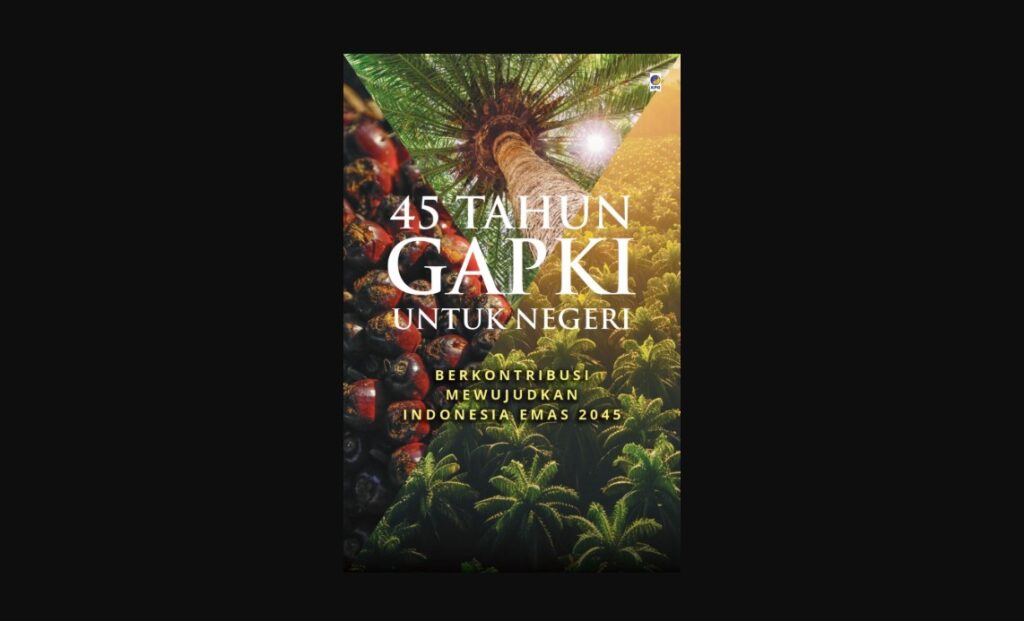
JAKARTA – Behind the strong position of Indonesia as the world’s largest producer and exporter of palm oil lies a long historical record of twists and turns that remains largely unknown to the general public. But all of it has been now clearly documented in a book titled “45 Tahun GAPKI untuk Negeri” (45 Years of GAPKI for the Nation).

At the peak celebration of the Indonesian Palm Oil Association’s (GAPKI) 45th anniversary in Jakarta on Tuesday (29/04/2026), GAPKI Advisory Board Member Joko Supriyono, who is also former chairman of GAPKI for the period of 2015-2018 and 2018-2023, exclusively reviewed the contents of the book that chronicles the epic journey of Indonesian palm oil industry from 1981 to the present day. The event was also attended by Deputy Minister of Transmigration Viva Yoga Mauladi and a number of palm oil stakeholders.
Behind the scene of book writing
Joko Supriyono frankly stated that it is not an easy task when it comes to the efforts of compiling the historical record of more than four decades. The biggest challenge: The limited availability of historical archives!
“Weaving together the history from 1981 to the present is not an easy task, as many sources and documents are incomplete,” Joko explained.
To ensure the validity and authenticity of the history, the compilation team had to go down the mountain and conducted in-depth research. They directly interviewed living witnesses, including the founders and first-term administrators of GAPKI, such as Suwito and Udayan, to ensure the narrative remained authentic and consistent with the facts.
The era of 80s: Catching up with Malaysia
One of the interesting facts revealed in this book is the crucial role of the legendary national economic figure, Prof. Sumitro Djojohadikusumo. In the early stages of GAPKI’s formation, his thinking significantly influenced the dynamics of the cooking oil industry and the direction of national export policy at the time.
The book also covers a grand ambition in the early 1980s. At that time, Indonesia’s modern palm oil industry was still a fledgling, lagging far behind its neighbor, Malaysia.
“In the early 1980s, our production was still far below Malaysia’s. But by then, there was a strong determination among industry players to catch up with the players in Malaysia and even surpass them,” Joko enthusiastically recounts. And that determination has paid off as the industry players’ ambition has been realized.
Three crucial phases of RI’s palm oil transformation
To help readers understand the industry’s evolution, the book “45 Years of GAPKI for the Nation” divides Indonesia’s palm oil journey into three main phases:
- Early Development Phase (1981–1999): The period when the industry’s foundations were built from scratch, accompanied by various policy adjustments and land clearing.
- Expansion Phase (2000–2015): The golden era during which the national palm oil industry grew rapidly, expanded its market reach, and started gathering force to dominate the global market of vegetable oils.
- Sustainability Phase (2016–2025): The most challenging period, forcing the industry to adapt to global environmental standards and environmentally friendly business practices.
Tough challenges ahead
According to Joko, the current sustainability phase is the toughest test for the palm oil industry. Being the world’s largest palm oil producer and exporter apparently comes with significant consequences.
“We are currently facing major challenges. Domestically, we must adapt to frequently changing regulations. Meanwhile, internationally, we are being hit by global issues of protectionism and increasingly stringent demands for sustainability,” he said.
Therefore, vigilance and adaptability are absolutely key to maintaining Indonesia’s palm oil competitiveness. With the release of the book “45 Years of GAPKI for the Nation,” Joko expressed high hopes that this work will not be merely a showcase but becomes a valuable reference for the general public. It can serve as a compass for the government, industry players, and the next generation (Gen Z and Millennials) to formulate strategies and determine the future direction of a more vibrant palm oil industry in Indonesia. (*)