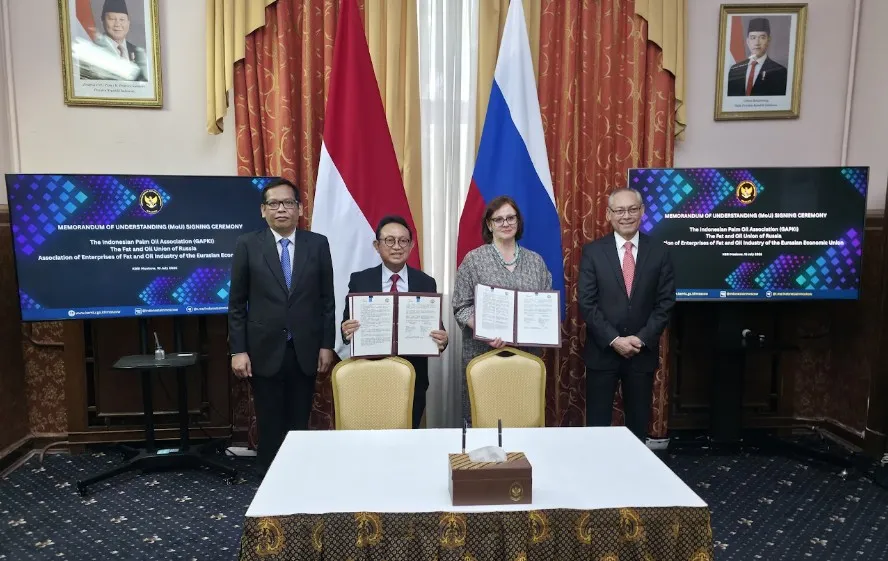
MOSCOW – The Indonesian Palm Oil Association (GAPKI) has expanded its international cooperation by signing a Memorandum of Understanding (MoU) with The Fat and Oil Union of Russia and the Association of Enterprises of the Fat and Oil Industry of the Eurasian Economic Union (EAEU). The agreement has become an important step in strengthening relationships of vegetable oil industries between Indonesia and Russia and opens greater market opportunities for Indonesian palm oil products.

GAPKI Chairman Eddy Martono emphasized that the international cooperation stands as a foundation for developing long term partnerships that are mutually beneficial for both countries.
According to him, a stronger collaboration between the vegetable oil industry players of Indonesia and Russia will push up the growth of trade, investments, technological innovations, and further strengthen product competitiveness at the global market.
Diplomatic support and stakeholders’ presence
The signing of this MoU was witnessed by the Ambassador of the Republic of Indonesia to the Russian Federation and Belarus, Jose Tavares; the Trade Attaché of the Indonesian Embassy in Moscow; officials from the Embassy; and representatives from the Plantation Fund Management Board (BPDP).
The presence of these various parties demonstrates strong support for pursuing efforts to enhance economic relations between Indonesia and Russia, particularly in the vegetable oil sector.
Synergy with trade agreement of RI–EAEU
This collaboration also follows the strengthening of economic ties between Indonesia and the member states of the Eurasian Economic Union (EAEU)—comprising Russia, Kazakhstan, Belarus, Armenia, and Kyrgyzstan.
Previously, Indonesia and the EAEU reached a Free Trade Agreement (FTA) in December 2025. This agreement paves the way for the elimination or reduction of tariffs on the majority of Indonesian products entering the Eurasian region.
With a market population of approximately 180 million, the EAEU region is considered to hold significant potential for boosting exports of Indonesian palm oil and its derivative products.
Vegetable oil industry cooperation
Through the MoU signed in Moscow, the two organizations agreed to strengthen communication and collaboration via various strategic programs, including:
- Exchange of information and data regarding the vegetable oil industry.
- Development of business networks between Indonesian and Russian business players.
- Establishment of a joint working group to address strategic issues in the vegetable oil sector.
- Organization of seminars, business forums, and investment promotion activities.
- Strengthening cooperation in technology development and innovation.
- Collaboration on policy advocacy and market development.
These measures are expected to foster stronger trade relations while expanding market access for Indonesian palm oil products in the Eurasian region.
Russia becomes strategic market for RI’s palm oil products
Russia continues to play a significant role as a destination for Indonesian palm oil exports. Key products shipped to the country include Refined, Bleached, and Deodorized (RBD) palm oil, RBD palm kernel oil (PKO), and various oleochemical products.
Throughout 2025, Indonesia’s total palm oil exports to Russia reached approximately 792,000 tons, valued at US$919 million. This represents an increase from the previous year, when exports stood at around 680,000 tons valued at US$681 million.
Meanwhile, as of April 2026, Indonesian palm oil exports to Russia had reached approximately 189,000 tons, valued at US$237 million.
In addition to these primary products, Indonesia also exports various downstream products—such as shortening, hydrogenated palm oil, vegetable ghee, and emulsifiers—that add value to the national palm oil industry.
Alternative markets amid Global challenges
Amidst rising regulations and trade barriers in the European Union (EU) market—including the implementation of the European Union Deforestation Regulation (EUDR)—Russia is considered a crucial alternative market for the sustainability of Indonesian palm oil exports.
Market diversification serves as a key strategy to sustain the growth of the national palm oil industry while reducing reliance on traditional markets.
GAPKI’s participation in INNOPROM 2026
The signing of the MoU was part of a series of activities undertaken by GAPKI in Russia from 06 – 10 July 2026. During this period, the GAPKI delegation also participated in INNOPROM 2026 in Yekaterinburg, one of Russia’s largest industrial exhibitions.
At a forum titled “Palm Oil and the Future of Sustainable Energy: Balancing Climate Goals, Energy Security, and Economic Development,” GAPKI’s Head of Foreign Affairs Division, Fadhil Hasan, outlined the strategic role of palm oil in supporting global energy security and industrial competitiveness.
Fadhil explained that Indonesia’s palm oil production (CPO and PKO) in 2025 reached approximately 56.6 million tons, an increase of more than 7 percent compared to the previous year.
Meanwhile, the volume of Indonesia’s palm oil exports rose to approximately 32.3 million tons, with an export value reaching US$35.9 billion, reflecting strong global demand for the country’s palm oil products.
Strengthening sustainability through ISPO
In addition to focusing on market expansion, Indonesia continues to strengthen sustainability through the Indonesian Sustainable Palm Oil (ISPO) scheme.
The ISPO certification scheme has now extended beyond the plantation sector to include downstream and bioenergy sectors, emphasizing traceability, transparency, and continuous improvement.
Data from the agriculture ministry’s Directorate General of Plantation as of October 2025 indicates that over 1,100 business entities hold valid ISPO certification, comprising state-owned plantation companies, private enterprises, and smallholder groups.
New Momentum for economic relations of RI–Russia
GAPKI views the combination of participation in INNOPROM 2026 and the signing of an MoU with the Fat and Oil Union of Russia as a pivotal moment for strengthening economic ties between Indonesia and Russia.
Through closer collaboration between industry associations, both nations are expected to boost trade, investment, and technology transfer, while also establishing a more efficient, resilient, and sustainable supply chain of vegetable oils for the future. (*)