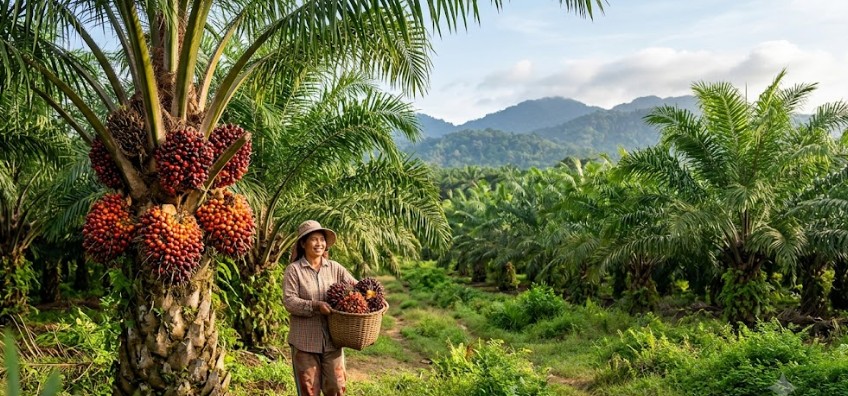
When the word “palm oil” is mentioned, many people immediately think of cooking oil. Yes, it is a vegetable oil, but its function is far beyond just raw material for cooking oil. It has a long history, performing many functions as raw materials for various industries, ranging from foods to energy, pharmacy, health, cosmetics, personal care and to other industries.
Globally, palm oil is the leading vegetable oil due to its highest efficiency, productivity, and versatility. Having rich properties, palm oil becomes the most widely used vegetable oil in various industries across the globe compared to other vegetable oils. It is not a native plant of Indonesia, but it has become one of the top industries in the country, contributing significantly to its foreign exchange, employing tens of millions of Indonesians, and acting as one of the main drivers of its national economic growth.
Such an outstanding position at global and national levels will certainly makes many people curious about the palm oil. Following are six interesting facts about the palm oil.
Oil Palm not native to Indonesia
Many people assume that oil palms have grown in the Indonesian archipelago since ancient times. In reality, the oil palm (Elaeis guineensis) originated in West and Central Africa. The plant was first introduced to Indonesia in 1848, when four seedlings were brought to the Bogor Botanical Gardens—two from Bourbon Island (now Mauritius) and the other two from Amsterdam.¹
At that time, the oil palm was not cultivated as a plantation crop. It served primarily as a scientific specimen and an ornamental plant lining the roads. Few could have foreseen that this introduced species would eventually become one of Indonesia’s strategic commodities.
It takes more than 60 years to become an industry
The development of Indonesia’s palm oil industry did not happen overnight. After being planted at the Bogor Botanical Gardens, oil palm seeds were sent to Deli, North Sumatra, in 1875. This marked the origin of the renowned variety known as Deli Dura, which subsequently became a cornerstone of modern oil palm plantation development.² The first commercial oil palm plantations were not established until 1911—in the East Sumatra and Aceh regions—by Belgian and German investors.² In other words, it took approximately 63 years from the initial introduction of oil palm in Indonesia for it to evolve into an economically valuable plantation industry.
RI keeps position as the world’s largest palm oil producer
Indonesia is currently the world’s largest palm oil producer. In 2025, Indonesia’s Crude Palm Oil (CPO) production reached approximately 51.66 million tons, a 7.26 percent increase from the 48.16 million tons produced in 2024.³ When combined with Palm Kernel Oil (PKO) output, total national palm oil production reached approximately 56.55 million tons, up 7.18 percent from the previous year.³ This increase was driven in part by rising domestic demand for biodiesel feedstock.
Palm exports contribute foreign exchange up to trillion rupiah
In addition to being a key commodity, the palm oil industry is also one of Indonesia’s largest sources of foreign exchange earnings. Throughout 2025, the export value of Indonesian palm oil products reached approximately US$35.87 billion, equivalent to around IDR 590 trillion.⁴
This figure represents an increase of about 29 percent compared to the previous year, driven by rising export volumes and palm oil prices in the global market.⁴ This contribution underscores the vital importance of the palm oil industry to both international trade and the national economy.
Palm oil not only raw material for cooking oil
Although best known as a raw material for cooking oil, the utilization of palm oil is actually far more extensive. By 2025, domestic palm oil consumption is projected to reach approximately 24.77 million tons, with the largest share coming from the biodiesel sector.⁵
The rise in biodiesel consumption follows the implementation of the biodiesel blending policy, shifting from B35 to B40. Furthermore, palm oil serves as a raw material for various oleochemical products—ranging from soaps, detergents, cosmetics, and personal care items to industrial chemicals.⁵
Without realizing it, many products used by the public on a daily basis contain palm oil derivatives.
Palm oil is the world’s most efficient vegetable oil
One of the most compelling facts about oil palm is its exceptionally high productivity compared to other vegetable oil crops.
Data cited from various studies by the International Union for Conservation of Nature (IUCN) indicate that oil palm utilizes less than 10 percent of the world’s total land dedicated to vegetable oil crops, yet it generates approximately 35 percent of global vegetable oil production.⁶
On average, a single hectare of oil palm plantation yields about 3.3 tons of oil annually, with production ranging from 1.9 to 4.8 tons per hectare. Producing one ton of palm oil requires only about 0.26 hectares of land.⁶
Recent IUCN studies also confirm that oil palm boasts the highest productivity among oil-producing crops. Crops such as soybean, sunflower, rapeseed, and coconut require significantly more land to produce the same quantity of oil.⁷
Researcher Douglas Sheil from the Norwegian University of Life Sciences has even noted that oil palm can produce 2 to 8 times more oil per hectare than rapeseed, soybean, peanut, coconut, or sunflower.⁷
Palm oil is more than just commodity
Oil palm is more than just a source of cooking oil. Behind it lies a long history, significant economic contributions, a livelihood for millions of farmers, and a vital role in efficiently meeting global demand for vegetable oils.
The more we understand the facts about palm oil, the easier it becomes to view this commodity in its entirety—not merely through an economic lens, but also in terms of its history, innovation, and contribution to the needs of modern society. (*)
¹ Pusat Penelitian Kelapa Sawit (IOPRI), Kelapa Sawit Era Kolonial, https://iopri.co.id/news/detail/kelapa-sawit-era-kolonial
² Wikisawit, Sejarah Kelapa Sawit di Indonesia, https://gapki.id/id/wikisawit/knowledge-base/sejarah-kelapa-sawit-indonesia/
³ Tempo.co, Produksi CPO 2025 Capai 51,66 Juta Ton, Naik 7,26 Persen (13 Maret 2026), https://www.tempo.co/ekonomi/produksi-cpo-2025-capai-51-66-juta-ton-naik-7-26-persen-2121887
⁴ Sahabat Sawit, GAPKI: Produksi Sawit 2025 Naik 7,26 Persen, Nilai Ekspor Tembus Rp590 Triliun, https://sahabatsawit.com/berita/gapki-produksi-sawit-2025-naik-726-persen-nilai-ekspor-tembus-rp590-triliun
⁵ InfoSAWIT, GAPKI: Produksi Sawit 2025 Naik 7,2%, Industri Hadapi Tantangan Tata Kelola dan Tekanan Global (13 Maret 2026), https://www.infosawit.com/2026/03/13/gapki-produksi-sawit-2025-naik-72-industri-hadapi-tantangan-tata-kelola-dan-tekanan-global/
⁶ Sustainable Palm Oil Choice, More Facts (mengutip data IUCN & WWF), https://www.sustainablepalmoilchoice.eu/more-facts/
⁷ Sustainable Palm Oil Choice, Facts on Palm Oil (mengutip studi IUCN 2024), https://www.sustainablepalmoilchoice.eu/facts-on-palm-oil/