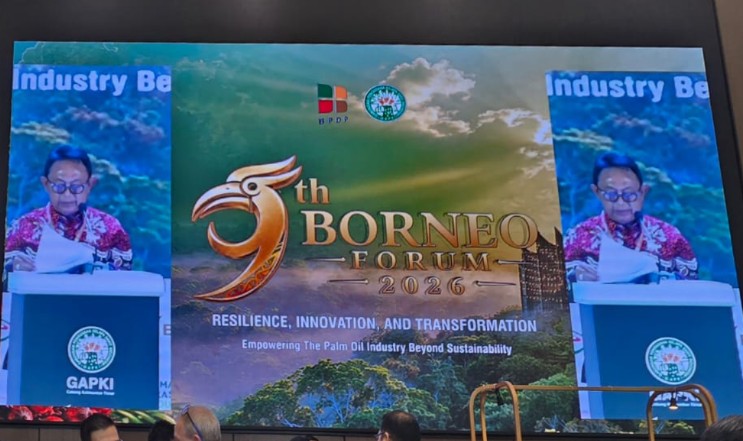
The Indonesian Palm Oil Association (GAPKI) had formally opened the Borneo Palm Oil Forum (BPOF) 2026 in Balikpapan, East Kalimantan province. Initiated by all GAPKI Kalimantan branches, the annual Forum this year has the theme “Resilience, Innovation and Transformation: Empowering the Palm Oil Industry Beyond Sustainability”.
Palm Oil Proven To Be Tough In Dealing With Crisis
In his remarks, GAPKI Chairman Eddy Martono emphasized that the overarching theme of this year’s forum is not merely a slogan but a reflection of the national palm oil industry’s journey—one constantly tested by various global challenges, ranging from commodity price fluctuations, climate change, and geopolitical dynamics to trade barriers and regulatory shifts in export destination countries.
Eddy highlighted that throughout its history, the palm oil industry has consistently served as a key pillar of the national economy during times of crisis. He cited the 1998 economic crisis, during which the industry continued to operate and generate approximately US$9 billion in foreign exchange earnings. Similarly, at the height of the COVID-19 pandemic in 2022, the industry achieved a historic record in foreign exchange earnings of around US$39 billion—equivalent to IDR 600 trillion.
Subsequently, after dipping to US$30 billion in 2023 and US$27.76 billion in 2024 due to global price corrections, foreign exchange earnings from palm oil exports rebounded to US$35.9 billion in 2025.
He also highlighted the contribution of the biodiesel program to national foreign exchange savings. The implementation of the biodiesel 35 percent (B35) mandate resulted in savings of approximately IDR 120 trillion in 2023 and IDR 124 trillion in 2024, while the adoption of B40 in 2025 was projected to save around IDR 133 trillion. Currently, the palm oil industry also provides a livelihood for more than 16 million smallholders and workers across Indonesia, including in Kalimantan.
Resilience, Innovation and Transformation
According to Eddy, resilience alone is no longer sufficient. The industry must go further through innovations across the entire value chain—from upstream in the plantation areas to downstream operations—including the adoption of digital technology, artificial intelligence, mechanization, and energy efficiency.
In the upstream sector, GAPKI—in collaboration with BPDP, the Ministry of Agriculture, the Quarantine Agency, PT RPN/PPKS, and a consortium of palm oil companies—has imported pollinating insects and genetic resources from Tanzania. These were released just a few months ago to boost oil palm plantations’ productivity, which had recently tended to stagnate. Similar efforts will continue this year with the importation of new genetic resources from Zambia.
Eddy added that transformation also means strengthening industry governance, accelerating the replanting of smallholder plantations, expanding downstream processing, developing a circular economy, and shifting the perspective on sustainability from mere market standard compliance to a foundation for long-term competitiveness. In line with this, GAPKI is committed to ensuring that all its members obtain ISPO certification.
He also touched upon two new regulations taking effect this year: Government Regulation (PP) No. 21/2026, regarding the strengthening of transparency and optimization of state revenue from strategic commodity exports; and Government Regulation (PP) No. 24/2026, regarding the governance of strategic natural resource commodity exports.
GAPKI expressed support for the spirit of improving governance but hopes that implementation will take into account supply chain efficiency and Indonesia’s export competitiveness in the global market.
In his closing remarks, Eddy expressed optimism that through close collaboration among the central government, local governments, the business sector, academia, and palm oil smallholders, East Kalimantan—now home to the new national capital, Ibu Kota Nusantara (IKN)—has a significant opportunity to become a new national hub for palm oil downstreaming, bioenergy, oleochemicals, and the circular economy.
Export Governance and Role of BUMN Export Highlighted
One of the discussion sessions at the BPOF 2026 addressed the topic “Governance of Palm Oil Product Exports and the Role of State-Owned Enterprises (BUMN) in Exports,” presented by Dr. Yustinus Lambang Setyo Putro, Head of the Taxation and Fiscal Division at GAPKI.
In his presentation, Yustinus explained that although the export volume of palm oil products had declined over the past five years, the trend for 2026 shows improvement; export value up to February 2026 was recorded at US$ 7.05 billion, an increase from the US$ 5.47 billion recorded during the same period in 2025.
Regarding destination markets, exports to China, India, Africa, and several other key markets also saw an increase in early 2026, although exports to Russia experienced a decline.
He outlined the end-to-end business flow for CPO and its derivative products—ranging from smallholder plantations, palm oil mills, trading/procurement, and refineries to the shipping process and the receipt of Natural Resource Export Earnings (DHE SDA) into special accounts at Himbara (state-owned) banks.
Yustinus also detailed the various levies and obligations associated with palm oil exports, including Export Duties (BK)—set at US$ 148 per metric ton for CPO in July 2026—and Export Levies (PE) of US$ 125.11 per metric ton managed by BPDP. Other requirements include the Domestic Market Obligation (DMO) and Domestic Price Obligation (DPO)/Minyak Kita (a prerequisite for obtaining export quotas), the obligation to place 50% of export earnings (DHE SDA) in a special account for 12 months, a 22% corporate income tax on profits, and various regional taxes and levies.
Yustinus also emphasized the importance of compliance with transfer pricing regulations in accordance with Minister of Finance Regulation (PMK) No. 172 of 2023, considering that related inter-party transactions must be supported by Transfer Pricing Documentation (TP Doc)—comprising the Master File, Local File, and Country-by-Country Report (CbCR).
He distinguishes between neutral transfer pricing practices and trade mis-invoicing or under-invoicing—illegal practices involving the incorrect declaration of the value, volume, or type of export commodities to reduce tax payable.
The New Role of PT Danantara Sumberdaya Indonesia (PT DSI)
This material also addresses the role of PT Danantara Sumberdaya Indonesia (PT DSI) as the State-Owned Export Enterprise (BUMN Ekspor) established under Government Regulation No. 24 of 2026 concerning the Governance of Strategic Natural Resource Commodity Exports.
Under Article 3 of the regulation, palm oil—classified as a strategic natural resource—may only be exported through this state-owned export entity, acting either as the sole exporter (owner of the goods) or as the sole intermediary/sales agent. The selling price of these strategic commodities is determined by the state-owned export entity, which is also authorized to set margins at reasonable levels.
This single-window export scheme for natural resources via PT DSI is projected to safeguard up to IDR 2,654 trillion in foreign exchange annually, while simultaneously curbing potential revenue leakage and boosting state earnings from strategic commodities such as palm oil (CPO), coal, and ferroalloys.
The 2026 Borneo Palm Oil Forum is expected to yield strategic recommendations that strengthen the palm oil industry’s role—benefiting both the national economy and the economy of the Kalimantan region—in alignment with the forum’s guiding themes of Resilience, Innovation, and Transformation. (*)