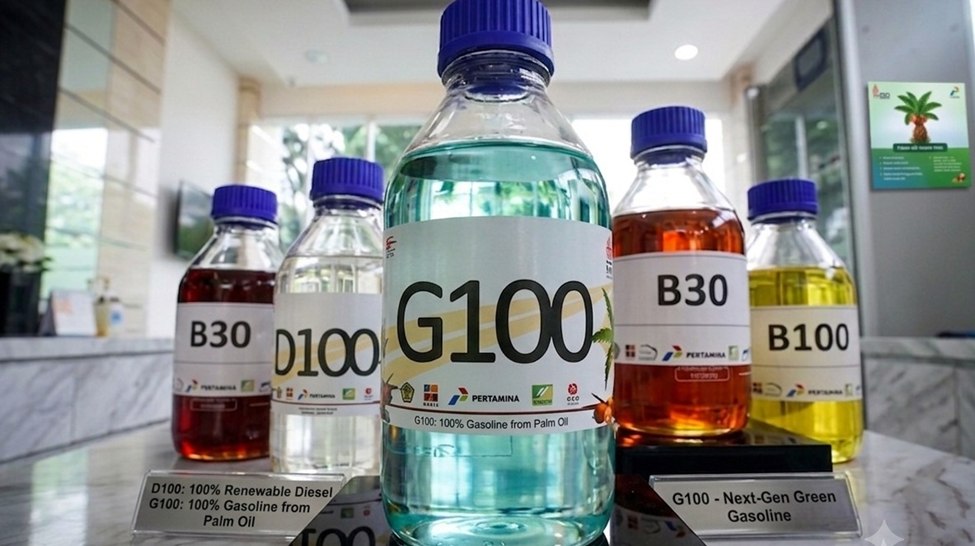
Just as the diesel fuel has a 100% palm-based “sibling” known as D100, gasoline also has its own version—G100, which is more commonly referred to as palm gasoline. Unfortunately, unlike D100, which has successfully reached full production, the story of G100 remains unfinished. What is the current state of its development, and why we cannot yet fill up our motorcycles or cars with palm gasoline at the nearest public refueling stations (SPBU)?
What is G100?
G100 is the term for gasoline made entirely (100%) from palm oil, not petroleum. The process utilizes RBDPO—palm oil that has been stripped of its sap and odor—which is then processed through a chemical reaction in a refinery until it is transformed into a gasoline-like compound. Interestingly, this process actually increases the octane rating of the resulting gasoline, rather than decreasing it.
How far has the progress come?
The story began in late 2018, when Pertamina started piloting this technology at the Plaju Refinery in South Sumatra. The method involved gradually injecting palm oil (RBDPO) into the refinery’s gasoline production process—a technique known as co-processing.
The results were quite promising:
- Injecting 5% RBDPO yielded gasoline with an octane rating of 90.7.
- Increasing the blend to 7.5% resulted in an octane rating of 91.3.
- Projections suggest that raising the blend to 12.5% could produce gasoline comparable to Pertamax, which has an octane rating of 92.
Since December 2018, the Plaju Refinery has been routinely producing 405,000 barrels of this green gasoline per month, which is a substantial volume. As a bonus, the process also yields 11,000 tons of eco-friendly LPG per month.
But why it’s not yet sold in SPBU?
Now, this is an important point to clarify. What Pertamina has achieved so far is still a blend—not the 100% pure palm-based gasoline that the name “G100” implies. There were plans to process palm oil entirely into fuel, but there has been no news yet regarding its widespread implementation. In all likelihood, substantial investment and further policy support will be required to truly realize the dream of palm-based gasoline.
Don’t get it wrong: Pertamax Green is not made from palm oil. Many people assume that Pertamax Green (both the 92 and 95 variants) currently sold at refueling stations (SPBU) is made from palm oil. In reality, the bio-based content (approximately 5–7%) comes from sugarcane bioethanol, not palm oil. So, following is the current condition:
- Pertalite, standard Pertamax, and Pertamax Turbo — remain 100% fossil fuels with no bio-based additives whatsoever.
- Pertamax Green 92/95 — contains bio-based fuel, but derived from sugarcane, not palm oil.
- G100/palm-based gasoline — remains in the research and testing phase and is not yet available to the public.
Why is this important to fight for?
To date, the raw material for production of gasoline has relied heavily on sugarcane through bioethanol programs. Yet, Indonesia is a global giant in palm oil production, possessing a far more abundant supply of raw material. If G100 is successfully developed to a commercial scale, it could open up a massive new domestic market for Crude Palm Oil (CPO)—complementing the biodiesel (for diesel engines) and bio-aviation fuel (for aircraft) sectors that are already established.
Hopefully, the government will reinvigorate research into G100, given that test results since 2018 have actually been quite promising. With the right support, it is very likely that one day we might fuel our motorcycles and cars with the bio-gasoline based entirely on the palm oil, which is produced by Indonesian oil palm smallholders. (*)
WikiSawit. Bensin Sawit G100 Green Gasoline: Mimpi Besar Indonesia yang Masih Tertunda. https://gapki.id/id/wikisawit/knowledge-base/apa-itu-g100-green-gasoline/