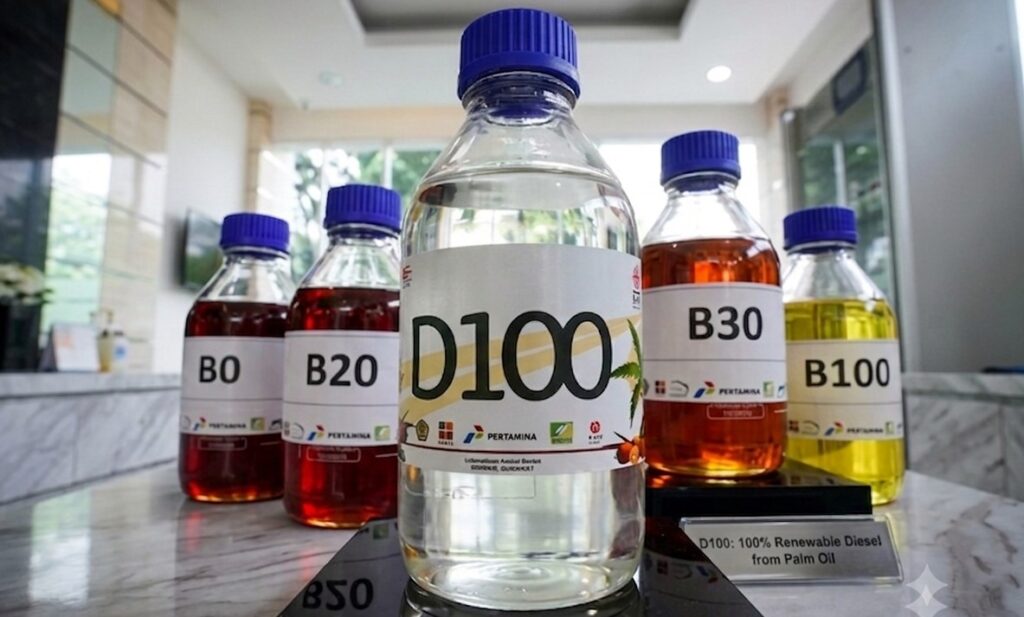
Indonesia is not only known as the world’s largest producer of palm oil. But it has also managed to use it as single raw material to produce 100 percent green diesel. The innovative product is known as palm oil-based D100 or Green Diesel D100, as it is purely produced from palm oil without blending with fossil fuels.
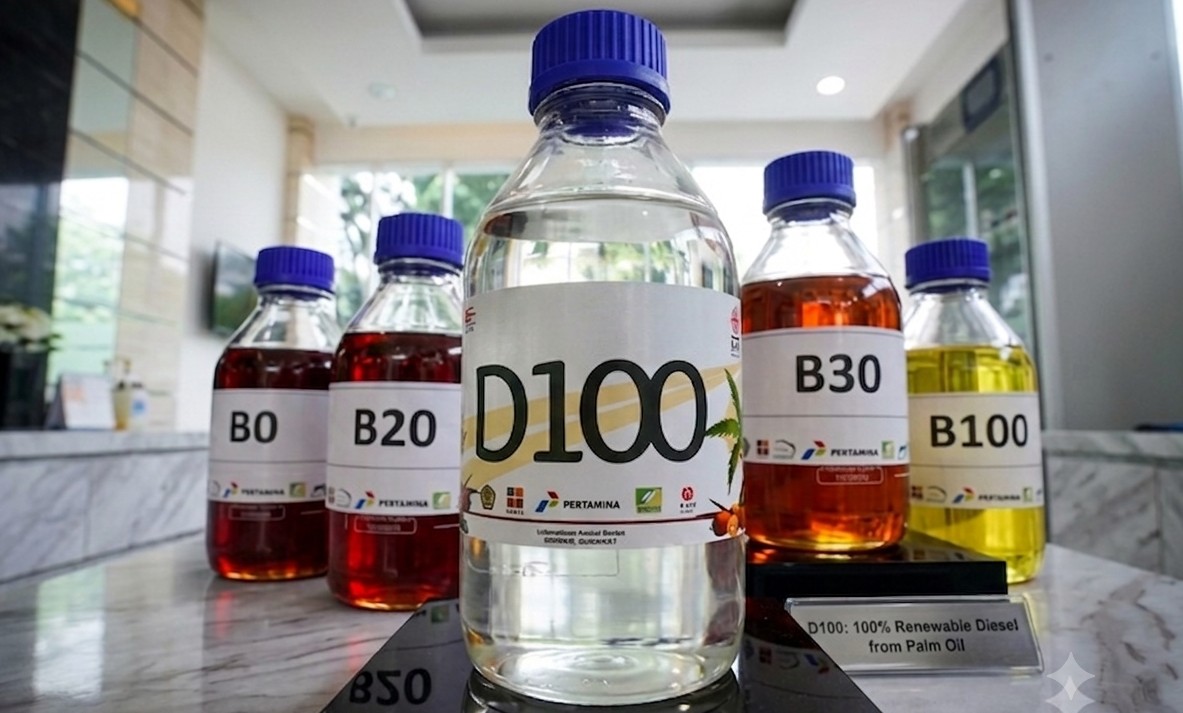
The production of D100 has proven that palm oil is not just used as raw materials for foods and oleochemical, but it also has big potential as the source of renewable energy that can support the national energy resilience. By capitalizing on the abundant domestic supply of palm oil, D100 has opened an opportunity for Indonesia to reduce its dependence on the imports of fossil fuels, while increasing the added value of the country’s national palm oil industries.
What is palm D100?
Palm-based D100 is a diesel fuel produced entirely from palm oil through a specialized processing method that yields a fuel with characteristics very similar to those of fossil diesel.
The letter “D” in D100 stands for diesel, while the number “100” indicates that the fuel is derived exclusively from a plant-based source, without any petroleum-based diesel blend.
Unlike the biodiesel currently used in Indonesia’s mandatory biodiesel programs—such as B35, B40, or B50—D100 contains no fossil diesel at all.
For comparison:
- B35 = 35% biodiesel (FAME) + 65% fossil diesel
- B40 = 40% biodiesel (FAME) + 60% fossil diesel
- B50 = 50% biodiesel (FAME) + 50% fossil diesel
- D100 = 100% fuel derived from palm oil
Consequently, D100 is often referred to as “Green Diesel.”
The history of D100 development in Indonesia
The development of D100 marks a significant milestone in the journey of Indonesia’s renewable energy industry.
This product was successfully developed by PT Kilang Pertamina Internasional in collaboration with the Bandung Institute of Technology (ITB), utilizing a technology of catalyst called “Katalis Merah Putih” (Red and White Catalyst), which is created by a group of Indonesian researchers.
The initial production of D100 took place at the Dumai Refinery in Riau in 2020. This success represents a major achievement, as the core technology employed is the result of domestic research and development.
In other words, D100 is not merely a renewable energy product but also a symbol of the innovative capabilities and technological mastery of the Indonesian people.
How the palm D100 produced?
The primary raw material for D100 is refined palm oil, known as RBDPO (Refined, Bleached, and Deodorized Palm Oil). This refined palm oil undergoes hydrotreating—a process utilizing a catalyst and hydrogen to remove oxygen from the vegetable oil molecules.
This process alters the chemical structure of the palm oil, yielding hydrocarbons that closely resemble fossil-based diesel.
The simplified stages include:
- Refining the palm oil.
- Reacting it with hydrogen using a specialized catalyst.
- Removing oxygen from the oil molecules.
- Forming long-chain hydrocarbons equivalent to diesel.
- Final refining to meet diesel fuel specifications.
The end product is a high-quality diesel fuel suitable for use in modern diesel engines.
The difference of D100 with Biodiesel FAME
People often consider D100 and biodiesel as the same product. But in fact, both have different process of production and characteristics.
Biodiesel FAME
Biodiesel is produced through a transesterification process using methanol, resulting in Fatty Acid Methyl Ester (FAME).
Biodiesel characteristics:
- Contains oxygen.
- Typically used as a blend with fossil diesel.
- Used in the B35, B40, and B50 programs.
- Possesses characteristics different from fossil diesel.
D100 Green Diesel
D100 is produced through a hydrotreating process.
D100 characteristics:
- It contains no oxygen.
- Its molecular structure is very similar to that of fossil diesel.
- It can be used at 100% concentration without blending with diesel.
- It offers superior combustion quality.
Due to these characteristics, D100 is often referred to as the next generation of conventional biodiesel.
D100 road test: Very promising result
D100 has been tested on diesel vehicles under real-world conditions.
In road tests conducted by Pertamina, diesel vehicles using D100 were able to travel approximately 200 kilometers with excellent performance.
Several test results indicate that:
- The engine runs smoother
A more complete combustion process results in smoother engine operation compared to the use of conventional diesel.
- Lower emissions
As a plant-based fuel, D100 has the potential to produce lower exhaust emissions compared to fossil diesel.
- More Efficient Combustion
D100 possesses excellent combustion quality, thereby enhancing the operating efficiency of diesel engines.
- The cetane number is very high
One of the greatest advantage of D100 is its cetane number that can reach around 79.
As a comparison:
| Fuel Type | Cetane number |
| Conventional diesel | 48–51 |
| Pertamina Dex | around 53 |
| Palm D100 | around 79 |
The higher the cetane number, the faster and more perfect the combustion process in the diesel engine.
Benefits of D100 for Indonesia
The development of D100 has provided strategic benefits for the national economy and energy resilience of Indonesia.
Reducing import of diesel fuel
Indonesia still needs the supply of diesel fuel in big volume. The production of D100 can help Indonesia in reducing its dependence on the imports of fossil fuels.
Supporting Energy self-sufficiency
With raw materials sourced from domestic palm oil plantations, Indonesia has the opportunity to strengthen its national energy independence.
Increasing added value in downstream palm oil
To date, the majority of palm oil has been exported as raw material or semi-finished products. D100 offers higher added value through the downstream processing of the product.
Absorbing national palm oil production
The development of green diesel will increase the need for palm oil that will then raise the local demand at the domestic market.
Supporting target of renewable energy
D100 has become one of the solutions to increase the contribution of renewable energy in the national energy mix.
D100, G100, and J100: The future of fuel based on palm oil
The development of fuels based on palm oil will not stop in D100.
Indonesia has also developed:
D100 (Green Diesel)
Replacement of diesel fuel based on palm oil.
G100 (Green Gasoline)
A type of biofuel as a replacement of gasoline based on palm oil.
J100 (Green Jet Fuel)
Aviation fuel—or bio-jet fuel—produced from palm kernel oil (PKO).
If this technology reaches commercial maturity, Indonesia has the potential to become one of the first countries in the world capable of producing various types of transportation fuels from domestic palm oil resources.
Challenges of D100 development
Despite being prospective, the development of D100 still faces several challenges, including:
- The need for substantial refinery investment.
- Hydrogen supply for the hydrotreating process.
- The need to scale up production.
- Production costs that must be competitive with fossil-based diesel.
- The availability of sustainable feedstock.
However, with technological support and abundant palm oil feedstock, the potential for D100 development remains immense.
Palm-based D100 represents a significant innovation, demonstrating that palm oil can be processed into high-quality diesel fuel without blending in petroleum. Through hydrotreating technology and the “Merah Putih” (Red and White) catalyst, Indonesia has successfully produced D100 Green Diesel, which boasts a high cetane number, lower emissions, and performance capabilities that rival—or even surpass—conventional diesel.
As the world’s largest palm oil producer, Indonesia has a major opportunity to develop D100 as part of its national strategy of energy resilience, the down-streaming of the palm oil industry, and the transition toward more sustainable energy. The success of D100 proves that palm oil yields not only food and industrial products but can also serve as a vital foundation for Indonesia’s energy future. (*)
Wikisawit. https://gapki.id/id/wikisawit/knowledge-base/apa-itu-d100/