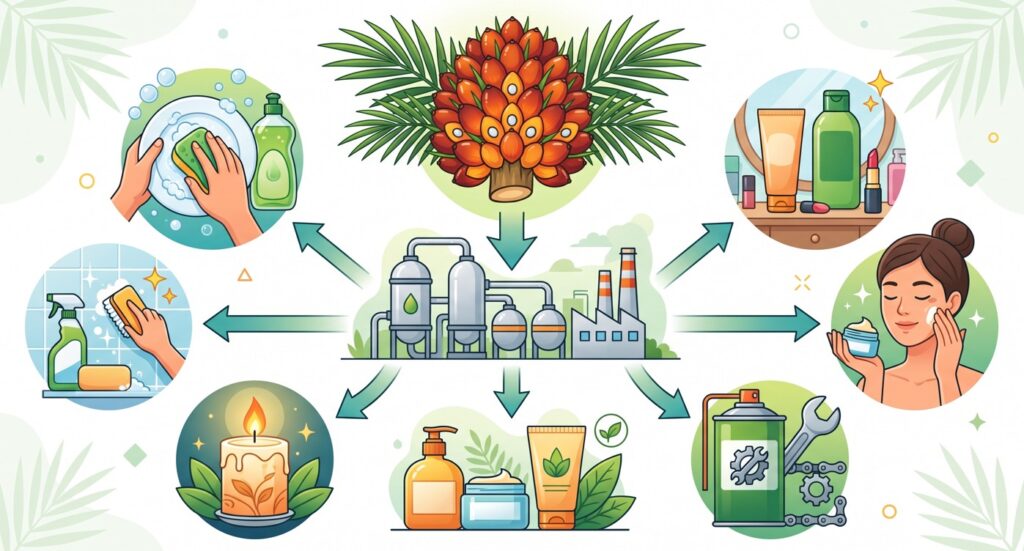
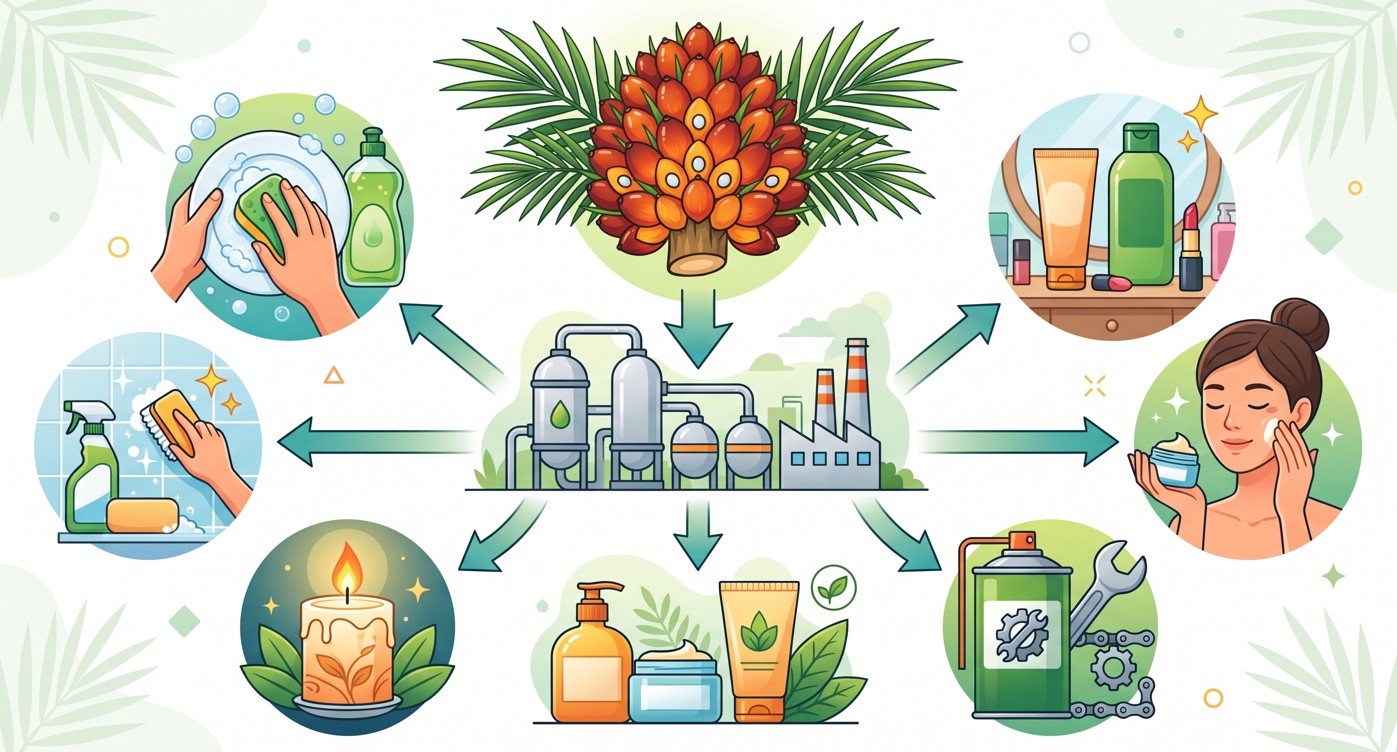
Many people relate palm oil to only cooking oil and biodiesel. But in fact, the two products only represent a small part of the total potential of palm oil as raw material to produce various kinds of products to meet the needs of human being in their everyday lives. Through an oleochemical process, the palm oil is processed into a raw material to produce thousands of products for daily needs — from soap, shampoo, toothpaste, cosmetics, pharmacy and other manufactured goods.
Understanding palm-based oleochemical
Oleo-chemistry is a branch of the chemical industry that utilizes vegetable and animal oils and fats as raw materials to produce various chemical compounds. In the palm oil industry, the primary raw materials are Crude Palm Oil (CPO) and Palm Kernel Oil (PKO).
These products undergo a series of chemical processes to yield base materials such as fatty acids, fatty alcohols, glycerin, and methyl esters. These base materials subsequently serve as essential components in the manufacture of consumer and industrial products.
Why palm oil becomes important oleochemical raw material?
Oil palm boasts significantly higher oil productivity compared to other vegetable oil crops such as soybean, sunflower, and rapeseed. It is capable of producing far greater quantities of oil from a smaller land area.
Beyond its high productivity, the fatty acid composition of Crude Palm Oil (CPO) and Palm Kernel Oil (PKO) is ideally suited to the needs of the oleochemical industry. These characteristics make palm oil one of the most competitive sources of oleochemical feedstock globally.
It is therefore unsurprising that Indonesia—as the world’s largest palm oil producer—holds immense potential to strengthen its position as a global hub for the oleochemical industry.
From palm oil to high-value chemicals
Before serving as a raw material for various consumer products, palm oil must undergo several stages of processing . Common processes include hydrolysis, fractionation, esterification, and transesterification.
Through these processes, palm oil is broken down into various fundamental components that are subsequently utilized across different industrial sectors.
Fatty Acids — These compounds serve as key raw materials in the manufacture of soaps, detergents, surfactants, and various other cleaning products.
Glycerin — Glycerin is widely used in the pharmaceutical and cosmetic industries. Its moisture-retaining properties make it a common ingredient in products ranging from toothpaste, lotions, and face creams to general skincare items.
Methyl Esters — These are used in diverse industrial applications, serving as raw materials for everything from surfactants to lubricants. They are also a crucial component in biodiesel production.
Fatty Alcohols — These are widely utilized in the detergent, liquid soap, shampoo, and cosmetic industries, where they function as foaming agents and emulsifiers.
Oleochemical products in everyday lives
Most people use oleochemical-based products every day without even realizing it.
Hygiene and Personal Care Products: items such as bath soap, shampoo, toothpaste, liquid soap, and various household cleaning products utilize active ingredients derived from palm-based oleochemicals.
Cosmetics and Skincare: a wide range of beauty products—including lotions, moisturizers, face creams, lipsticks, and sunscreens—use glycerin and fatty acid derivatives to maintain product quality and ensure a pleasant user experience.
Pharmaceutical Products: the pharmaceutical industry utilizes oleochemicals in various health products, including softgel capsules, ointments, and numerous drug formulations.
Manufacturing Industry: oleochemical derivatives are also used in the production of lubricants, candles, textile additives, paper industry processing aids, and renewable-based plastics.
Oleochemical role in palm down-streaming
Oleochemicals serve as a prime example of the success of palm oil down-streaming. While selling Crude Palm Oil (CPO) and Palm Kernel Oil (PKO) solely as raw materials yields relatively limited economic value, processing them into oleochemical products significantly increases the value added to the national economy.
Given their use across numerous industrial sectors, oleochemical products enjoy a broad market reach, spanning both domestic and export markets. Developing the oleochemical industry not only generates economic benefits but also creates investment opportunities and jobs, while strengthening the competitiveness of the national industry.
Why oleochemical industry important for Indonesia?
There are several reasons why the oleochemical industry is a strategic sector in the development of the palm oil-based industry:
- Increasing palm oil value-added — processing CPO and PKO into oleochemical products generates higher economic value compared to exporting raw materials.
- Supporting national industrial development — oleochemical products serve as raw materials for various manufacturing sectors, thereby fostering domestic industrial growth.
- Encouraging the use of renewable resources — derived from plant-based raw materials, oleochemicals offer an alternative that complements the use of fossil-based chemicals.
- Strengthening export competitiveness — global demand for palm oil derivatives continues to grow, including for oleochemical products used by industries worldwide.
Oleochemicals represent a strategic downstream sector that demonstrates the significant value-added potential of the palm oil industry. Through various processing methods, palm oil can be transformed into raw materials for thousands of products used in daily life, ranging from soaps and cosmetics to pharmaceuticals and manufactured goods.
For Indonesia, developing the oleochemical industry not only strengthens palm oil down-streaming but also presents an opportunity to enhance national industrial competitiveness while increasing the palm oil sector’s contribution to the economy. (*)
Wikisawit. Apa Itu Oleokimia?. https://gapki.id/id/wikisawit/knowledge-base/apa-itu-oleokimia/