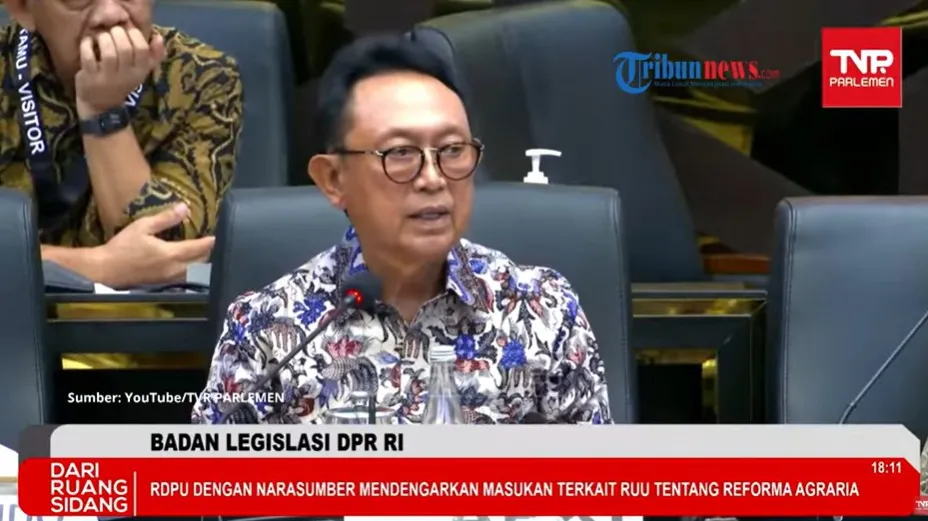
JAKARTA – The Indonesian Palm Oil Association (GAPKI) attended a public hearing held by the Legislation Body (Baleg) of the House of Representatives (DPR) regarding the deliberation of the agrarian reform bill (RUU Reforma agraria).
During the hearing, GAPKI was given the opportunity to present its views, data, and input concerning the position of the national palm oil industry, particularly regarding issues of land tenure and management.
Palm industry largest employer and contributor of foreign exchange
GAPKI Chairman Eddy Martono opened his presentation by highlighting the palm oil industry’s strategic role in the national economy. He noted that national palm oil production in 2025 reached 51.6 million tons of crude palm oil (CPO) and 4.89 million tons of palm kernel oil (PKO), with an export value of US$35.8 billion equivalent to approximately IDR 538 trillion. The industry also employs 4.2 million people directly and 12 million indirectly.
“We are the world’s largest palm oil producer, but at the same time, we are also the world’s largest palm oil consumer. So, we are champions in both respects champions in production and champions in consumption,” said Eddy.
Palm industry challenges: From Production Stagnation to Overlapping Regulations
Eddy Martono also revealed various challenges looming over the sustainability of the national palm oil industry, including:
- Stagnation in production and productivity over the past five years
- Slow progress in the replanting of smallholder plantations
- Negative campaigns against palm oil both domestically and internationally including the use of “palm oil-free” labels on products that actually originate from Indonesian palm oil
- Overlapping regulations across various ministries and agencies
“By our count, there are 37 ministries and agencies that regulate or are involved with the palm oil industry,” said Eddy, adding that such situation has often created legal uncertainty for business players such as in cases where land previously granted under long-term cultivation rights (HGU) is subsequently declared to be within forest areas.
Agrarian Reform Bill should not apply retroactively
Concluding his presentation, Eddy emphasized the hope that the Agrarian Reform Bill would not apply retroactively to existing legal instruments.
“New legislation does not apply retroactively,” he stated, expressing the hope that “legal instruments or laws already issued will continue to be respected and not be annulled by the application of the new legislation.”
Eddy Martono’s presentation was supplemented by GAPKI Executive Director Mukti Sardjono, who specifically highlighted the substance of the Agrarian Reform Bill.
Mukti proposed that land or plantations already possessing valid legal title should not be subject to agrarian reform.
“For companies or plantations that already hold legal title whether it be a Right to Cultivate (HGU) or a Freehold Title (Hak Milik)—these should not be objects of agrarian reform,” he stated.
He also urged the government to exercise caution when identifying land deemed “abandoned,” noting that some areas are intentionally left uncultivated to preserve land with high conservation value.
20% Plasma Plantation Obligation Must Continue to Refer to the Plantation Law
Regarding the 20% plasma plantation obligation, Mukti emphasized that the reference point must remain Law No. 39/2014 concerning Plantations, which serves as “lex specialis” (specialized legislation). The same applies to regulations on maximum landholding limits, which he noted are already detailed within that law.
Land Redistribution Must Serve as a Source of Community Income
Regarding the concept of land allocation, Mukti conveyed a key point from GAPKI’s input:
“Land allocation should not be treated merely as a distribution exercise… it must genuinely serve as a source of income for the community,” he said, warning that land redistribution unaccompanied by productive activities would ultimately be futile for the recipients. (*)
Live kanal resmi. Tribunnews. https://www.youtube.com/watch?v=8MZcyIUajjg. Sumber: Youtube/TVR PARLEMEN. (Fetry Wuryasti)