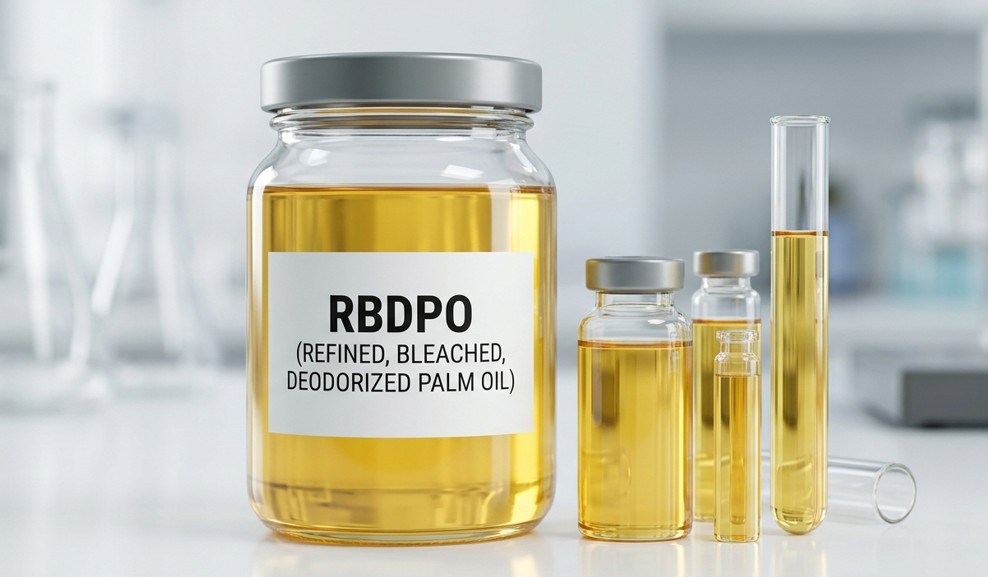
What is RBDPO (Refined Bleached Deodorized Palm Oil)?
RBDPO (Refined Bleached Deodorized Palm Oil) is palm oil refined from CPO (Crude Palm Oil) that has undergone refining, bleaching, and deodorizing processes. Unlike CPO, which still contains gums, impurities, and undesirable odors/flavors, RBDPO is a form of palm oil ready to be further processed into various food and non-food products. RBDPO is one of Indonesia’s strategic commodities because it is the main raw material for cooking oil at a relatively lower price compared to other vegetable oils such as corn oil, rice bran oil, or soybean oil.
Stages of Refining CPO into RBDPO
The process of converting CPO into RBDPO is known as refining, which aims to improve the quality of the oil by removing undesirable minor components. The stages include:
- Degumming uses phosphoric acid to remove gums and phosphatides from CPO.
- Bleaching uses activated bleaching earth to absorb color pigments such as carotenes and chlorophyll. The used bleaching material (spent bleaching earth/SBE) is then filtered out and becomes a separate waste stream.4
- Deodorizing uses a stripping agent in the form of steam at high temperature to remove the odor of free fatty acids. This process also produces a by-product in the form of PFAD (Palm Fatty Acid Distillate).5
The final result of this CPO refining process generally yields about 73% olein (liquid phase), 21% stearin (solid phase), 5% PFAD, and about 0.5% losses.
RBDPO Fractionation: Into Olein and Stearin
After becoming RBDPO, the oil is generally further processed through fractionation, which separates the palm oil into two fractions based on their melting points:6
- RBD Olein the liquid fraction, which is then commonly used as the raw material for cooking oil.
- RBD Stearin the solid fraction, which is used more in the margarine, shortening, and oleochemical industries.
Fractionation is carried out through crystallization, in which the fraction that solidifies at a certain temperature (stearin) is separated from the fraction that remains liquid (olein).6 Chemically, the triglyceride content of the stearin fraction tends to be concentrated in components with a high degree of saturation (such as POP and PPP), while the olein fraction is dominated by triglycerides with a higher degree of unsaturation (such as POO and OOO).7
RBDPO Quality Standards
Before being distributed to consumers or further processed through fractionation, the quality of RBDPO including free fatty acid (FFA) content, moisture content, and color needs to be tested in the laboratory to ensure it meets the applicable standards, one of which is the PORAM (Palm Oil Refiners Association of Malaysia) standard, which is also commonly used as a quality reference by the palm oil industry in Southeast Asia.8
Uses of RBDPO
RBDPO and its fractions (olein and stearin) are widely used in various industries:?
- Food raw material for cooking oil (RBD Olein), margarine, and shortening
- Oleochemicals raw material for fatty acid production through the hydrolysis/splitting process
- Biodiesel as one of the alternative feedstocks for biofuel production
Relevance to the Indonesian Palm Oil Industry
RBDPO is a key link between crude CPO and the end products consumed by the public every day, especially cooking oil one of the national strategic commodities whose impact is felt directly by consumers. The stability of RBDPO supply and quality also determines the availability and price of cooking oil in the domestic market, making it one of the crucial points in the downstream value chain of the Indonesian palm oil industry.
References
Neliti, “Pre-Design of a Refined Bleached Deodorized (RBD) Olein Plant from Crude Palm Oil”, https://www.neliti.com/publications/511253/pra-desain-pabrik-refined-bleached-deodorized-rbd-olein-dari-crude-palm-oil-oil
ResearchGate/UNITEK Journal, “The Process of Processing CPO (Crude Palm Oil) into RBDPO (Refined Bleached and Deodorized Palm Oil) at PT XYZ Dumai”, https://www.researchgate.net/publication/351149903_Proses_Pengolahan_CPO_Crude_Palm_Oil_menjadi_RBDPORefined_Bleached_and_Deodorized_Palm_Oil_di_PT_XYZ_Dumai
ResearchGate/UNITEK Journal, “The Process of Processing CPO (Crude Palm Oil) into RBDPO (Refined Bleached and Deodorized Palm Oil) at PT XYZ Dumai”, https://www.researchgate.net/publication/351149903_Proses_Pengolahan_CPO_Crude_Palm_Oil_menjadi_RBDPORefined_Bleached_and_Deodorized_Palm_Oil_di_PT_XYZ_Dumai
4 Kocenin Serial Konferensi, “Analysis of the Palm Oil Production Process”, https://publikasi.kocenin.com/index.php/pakar/article/download/556/457/956
5 Padang ATI Polytechnic Repository, “Analysis of Free Fatty Acid (FFA) Content, Moisture Content, and Color in RBDPO Samples in Storage Tanks at PT Ivo Mas Tunggal”, https://repository.poltekatipdg.ac.id/id/eprint/961/
6 Kocenin Serial Konferensi, “Analysis of the Palm Oil Production Process”, https://publikasi.kocenin.com/index.php/pakar/article/download/556/457/956
7 AgriTECH Journal UGM, “Dry Fractionation of RBD (Refined Bleached and Deodorized) Palm Oil”, https://jurnal.ugm.ac.id/agritech/article/view/9858
8 Padang ATI Polytechnic Repository, “Analysis of Free Fatty Acid (FFA) Content, Moisture Content, and Color in RBDPO Samples in Storage Tanks at PT Ivo Mas Tunggal”, https://repository.poltekatipdg.ac.id/id/eprint/961/
? ResearchGate, “Pre-Design of a Refined Bleached Deodorized (RBD) Olein Plant from Crude Palm Oil”, https://www.researchgate.net/publication/334199540_Pra_Desain_Pabrik_Refined_Bleached_Deodorized_RBD_Olein_dari_Crude_Palm_Oil_Oil