Palm Oil Oleic Acid
Oleic acid is a monounsaturated fatty acid (monounsaturated fatty acid/MUFA) with the chemical formula C18:1, belonging to the omega-9 group, and is one of the main components of palm oil (CPO Crude Palm Oil).
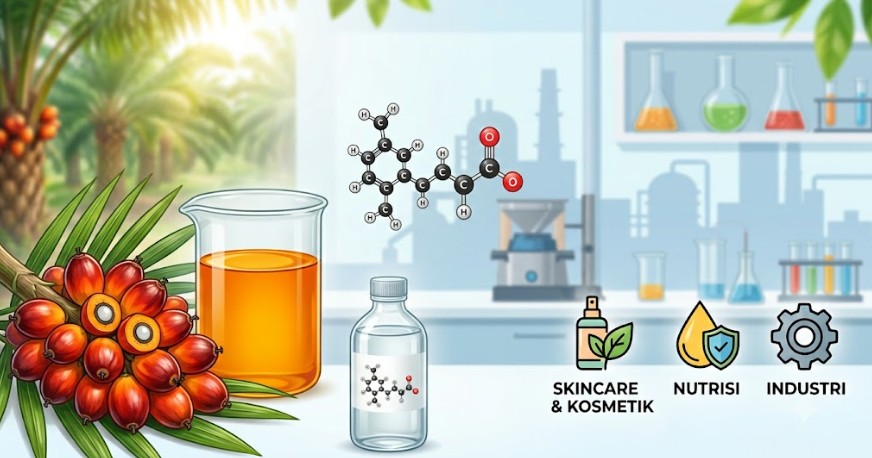
Content in Palm Oil
Based on studies of the fatty acid composition of CPO, the dominant fatty acids in CPO are palmitic acid at 43.244.4% and oleic acid at 39.841.4%.?? Another study reports a composition of palmitic acid (C16:0) at 4447%, oleic acid (C18:1) at 3640%, and linoleic acid (C18:2) at 912%.??
By comparison, red palm olein (RPOl) one of the palm oil derivative products shows an oleic acid content reaching 41.58%.??
Characteristics and Benefits
Palm oil is known for its good oxidative stability as well as its wide availability in various low- and middle-income countries.?? The high content of saturated and monounsaturated fatty acids in palm oil, along with fat-soluble bioactive compounds such as tocopherols, tocotrienols, carotenes, and phytosterols, has been studied for its benefits related to antioxidant and neuroprotective effects and the modulation of cholesterol levels.??
Industrial Uses of Oleic Acid
Oleic acid from palm oil is widely used across various industrial sectors, including:
- Food Industry As a main component of cooking oil and margarine, oleic acid improves oxidative stability, making food products more durable and suitable for frying.?4?
- Cosmetics and Body Care The moisturizing and emollient properties of oleic acid make it a common ingredient in soaps, creams, lotions, and hair care products.?4?
- Pharmaceuticals Used in drug formulations, both to support the stability of active ingredients and in topical medications, due to its ability to penetrate the skin.?4?
- Other Industrial Applications Serves as a raw material for biodegradable lubricants, a softening agent in the textile industry, a surfactant in detergents and soaps, and a supporting ingredient in paint and coating products.?4?
- Oleochemicals Through the hydrolysis (splitting) of palm oil into fatty acids and glycerin, oleic acid becomes one of the basic oleochemical derivative products that serve as raw materials for various chemical industries.?5?
References
?? Physicochemical characteristics of high free fatty acid crude palm oil. OCL Oilseeds and fats, Crops and Lipids. https://www.ocl-journal.org/articles/ocl/full_html/2017/05/ocl170016/ocl170016.html
?? Palm oil: a review on nutritional composition, processing, contaminants, and sustainability frameworks in the food system. Frontiers in Plant Science, 2026. https://www.frontiersin.org/journals/plant-science/articles/10.3389/fpls.2026.1798946/full
?? Characteristics of fatty acid composition and minor constituents of red palm olein and palm kernel oil combination. PMC National Center for Biotechnology Information. https://pmc.ncbi.nlm.nih.gov/articles/PMC7832187/
?4? Oleic Acid 101: Don’t Judge Fat by Its Culinary Charm Alone. PT Sinar Mas Agro Resources and Technology Tbk (SMART Tbk). https://www.smart-tbk.com/asam-oleat-101-jangan-menilai-lemak-dari-pesona-kulinernya-saja/
?5? Fatty acids based on palm oil and palm kernel oil: Production process and color stability. WARTA of the Indonesian Oil Palm Research Institute (PPKS). http://warta.iopri.org/index.php/Warta/article/view/145