Palm Oil in Cosmetics and Personal Care
- Palm oil derivatives commonly used in cosmetics: olein, stearin, fatty acids, glycerol, sodium palmitate, plus tocopherol and tocotrienol.
- Their roles as emollients, texture builders, emulsifiers, humectants, surfactants, and antioxidants in soaps, lotions, creams, lipsticks, and sunscreens.
- Their use is restricted by cosmetic ingredient regulations governing safety, efficacy, and quality, including permitted and prohibited ingredients.
Palm oil is rarely used as a whole oil in cosmetics; its derivatives are widely used, such as olein, stearin, fatty acids, glycerol, and sodium palmitate (GAPKI, 2026). These derivatives act to build texture, stabilize emulsions, moisturize, and cleanse in soaps, lotions, creams, lipsticks, and sunscreens (MPOB, 2026).
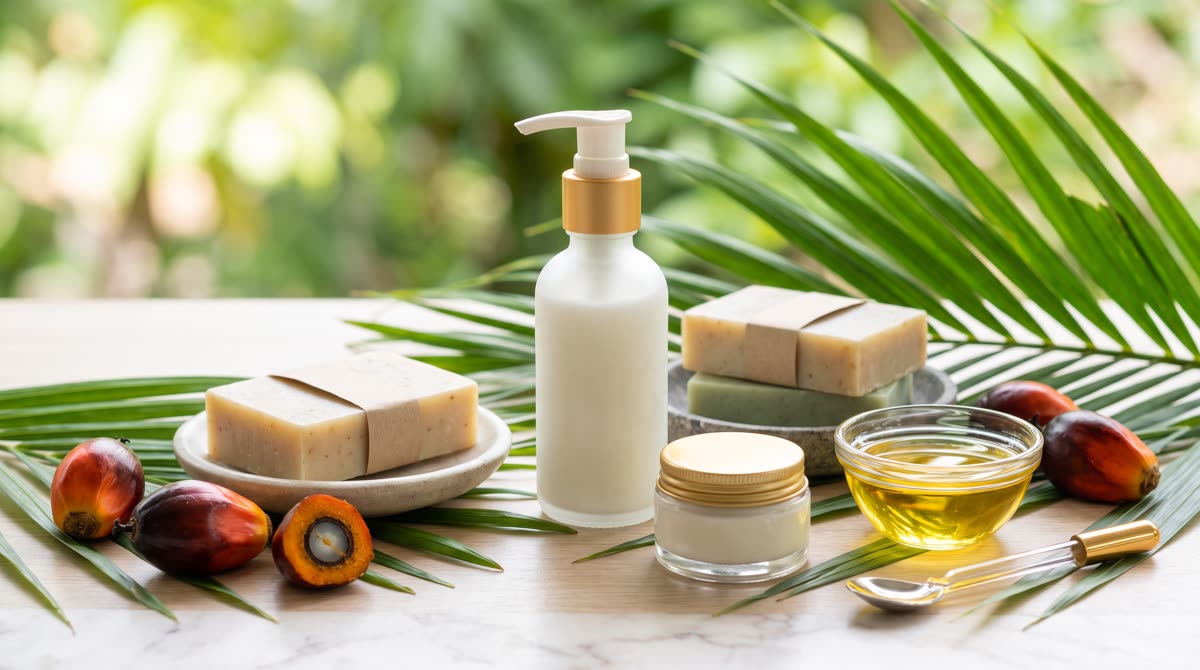
Table of Contents
The Position of Palm Oil in Cosmetic Formulations
The personal care industry uses palm oil primarily as a raw material for oleochemicals rather than as crude oil. Its flexible chemical character allows the derivatives to serve as surfactants, emulsifiers, moisturizers, solvents, and texture builders (GAPKI, 2026).
Palm oil generally occupies a supporting role in formulations rather than serving as the main active ingredient, so ingredient lists on labels often mention derivative names such as glycerin, stearic acid, or palmitic acid (MPOB, 2026).
Liquid and Solid Fractions: Olein and Stearin
After refining, palm oil can be separated through fractionation, namely controlled cooling, crystallization, and filtration, to obtain the liquid fraction (olein) and the solid fraction (stearin) (FAO).
The fatty acid composition of these two fractions differs and determines their function. Olein is more liquid and rich in oleic acid, making it easy to spread, while stearin is more solid and high in palmitic acid, so it is often used as a solid fat component that provides firmness to preparations (FAO).
| Ingredient | Function |
|---|---|
| Olein | Emollient and carrier; gives a soft texture and easy spreadability |
| Stearin | Solid fat that provides firmness and shape to the product |
| Palmitic acid and stearic acid | Soap base, emulsion, and texture-building ingredient |
| Sodium palmitate | Surfactant and foaming agent in soap |
| Glycerol | Humectant that retains water and maintains moisture |
| Tocopherol and tocotrienol | Antioxidants that maintain formula quality and stability |
Fatty Acids and Sodium Salts as Surfactants
The dominant fatty acids in palm oil, namely palmitic acid and stearic acid, can be used directly or neutralized into their sodium salts. Sodium palmitate is an anionic surfactant that helps form foam and lifts dirt and oil from the skin (GAPKI, 2026).
This class of ingredients is widely used in bath soaps and hand cleansers, where cleansing ability, foam stability, and soap texture become important parameters and also the reason formulations choose palm oil derivatives (GAPKI, 2026).
Glycerol and Tocopherol-Tocotrienol Antioxidants
Glycerol separated from palm oil serves as a humectant in lotions and creams, drawing in and retaining water on the skin surface so the product feels soft and does not dry quickly (MPOB, 2026).
Beyond glycerol, palm oil and its waste contain tocopherol and tocotrienol that act as antioxidants. The unsaponifiable fraction of Palm Fatty Acid Distillate (PFAD) is reported to contain total tocotrienols up to 2.136 ppm and vitamin E up to 12.282 ppm after purification, making it potentially useful as an anti-aging and moisturizing active ingredient (Jurnal JPS, 2026).
Applications in Soap, Lotion, Cream, Lipstick, and Sunscreen
In lotions and creams, olein and fatty acid derivatives serve as emollients that smooth the skin, while helping stabilize the mixture of oil and water in an emulsion (GAPKI, 2026).
In lipstick, palm-based ingredients help produce a soft texture, easy application, and stability of color and shine, while balancing the hardness of the stick so it does not break or melt easily (GAPKI, 2026; MPOB, 2026).
Palm oil derivatives are also documented in other preparations such as sunscreens, although ingredient names on labels do not always reveal their source (MPOB, 2026). Formulation studies report that preparations based on palm lipids, from creams and lotions to nanoemulsions, show good physical stability with a pH safe for skin (Jurnal JPS, 2026).
Safety, Regulations, and Usage Limits
In Indonesia, cosmetic ingredients must meet safety, efficacy, and quality requirements, including the obligation to use permitted ingredients and to prepare product information documents and labeling (BPOM, 2025). Business actors are prohibited from using non-permitted ingredients and must ensure that the cosmetics they distribute comply with these provisions (BPOM, 2025).
On the ingredient side, palm oleochemical derivatives are reported to be biodegradable, derived from renewable sources, and non-irritating to skin in the tests developed, adding value for cosmetic and toiletries products (MPOB, 2008).
It is important to note that ingredients sharing the same generic name can be produced from other vegetable oils or synthetic sources, so labels do not always reveal the originating raw material; supply chain traceability remains necessary to verify source claims (MPOB, 2026).
References
- Indonesian Palm Oil Association. Palm Oil in Beauty and Health Products: Raw Materials Used Every Day. gapki.id.
- Malaysian Palm Oil Board. Palm Oleochemicals for Cosmetics and Toiletries (MPOB TT No. 384). mpob.gov.my.
- Malaysian Palm Oil Board. If I Were Palm Oil in Your Bathroom Mirror. mpob.gov.my.
- Food and Agriculture Organization of the United Nations. Palm Oil Processing. fao.org.
- Journal of Pharmaceutical and Sciences. Downstream Utilization of Palm Oil Waste: The Potential of the Unsaponifiable Fraction as a Natural Anti-Aging and Moisturizing Active Ingredient for the Modern Cosmetics Industry. journal-jps.com.
- National Agency of Drug and Food Control. Technical Requirements for Cosmetic Ingredients (BPOM Regulation No. 25 of 2025). pom.go.id.