What Is a Digester in an Oil Palm Mill?
- The digester is a stirred vessel that mashes sterilized, stripped oil palm fruitlets into a homogeneous oily mash before pressing.
- Stirring and heating in the digester rupture the oil-bearing cells of the mesocarp and separate the flesh from the nut, easing CPO extraction.
- Correct digestion temperature and time—around 85–95°C—determine oil yield and the overall efficiency of the mill.
In the processing of fresh fruit bunches (FFB) into crude palm oil (CPO), the digester is the link between threshing and pressing. This article explains what a digester is, how it breaks down the mesocarp after sterilization, the temperature and residence time applied, its relationship with the screw press and oil yield, and good operating practices in an oil palm mill.
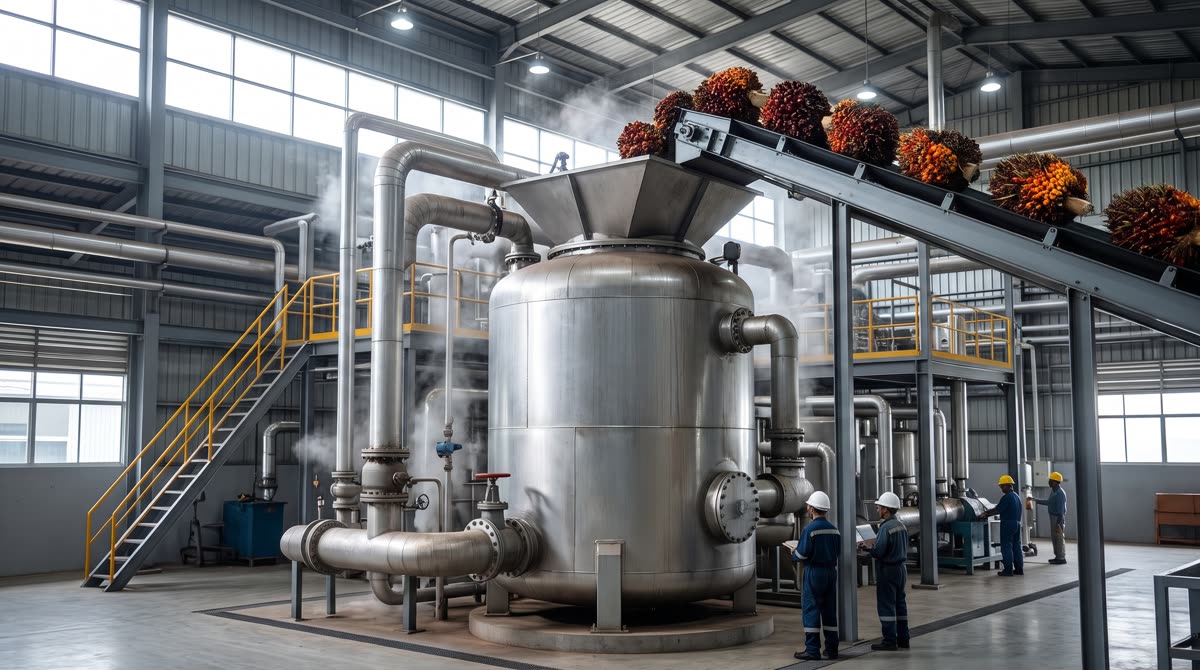
Table of Contents
What Is a Digester?
A digester is a vertical cylindrical vessel fitted with a rotating shaft carrying stirring arms. Inside this unit, oil palm fruitlets that have been sterilized and stripped from the bunch (loose fruitlets) are mashed under steam heating into a homogeneous oily mash [1][4]. It sits after the sterilization and threshing stations and before extraction with a screw press [2][4].
In the mill flow, FFB is first steamed in a sterilizer at about 140°C for 75–90 minutes to deactivate the enzymes that form free fatty acids and to loosen the fruit from the bunch [1]. The fruitlets are then detached from the empty bunches in a stripper, conveyed into the digester, and the digested mash is fed to the screw press to produce CPO [1][2].
The Function of the Digester in FFB Processing
The main function of the digester is to break up the fruit flesh (mesocarp) and its oil-bearing cells through the rubbing and beating action of the stirring arms [1][5]. This cell rupture completes the work of sterilization and allows oil to flow out when the fruit is pressed [2][5]. At the same time, the stirring separates the mesocarp from the nut and prepares a homogeneous feed for the press [1][4].
Five stirring arms mounted alternately in opposite directions create a lifting effect that makes the fruitlets rub against one another and become heavily bruised; the pericarp breaks down into mash and the oil cells rupture [5]. The mash is then pushed out by the expeller arm into the screw press [5]. Heating also lowers oil viscosity, crushes the exocarp, and evens out the temperature so that no local overheating occurs [2].
| Function | Description | Benefit |
|---|---|---|
| Mashing the mesocarp | Breaking the fruit flesh into a homogeneous mash | Increases the surface area for oil extraction |
| Rupturing oil cells | Stirring arms rupture the oil-bearing cells | Releases more oil during pressing |
| Separating mesocarp from the nut | Stirring detaches the flesh from the kernel nut | Eases fibre and nut separation at the depericarper |
| Heating and temperature levelling | Steam keeps the mash hot and uniform | Lowers oil viscosity and prevents emulsion |
| Feeding the screw press | The expeller arm pushes the mash into the press | Stable feed and more efficient pressing |
Temperature, Time, and Operating Conditions
The MPOB Code of Good Milling Practice states that the digester level should always be kept at least three-quarters full and the digested mash temperature should be within 85–95°C; the digester drainage must be fully functional [3]. The temperature of the crude oil produced is also maintained at 85–95°C during the process [3].
In a conventional mill, the fruitlets are digested at about 90°C for roughly 20 minutes [5]. This combination of temperature and time is sufficient to rupture the oil cells without damaging the nuts. The digester level is controlled by adjusting the feed and discharge rates so that residence time stays consistent and the mash remains homogeneous [6].
Relationship with Pressing and Oil Yield
Adequate digestion is a prerequisite for high oil recovery at the press station. If digestion is incomplete, oil remains trapped inside the cells and cannot be extracted during pressing, causing oil loss in the pressed fibre [5]. A homogeneous mash, by contrast, allows the screw press to expel oil optimally [4][5].
A well-run mill generally targets a milling efficiency of 92–94%, equivalent to total oil losses of about 1.2–1.5% [6]. At the press station a balance must be struck between oil loss in the fibre and the risk of nut breakage; two-stage pressing can be an option to improve recovery [6]. On average, one tonne of FFB yields about 21% CPO, so every improvement in the digester has a direct impact on yield [2].
Good Operating and Maintenance Practices
Good practice includes keeping the digester at least three-quarters full, ensuring the drainage works, and monitoring the mash temperature regularly [3]. Feed and discharge rates must be adjusted so the mash stays homogeneous and residence time meets the target [6]. Sudden stops or bunching of fruit can lower mash quality and disrupt pressing [5].
Routine checks of the stirring arms, shaft, and steam heating system help maintain continuity of operation [5]. Equipment cleanliness and temperature control also suppress the build-up of free fatty acids, keeping CPO quality intact from the press station through clarification [1][3].
Conclusion
The digester is the heart of the pressing station, turning sterilized and stripped fruitlets into an oily mash ready for the press [1][2]. Through stirring and heating at 85–95°C, it ruptures the mesocarp cells, separates the flesh from the nut, and prepares a homogeneous feed for the screw press [3][5].
Digestion quality goes hand in hand with oil yield and mill efficiency. When operated according to good practice—with the level maintained, temperature controlled, and drainage functioning—the digester contributes directly to CPO recovery and the competitiveness of palm oil processing [3][6].
References
- Malaysian Palm Oil Board (MPOB). Processing of Fresh Fruit Bunches (Palm Oil Milling). mpob.gov.my.
- GAPKI WikiSawit. The Process of Processing Fresh Fruit Bunches (FFB) into Crude Palm Oil (CPO). gapki.id.
- Malaysian Palm Oil Board (MPOB). Code of Good Milling Practice for Palm Oil Mills, Third Edition (2025). mpob.gov.my.
- Vijaya, et al. Revenue of a Palm Oil Mill. Journal of Oil Palm Research 25(1), MPOB, 2013. jopr.mpob.gov.my.
- Yosri, et al. Screw Press Operation Optimisation for Oil and Kernel Recovery. Palm Oil Engineering Bulletin POEB130, MPOB. palmoilis.mpob.gov.my.
- Malaysian Oil Scientists’ and Technologists’ Association (MOSTA). Impacts of Palm Oil Milling & Refining on Product Quality. mosta.org.my.