Biogas Capture vs No Capture in Palm Oil Mills: What’s the Difference?
- POME is rich in organic matter: in open ponds it decomposes and releases methane.
- Biogas capture converts methane into electricity or boiler fuel.
- Emissions fall, energy self-sufficiency rises, and digestate returns to the plantation.
Palm oil mill effluent (POME) is rich in organic matter. When left in open ponds, POME decomposes and releases methane, a greenhouse gas with a warming potential far stronger than carbon dioxide [1]. Some mills treat POME only conventionally and discharge it once it meets quality standards, while others install biogas capture to convert methane into electricity or boiler fuel [2][6]. The difference between these two models determines the emission level, energy cost structure, and environmental footprint of a palm oil mill over the long term.
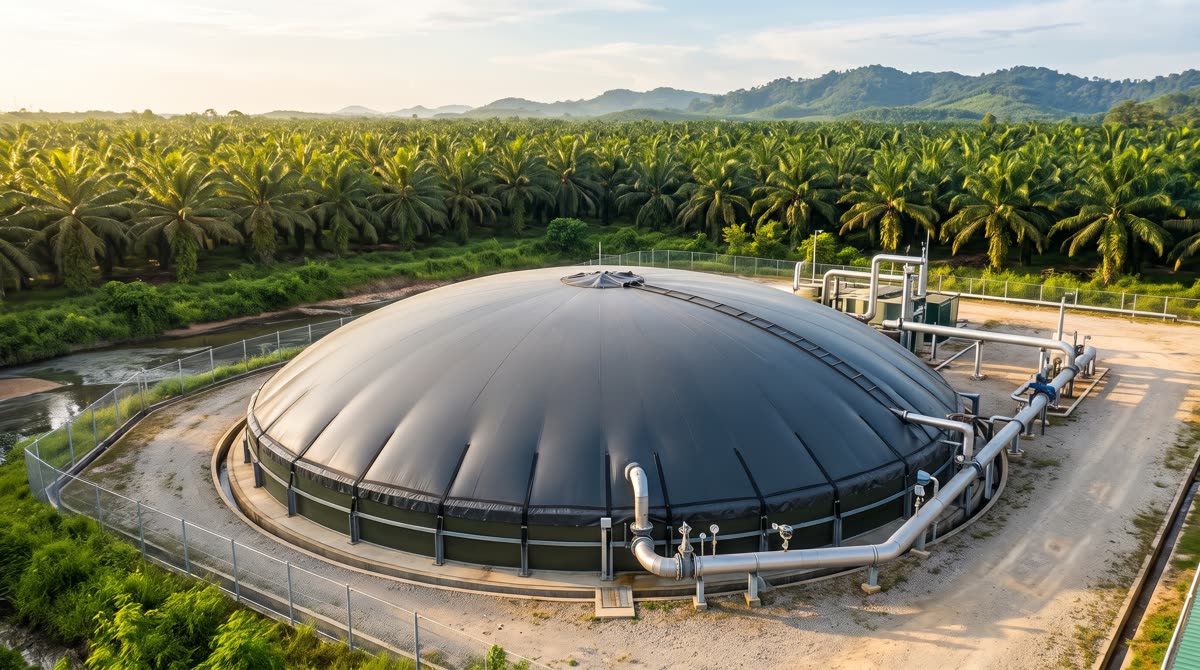
Table of Contents
Background: Two POME Management Models
In the no-capture model, POME flows through an open series of anaerobic, facultative, and polishing ponds. Organic decomposition still occurs, but the methane formed escapes freely into the atmosphere because there is no cover holding the gas [1][6]. This model is generally chosen for its low upfront investment and simple operation, even though its emission load is high.
In the capture model, the anaerobic pond is tightly sealed (covered lagoon) or replaced by closed reactors such as a continuous stirred tank reactor (CSTR) and UASB. The methane gas is collected and then delivered to a utilization unit so it does not escape into the environment [3][5].
What Is Produced and How It Is Utilized
Every ton of POME has the potential to produce about 28 m³ of biogas with a methane content of about 60-65% [3][5]. In a mill with a capacity of 60 tonnes of fresh fruit bunches per hour, this gas can generate electricity for internal needs or be sold to the national grid [4][6].
Besides electricity, biogas can be used as boiler fuel replacing diesel or biomass, and further purified into bio-CNG or biomethane for markets that require it [2][3].
Comparison of Emissions and Environmental Load
Research reports that a reduction of greenhouse gas emissions of around 75% per tonne of crude palm oil can be achieved when a mill installs biogas capture. In a recent survey, 135 mills in Malaysia in 2021 had installed biogas facilities using two main technologies, namely closed digester tanks and covered lagoons [3].
Without capture, methane emissions from open ponds become a significant source of emissions. With capture, the same emissions are converted into utilized energy, so the environmental load falls without sacrificing wastewater treatment functions [1][6].
| Aspect | No Capture | With Capture |
|---|---|---|
| Fate of methane | Escapes into the atmosphere from open ponds | Captured and utilized |
| Energy | Dependent on grid electricity and fossil fuels | Electricity/boiler from biogas, potential to sell surplus |
| GHG emissions | High; methane 28-36 times CO₂ | Significantly reduced, approaching zero discharge |
| Investment | Low, simple operation | Higher, requires technology and O&M |
| End waste | Treated effluent to water bodies or the plantation | Nutrient-rich digestate for soil |
| Incentives | Limited | Carbon, PPA, renewable energy incentives |
Impact on Mill Energy and Operations
Biogas utilization makes mills more energy independent. The Directorate General of New, Renewable Energy and Energy Conservation records the electricity potential from palm oil waste in Indonesia at 12,654 MW, with the largest contribution in Sumatra and Kalimantan, although utilization remains limited [4].
Covered lagoon, CSTR, and UASB technologies have been shown to reduce chemical oxygen demand (COD) by more than 90% while producing methane of 0.28-0.34 Nm³ per kg COD. Thus effluent quality and energy recovery can be achieved simultaneously [5].
Investment Costs and Returns
Building capture facilities requires capital, land, and good operational management [1]. Life-cycle cost analysis shows that the digester tank configuration has higher life-cycle costs and benefits compared to the covered lagoon, so technology selection must be tailored to scale and needs [3].
Returns can come from diesel savings, electricity sales through power purchase agreements, and carbon incentives. POME utilization for biogas in Indonesia currently stands at only about 15% of total potential, leaving ample room for investment growth [4].
Environmental Benefits and the Circular Economy
The cycle of POME, anaerobic treatment, biogas, and energy makes palm oil production more efficient in utilizing resources while reducing emissions, especially when the methane formed is successfully captured and utilized [1].
Remaining digestate still contains nutrients and organic matter that can be returned to the plantation. In this way, the mill moves toward the concept of zero discharge and a more measurable circular economy practice [3][6].
References
- GAPKI. POME: Liquid Waste Behind the Energy, Biogas, and Circular Economy of the Palm Oil Industry. gapki.id.
- Malaysian Palm Oil Board (MPOB). Capturing Methane for Electricity Generation. mpob.gov.my.
- FAO AGRIS. A Critical Analysis on Biogas Production and Utilisation Potential from Palm Oil Mill Effluent. fao.org.
- Ministry of Energy and Mineral Resources of the Republic of Indonesia. Palm Oil Waste in Indonesia Has the Potential to Generate 12,654 MW of Electricity. esdm.go.id.
- Jurnal Terpadu Teknik Pertanian, Universitas Lampung. Biogas Production from Palm Oil Mill Effluent and the Prospect of Co-digestion with Empty Fruit Bunches: A Comprehensive Review. jtep.fp.unila.ac.id.
- WIPO Green. Technology Options for the Treatment and Utilization of Palm Oil Mill Effluent (POME) in Indonesia. wipo.int.