Palm Oil?
Palm oil is a vegetable oil produced from the flesh of the oil palm fruit (Elaeis guineensis). It is different from palm kernel oil, which is obtained from the seed (kernel) of the palm fruit. Currently, palm oil is the most widely produced and consumed vegetable oil in the world because it is affordable, multifunctional, and its crop productivity is far higher than other vegetable oil sources.
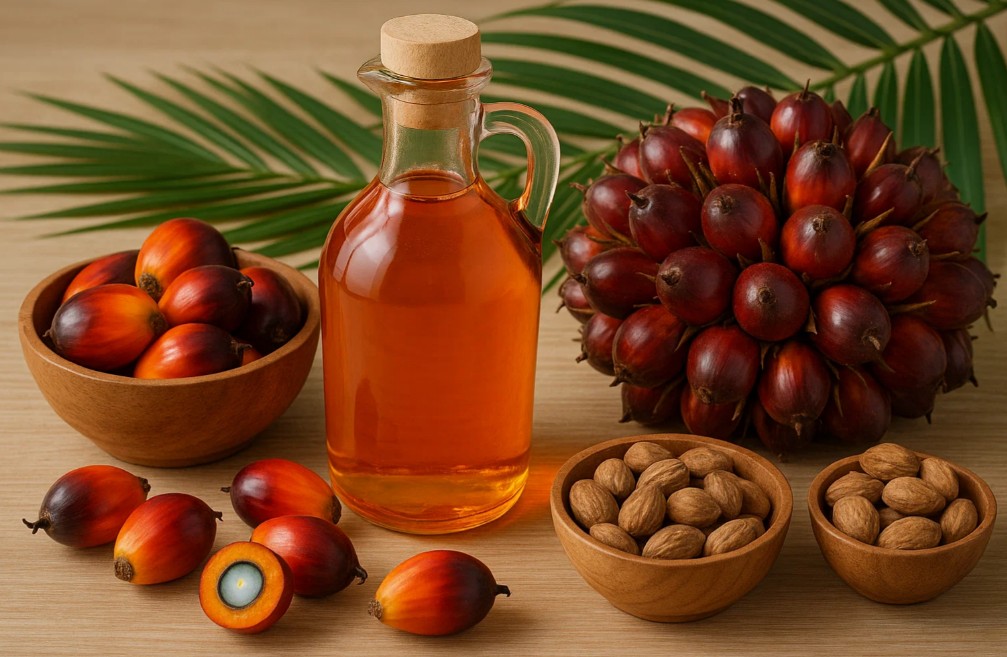
Origin and Production
- Main source: the oil palm fruit, particularly the Tenera variety, which has a high oil content.
- Largest producers: Indonesia and Malaysia, contributing more than 80% of the world’s palm oil supply.
- Part processed: the mesocarp (fruit flesh), producing crude palm oil (CPO). Meanwhile, the seed (kernel) produces palm kernel oil (PKO).
The production process begins with harvesting fresh fruit bunches (FFB), sterilization, threshing the fruit, pressing to extract the oil, and refining so that it is ready for food and industrial use.
Characteristics of Palm Oil
- Color: reddish-orange because it is rich in carotenoids, including -carotene (provitamin A).
- Fatty acid composition: 50% saturated (palmitic, stearic) and 50% unsaturated (oleic, linoleic).
- Stability: resistant to oxidation and high heat, making it suitable for frying.
- Nutritional content: contains vitamin A, vitamin E (tocotrienols & tocopherols), and bioactive compounds with potential health benefits.
Uses of Palm Oil
Food
- Cooking oil, margarine, shortening.
- An ingredient in biscuits, bread, instant noodles, ice cream, and chocolate.
Non-Food
- Cosmetic products (soap, shampoo, moisturizers).
- Household products (detergents, candles, lubricants).
Energy
- Biodiesel feedstock (for example: the B30 program in Indonesia).
Brief History
The use of palm oil has been known for about 5,000 years in West Africa. Archaeological evidence shows the presence of palm oil in the tomb of Abydos, Egypt (around 3,000 BC). In the 19th century, palm oil began entering global trade through European colonialism. Today, palm oil is a strategic global commodity because demand continues to rise for food, energy, and industrial purposes.
Advantages Over Other Vegetable Oils
- High productivity: oil palm can produce 46 tons of oil/ha/year, far higher than soybean (0.4 tons), sunflower (0.6 tons), or canola (0.8 tons).
- Multifunctional: can be used across various sectors (food, non-food, energy).
- Trans-fat free: so it is widely used to replace hydrogenated vegetable oils.
- Competitive price: production cost per ton is lower than other vegetable oils.
References
- FAO. (2020). The State of Agricultural Commodity Markets 2020. Food and Agriculture Organization of the United Nations.
- MPOB (Malaysian Palm Oil Board). (2021). Overview of the Malaysian Oil Palm Industry.
- Corley, R. H. V., & Tinker, P. B. (2016). The Oil Palm (5th ed.). Wiley-Blackwell.
- USDA. (2022). Oilseeds: World Markets and Trade. United States Department of Agriculture.
- Sundram, K., Sambanthamurthi, R., & Tan, Y. A. (2003). Palm fruit chemistry and nutrition. Asia Pacific Journal of Clinical Nutrition, 12(3), 355362.
- Basiron, Y. (2007). Palm oil production through sustainable plantations. European Journal of Lipid Science and Technology, 109(4), 289295.