What Is Palm Carotene? A Natural Pro-Vitamin A Source from Palm Oil
- Palm carotene is a group of natural carotenoid pigments that give crude palm oil (CPO) its orange-red colour.
- Palm oil is recognised as one of the richest natural sources of carotenoids, with roughly 500–700 ppm in CPO.
- Beta-carotene and alpha-carotene can be converted by the body into vitamin A, giving palm carotene both nutritional and economic value.
Palm carotene is a group of natural carotenoid pigments in oil palm fruit that give crude palm oil its orange-red colour. This article explains what palm carotene is, its main types, how the body converts it into vitamin A, its nutritional benefits, and its role in food fortification in Indonesia.
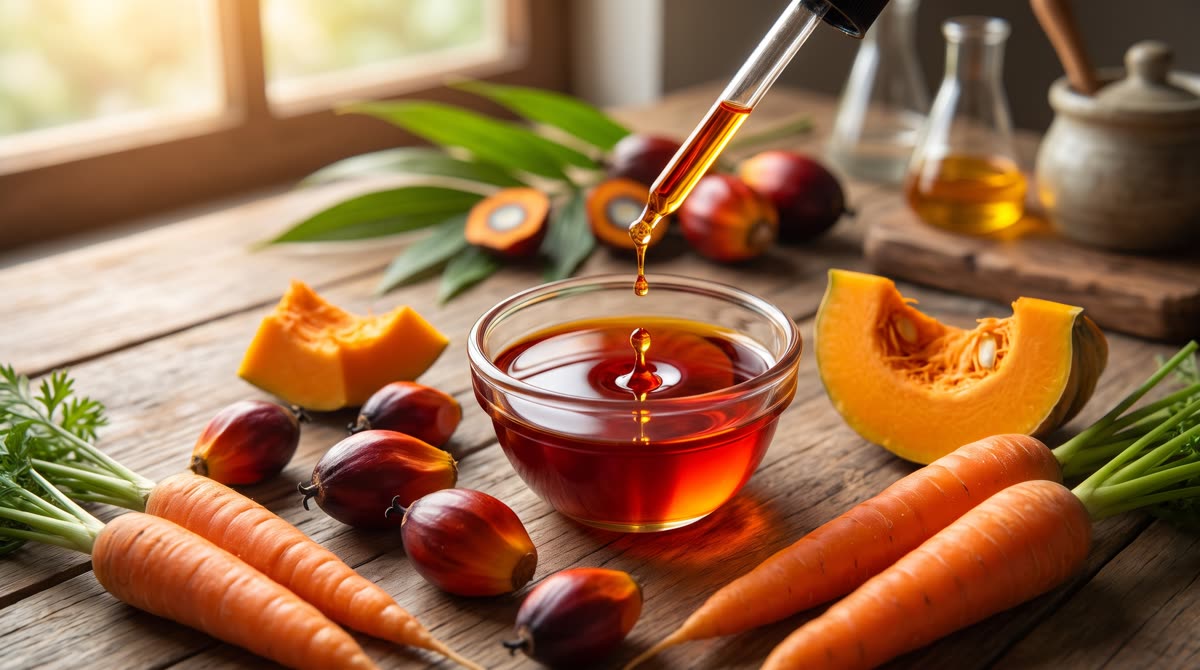
Table of Contents
What Is Palm Carotene?
Palm carotene is a group of natural carotenoid pigments that give crude palm oil (CPO) its characteristic orange-red colour. The term is commonly used for the mixture of carotenes in oil palm fruit, chiefly beta-carotene and alpha-carotene [2][3].
The carotenoid content of CPO is generally in the range of 500–700 ppm, while red palm oil (RPO) has been reported to contain 600–750 ppm of carotenoids [2][3]. An Indonesian source from BPDP states that the carotene (alpha and beta) content of virgin red palm oil (VRPO) reaches 300–500 mg/kg [1]. These figures do not conflict: they differ because of product type, fruit variety, and stage of processing, so they should be read as ranges rather than single numbers [1][2].
Types of Carotene in Palm Oil
MPOB identifies at least 13 types of carotenoids in palm oil, including phytoene, phytofluene, alpha-carotene, beta-carotene, gamma-carotene, cis-alpha-carotene, zeta-carotene, delta-carotene, neurosporene, beta-zeacarotene, alpha-zeacarotene, and lycopene [2].
In commercial red palm oil, beta-carotene and alpha-carotene account for about 41.0% and 41.3% of total carotenoids, respectively [2]. Of all known carotenoids, only a small share has provitamin A activity; in palm oil the main ones are alpha-, beta-, and gamma-carotene [2].
| Component | Role and Description |
|---|---|
| Beta-carotene | About 41.0% of total carotenoids; the highest provitamin A activity |
| Alpha-carotene | About 41.3% of total carotenoids; also acts as a vitamin A precursor |
| Gamma-carotene | A minor component that also shows provitamin A activity |
| Lycopene and other carotenoids | Minor components contributing to colour and antioxidant profile |
From Carotene to Vitamin A
Palm carotene is called provitamin A because the body can convert it into retinol (vitamin A) as needed [2][5]. Beta-carotene is the most effective precursor, followed by alpha- and gamma-carotene [2].
Research summarised by MPOB indicates that the provitamin A carotenoids in red palm oil are highly bioavailable, are efficiently converted into retinols, and store well in the liver [2]. This differs from taking retinol directly: the body converts carotene when vitamin A needs rise, which makes this approach a safer food-based strategy [2].
For this reason, red palm oil is studied as a natural dietary source of vitamin A that can complement a varied diet, not as a medicine or a substitute for medical treatment [2][5][6].
Nutritional and Health Benefits
Vitamin A plays a role in vision, growth, and immune function. WHO notes that vitamin A deficiency remains a leading cause of preventable blindness in children and increases the risk of severe illness from infections [5].
A meta-analysis of randomized controlled trials found that red palm oil consumption reduced the risk of vitamin A deficiency (relative risk 0.55; 95% confidence interval 0.37–0.82) and increased serum retinol levels in both children and adults [6].
BPDP cites studies showing that palm oil contains abundant beta-carotene, which functions both as an antioxidant and as a natural precursor of vitamin A [4]. These benefits should still be understood within the context of a balanced and varied diet [5][6].
Role in Food Fortification
WHO recognises fortification of edible oil with vitamin A as an effective and cost-effective intervention, because oil is centrally processed, widely distributed, and consumed by all age groups [5].
BPDP cites Hariyadi (2019): a blend of 10% VRPO containing 300 ppm beta-carotene with 90% palm cooking oil containing no beta-carotene produces carotene-rich cooking oil with 30 ppm, equivalent to about 50 IU of provitamin A, exceeding the 45 IU limit in the Indonesian standard (SNI) for palm cooking oil [1].
Microencapsulation using a combination of maltodextrin and xanthan gum has also been recommended to protect VRPO beta-carotene and improve its stability in food applications [1]. Palm carotene is therefore more than a colouring pigment; it is a strategic raw material for Indonesia’s food industry [1][4].
Preserving Carotene from Plantation to Consumer
The orange-red colour of CPO comes from carotenoids, so colour can serve as an initial visual indicator of carotene content [2][4]. Fruit handling and processing matter directly: excessive sterilisation temperature can damage carotenoids, while refining through bleaching and deodorisation yields a paler oil because most carotene is removed [2].
Red palm oil, on the other hand, is produced as a specialty product that retains most of its natural carotene [2][3]. Maintaining the quality of ripe fruit and applying proper processing helps preserve this content while supporting oil stability [4].
With a body of scientific evidence, policy support, and fortification potential, palm carotene stands as a natural advantage of Indonesian oil palm plantations, delivering both nutritional and economic value [1][2][5].
References
- BPDPKS. Optimising the Potential of Vitamin A from Palm Oil. bpdp.or.id.
- Malaysian Palm Oil Board (MPOB). Red Palm Oil: A Natural Source of Vitamin A. palmoilis.mpob.gov.my.
- Journal of Oil Palm Research (MPOB). Enhancing the Separation and Purification of Carotenoids from Palm Oil. jopr.mpob.gov.my.
- BPDPKS. Oil Palm Plantations as a Granary of Vitamin A and E. bpdp.or.id.
- World Health Organization. Vitamin A Fortification of Staple Foods. who.int.
- Nutrients. The Effect of Red Palm Oil on Vitamin A Deficiency: A Meta-Analysis of Randomized Controlled Trials. pmc.ncbi.nlm.nih.gov.