In India, the price of cooking oil can decide what a family eats—or if it eats at all. From household kitchens in rural Bihar to snack carts in Delhi, edible oils are a daily essential, not a luxury. For low- and middle-income families, even a small price fluctuation can force tough choices between nutrition and affordability. This is not a theoretical problem. India is the world’s largest importer of edible oils, with more than 60% of its needs met through foreign supply (WWF, 2022). Palm oil is the backbone of this system—affordable, versatile, and widely used in homes, restaurants, and industries alike. In 2024, palm oil accounted for nearly 40% of India’s edible oil consumption, with over 8.9 million tonnes imported primarily from Indonesia and Malaysia (USDA, 2024). In the coming years, palm oil imports are likely to reach 9.3 million tons (Reuters, 2025). But this system is under pressure. Indonesia’s domestic biofuel mandates, climatedriven production risks, and shifting global sustainability regulations are reshaping the edible oil trade. For India, the challenge is clear: How can the country ensure affordable, secure, and sustainable edible oil access for its people—without overexposing itself to supply shocks or geopolitical shifts?
At Globoil India 2025, senior leaders from the Indonesian Palm Oil Association (IPOA) tackled this challenge head-on. Chairman Eddy Martono reaffirmed, “Indonesia is ready. We are committed to responsible partnership.” Dr. Fadhil Hasan acknowledged the export pressures from rising domestic demand but made a key promise: “We shall always provide enough supply to the Indian market.” This white paper builds on those commitments. It examines the central role palm oil plays in India’s food economy, the risks emerging from global market shifts, and the bilateral roadmap needed to protect Indian households while empowering sustainable production in Indonesia.
Section 1: Why Palm Oil Matters for India’s Food Economy
India’s edible oil demand has steadily grown, driven by rising incomes, changing diets, and greater urbanization. In 2024, the Indian edible oil market size reached approximately 25 million tonnes with a projection of 28.2 million tonnes by 2033 (IMARC Group, 2025) Yet domestic oilseed production meets less than half of that demand, requiring large volumes of imports.
Within India’s import basket, palm oil occupies a dominant position. In recent years, palm oil and palmolein have accounted for more than 50% of India’s imported edible oils. For example, in the 2024/25 marketing year, palm oil accounted for about 56% of total edible oil imports (Grand View Research).But that share is volatile: in early 2025, palm’s share retreated to ~43% due to pricing pressures and increased competition from soy and sunflower oils (Reuters, 2025).
The importance of palm oil is not just in numbers—it is structural:
- Cost leadership: Palm oil is often 15–25% cheaper than alternative oils due to its high yield per hectare and low processing loss.
- Versatility and durability: Its oxidative stability makes it ideal for frying, baking, and processed foods.
- Anchor in the food system: From households in rural India to street-side vendors and large food processing clusters, many parts of India’s food supply chain depend on palm olein’s predictability and affordability
However, recent signs of stress are visible:
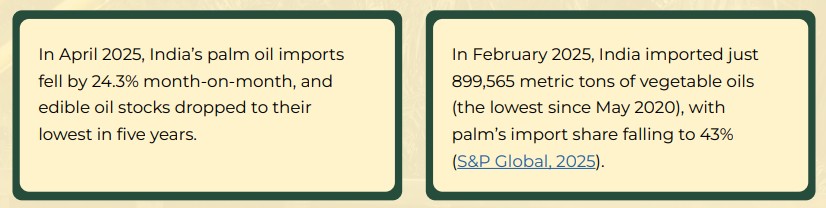
These developments underscore that shifts in global pricing, policy, or supply can ripple quickly into Indian households’ budgets. Maintaining the flow of affordable palm oil is not a matter of trade alone—it is central to food security, inflation control, and equitable nutrition.
Section 2: Indonesia’s Domestic Evolution and What It Means for India
Indonesia remains among the world’s largest palm oil exporters. Yet new domestic pressures are altering the dynamics of supply—and for India, these shifts carry deeper implications. Since 2025, Indonesia has fully implemented a B40 biodiesel mandate, requiring that 40% of diesel fuel be derived from palm-based biodiesel. This mandates a substantial internal absorption of palm oil—estimated at 15.6 million kilolitres in 2025 (Reuters, 2025). Analysts and government sources also project a move toward B50 blending by 2026, which would further intensify internal demand (Reuters, 2025).
As Dr. Hasan expressed during Globoil 2025:

This acknowledgment mirrors market expectations that the increment in domestic demand will reduce exportable surplus. To preserve export resilience, Indonesia is investing in replanting, yield enhancement, and certification efforts (especially ISPO). Importantly, smallholders—responsible for around 38–40% of national output—are central to this transformation (INDEF). But many of these farms face aging trees, low productivity, and climate stress, making rejuvenation and support essential if export volumes are to be maintained.
Reflecting the strategic value of the India market, Dr. Hasan reaffirmed: “Whatever financial policy we adopt, we shall always provide enough supply to the Indian market.” Forward view for India: As Indonesia’s internal demand for palm oil grows, India must anticipate tighter export supply windows, prioritize bilateral allocations, and participate in joint productivity and smallholder support initiatives to safeguard its edible oil security.
Section 3: From Commodity Trade to Strategic Co-Creation
The India–Indonesia palm oil relationship has entered a new phase—one no longer defined by simple volumes and price, but by co-investment, sustainability, and shared strategic interest. At Globoil 2025, the Indonesian Palm Oil Association (IPOA), the Solvent Extractors’ Association of India (SEA), and the Asian Palm Oil Alliance (APOA) formalized this evolution through a tripartite Memorandum of Understanding.
This agreement marks a shift from transactional trade to transformative cooperation. It is not just about the buying and selling of palm oil—it establishes a structured platform for:
- Joint policy advocacy in multilateral forums
- Technical alignment on sustainability certifications, including efforts to harmonize Indonesia’s ISPO with Indian procurement and traceability standards
- Shared consumer communication strategies to improve palm oil’s public perception
- Trade facilitation, including coordination on customs protocols and digital transparency tools
- Long-term demand assurance, safeguarding India’s edible oil supply amid tightening global conditions
In his keynote, IPOA Chairman Eddy Martono reinforced this spirit of partnership:

This commitment gains deeper significance in the current context. With Indonesia’s rising domestic demand—driven by the B40 biodiesel mandate and climate-aligned policy shifts—exportable volumes face increasing pressure. For India, which sources over 2.9 million tonnes annually from Indonesia, the stability of this supply is vital. Through this MoU, both sides acknowledge that palm oil trade is no longer immune to geopolitics, climate agendas, or food security pressures. As such, the agreement provides a diplomatic mechanism to manage price volatility, tariff adjustments, and sustainability alignment—not reactively, but proactively. In effect, the India–Indonesia palm oil corridor is being repositioned as a resilience axis—one that integrates trade with trust, market access with environmental progress, and short-term affordability with long-term cooperation.
Section 4: Aligning Sustainability with Supply Security
As India deepens its reliance on palm oil, the question is no longer whether sustainability matters—but how to align it with affordability and supply resilience. Criticism of palm oil’s environmental and social footprint has prompted important reforms— particularly in Indonesia. The Indonesian Sustainable Palm Oil (ISPO) certification—introduced in 2011—has long been mandatory for company-owned and state plantations. Under new regulations, ISPO will become mandatory for all oil palm producers, including smallholders, by November 2025 (EFI, 2024). ISPO enforces standards on traceability, labor rights, and land-use safeguards, particularly important as 40% of Indonesia’s palm oil is produced by smallholders. India, too, is raising the bar. Evolving FSSAI regulations on labeling and traceability, alongside growing consumer scrutiny, are reshaping procurement norms. Sourcing from ISPO-compliant producers offers India a clear path to:
- Meet Sustainable Development Goals (SDGs) through responsible sourcing
- Align with upcoming FSSAI traceability mandates
- Protect household affordability while supporting verified sustainability
But this alignment requires enabling policies. To future-proof India’s edible oil economy while securing responsible supply, the following joint actions are essential:
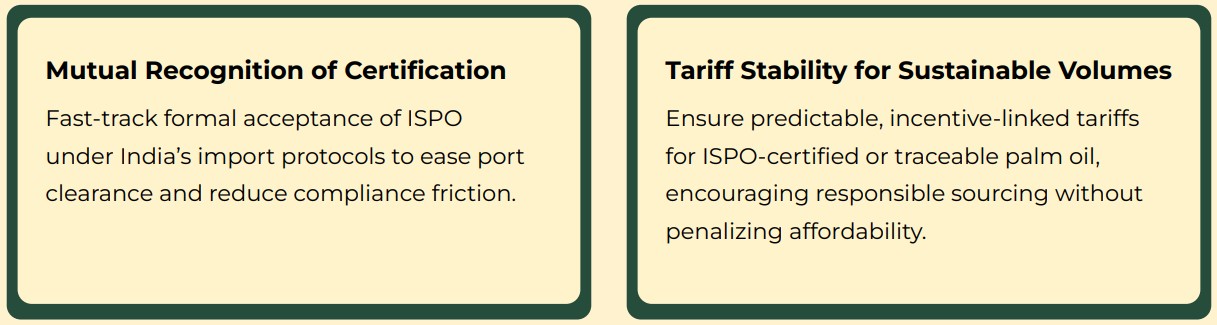
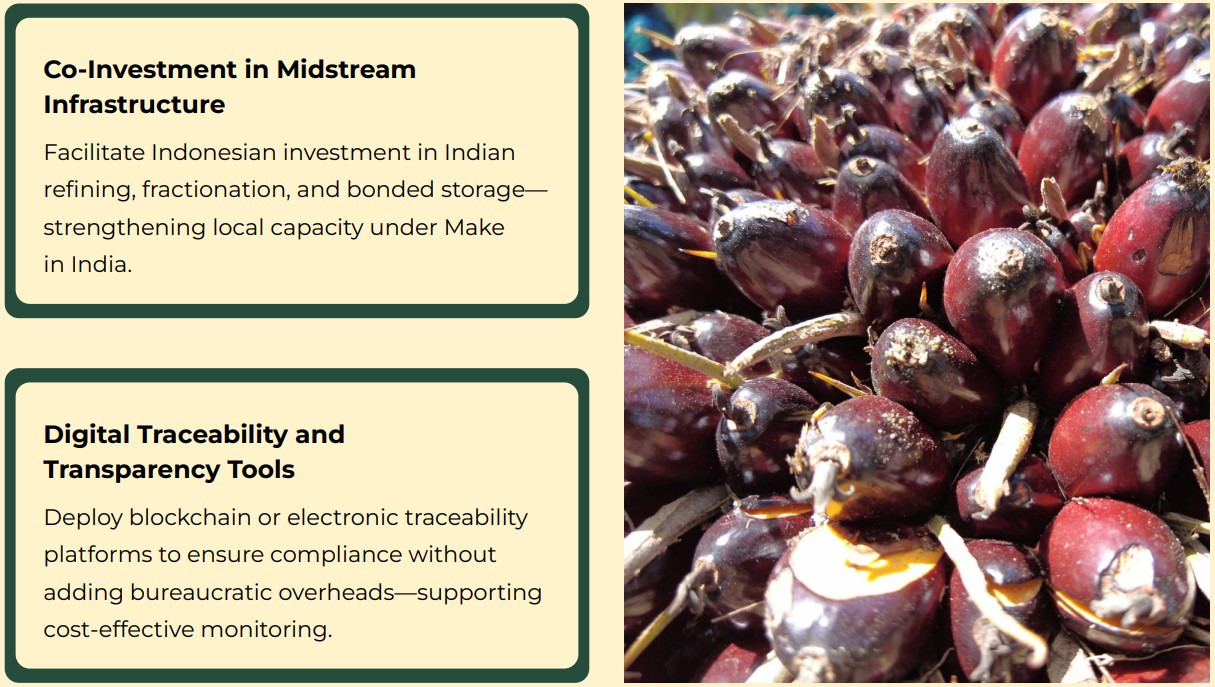
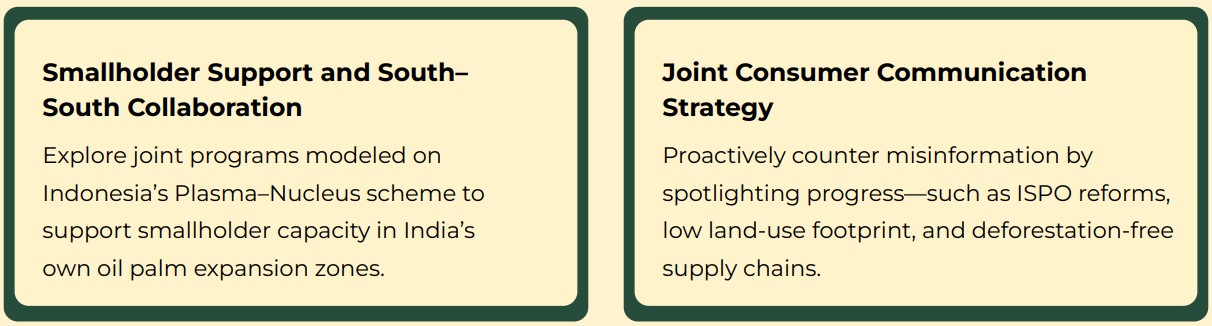
Taken together, these steps shift the palm oil narrative from one of compromise to one of co-creation: balancing climate credibility, food affordability, and economic inclusion.
Conclusion: Palm Oil as a Pillar of Food Security and Partnership
For millions of Indian families, palm oil is more than just an ingredient—it is a staple, a budget stabilizer, and a link in the chain of national nutrition. For Indonesia, India is not just a buyer—it is a long-term partner whose trust and alignment are key to regional resilience. As Eddy Martono affirmed at Globoil 2025, and as Fadhil Hasan emphasized in his address, Indonesia’s commitment to responsible, resilient supply is unwavering. The challenge now is to convert this intent into institutional alignment, policy reform, and joint innovation.
The future of palm oil in India is not about choosing between self-sufficiency and imports. It is about co-creating a stable, sustainable supply framework that feeds India affordably, empowers Indonesian smallholders, and strengthens the region’s food and climate security. (*)