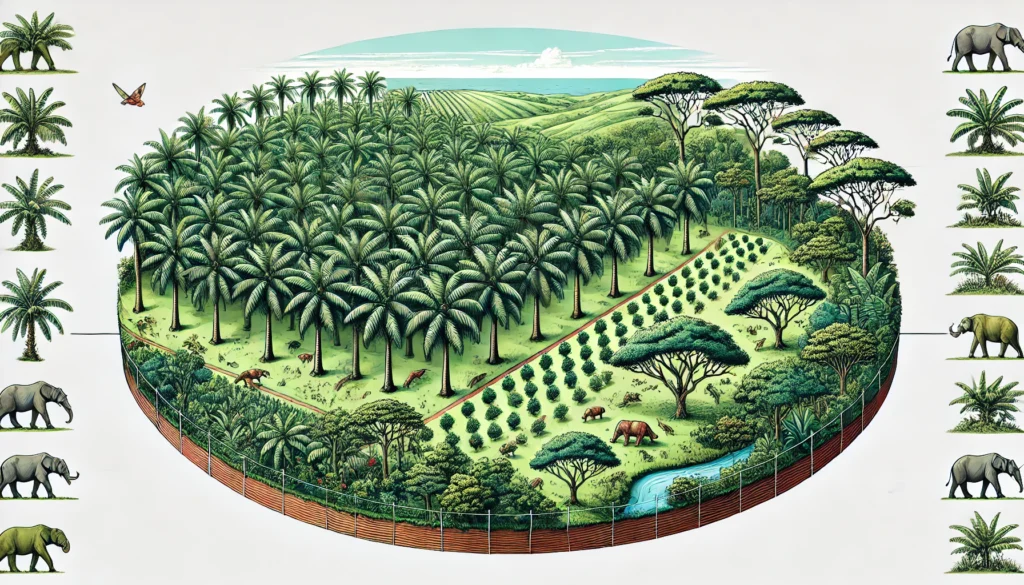
JAKARTA – Another myth attached to Indonesia’s oil palm plantations is the accusation that palm plantation areas originate from a direct conversion of forests (deforestation).
Apparently, one of the issue raised by anti-palm oil groups in their black campaigns against palm oil is an accusation that oil palm plantation expansion in Indonesia was resulted from direct conversions of forests. The study by Koh and Wilcove (2008) revealed that at least around 67 percent of Indonesian oil palm plantations were resulted from conversions of primary and secondary forests. The study by Fitzherdbert et al.
(2008) also revealed that the development of oil palm plantations by acquiring land areas through conversion of forests or deforestation during the period 1990-2015 was estimated at 16 percent. It seems that the definition of forest used in the studies by Koh and Wilcove (2008) and Fitzherdbert et al. (2008) is unclear and different from that adopted in Indonesia. Concerning this issue, it is necessary to trace the origins of the development of oil palm plantations in Indonesia (PASPI Monitor, 2021 ab).
Indonesia’s land area is divided into 22 types of ecosystems ranging from undisturbed upland forests to bare soil, of which only four types are categorized as forests (Gunarso et al., 2012; Suharto et al., 2019; Santosa et al., 2020). Studies related to the origin of oil palm plantation areas in Indonesia have been conducted by Gunarso et al. (2013) for 1990-2010 and continued by Suharto et al. (2019) for the period 2010-2018 (Figure 8). The study used data of land use change from satellite imagery reported by the Planning Agency of the Ministry of Environment and Forestry (KLH).

Based on data on the origin of oil palm plantations in Indonesia during period of 1990-2018, most of palm plantation expansion in Indonesia or around 61.6 percent was implemented on degraded lands. The degraded lands include upland shrub & grassland, swamp shrub & grassland, disturbed swamp forest, disturbed upland forest, bare soil, and others.
The second source of land areas for Indonesian oil palm plantations is from agricultural/plantation land at 37 percent, which includes intensive agriculture, plantations, and agroforestry. The remaining 1.4 percent comes from undisturbed upland forest, undisturbed swamp forest and undisturbed mangrove.
The above data shows that most of Indonesia’s oil palm plantations or around 98.6 percent do not come from direct forest conversion or not deforestation. The same reality was also found by Erniwati et al. (2017), Sunkar et al. (2018), Roda (2019), and Santosa et al. (2020) who concluded based on their studies that deforestation in Indonesia has no direct correlation with the expansion of oil palm plantations. (Mitos 6-30)
References:
- Erniwati, Zuhud EAM, Anas I, Sunkar A, Santosa Y. 2017. Independent Smallholder Oil Palm Expansion and Its Impact on Deforestation: Case Study in Kampar District, Riau Province, Indonesia. Journal of Tropical Forest Management. 23(3): 119-127.
- Fitzherbert E, MK.Struebug, A Morel, F Danielsen, CA Bruhi, PF Donald, B. Phalan. 2008. How Will Oil Palm Expansion Affect Biodiversity? Trends in Ecology and Evolution. 23(10): 538-545.
- Gunarso P, ME Hartoyo, Y Nugroho. 2013. Analysis of land cover and conversion to oil palm plantations in Indonesia: Case studies in 5 big islands in Indonesia during period of 1990-2010. Journal of Green Growth and Environment Management. 2(1):10-19.
- Gunarso P. ME Hartoyo, F Agus, TJ Killeen. 2013. Oil Palm and Land Use Change in Indonesia, Malaysia and Papua New Guinea. Tropenbos Organization. Available at: https://www.tropenbos.org/resources/publications/oil+palm+and+lan d+use+change+in+indonesia%2C+malaysia+and+papua+new+guinea
- Koh LP, Wilcove DS. 2008. Is Oil Palm Agriculture Really Destroying Tropical Biodiversity? Conservation Letters. 1(2): 60–64. https://doi.org/10.1111/j.1755-263X.2008.00011.x
- PASPI Monitor. 2021ab. The Origin History of Indonesian Oil Palm Plantation And The Polemic of Deforestation. Palm Oil Journal Analysis of Palm Oil Strategic Issues. 2(34): 489-494.
- Roda JM. 2019. The Geopolitics of Palm Oil and Deforestation. Available at: https://www.thejakartapost.com/academia/2019/07/08/the-geopolitics-of-palm-oil-and-eforestation.html.
- Santosa Y, Sunkar A, Kwatrina RT. 2020. Is it True that Oil Palm Plantations are the Main Driver of Indonesia’s Tropical Forest Deforestation? International Journal of Palm Oil. 3(1): 1-10. https://doi.org/10.35876/ijop.v3i1.37
- Suharto R, Agus F, Santosa Y, Sipayung T, Gunarso, P. 2019. An assessment on European Union Renewable Energy Directive (EU Directive 2018/2001) and EU Commission Delegated Regulation 2019/807 and Formulation of Indonesian position on the Policy. Jakarta (ID): Economic Coordinating Ministry; the Oil Palm Plantation Fund Management Board (BPDPKS); PT Riset Perkebunan Nusantara.
- Sunkar A, Erniwati, Santosa Y. 2018. Is It True that Oil Palm Smallholders’ Plantations the Cause of Deforestation? Case Study on 16 plantations owned by independent smallholders in Riau province. Presented during seminar of IPB International Convention Centre Bogor on 12 April 2018. (*)