JAKARTA – The Indonesian palm oil industry is facing a big challenge to maintain its position as the world’s largest producer and exporter of palm oil. Amid the mounting climate change pressures, increasingly fierce competition in global market, and plant disease threat, increasing the productivity of national palm oil industry becomes the key factor in maintaining the competitiveness of the industry sustainably.
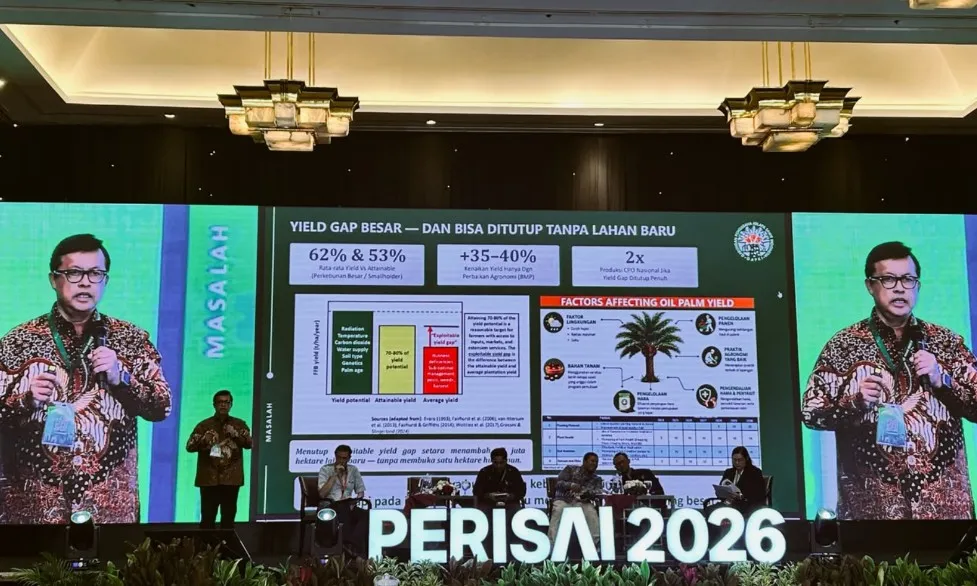
The Head of Research and Development Division at the Indonesian Palm Oil Association (GAPKI), Dwi Asmono said that Indonesia has production capacity of around 50 million tons of crude palm oil (CPO) per year with the support of extensive cultivation land. But the potential is not yet fully reflected in the productivity of national oil palm plantations.
Indonesia’s oil palm productivity still stagnant
Dwi explained that national palm oil productivity still faces significant challenges. Phenomena such as El Niño and climate change are among the factors causing the productivity of oil palm plantations to stagnate or even decline.
“Our productivity tends to stagnate—or even drop—during El Niño events, even though our oil palm plantations still hold immense potential for increased output,” Dwi stated during his presentation on “Strategies for Enhancing Sustainable Palm Oil Productivity in Indonesia” at the Indonesian Palm Oil Research Week in Jakarta on Monday (20/07/2026).
According to him, boosting palm oil productivity requires support through strengthened research and innovation. Compared to competitor countries and other agricultural commodities, investment in research in Indonesia remains relatively low.
Big gap in national Palm yield
Various studies indicate that the productivity of Indonesian oil palm plantations remains far below its optimal potential. Large-scale plantations currently achieve only about 62 percent of their maximum potential, while smallholder plantations hover around 53 percent.
A primary reason for this situation is the suboptimal implementation of best management practices at the plantation level. If best cultivation practices were consistently applied, productivity could potentially increase by 35–40 percent.
This productivity boost has the potential to drive a significant rise in national CPO production without the need to open new land areas.
GAPKI Sets up five consortiums of palm oil research
To accelerate innovation and boost the productivity of Indonesia’s palm oil sector, GAPKI, together with various stakeholders, has formed five strategic research consortia.
- Consortium of oil palm genetic resources
This consortium is aimed to expand access to oil palm germplasm from Africa, the plant’s center of origin. This initiative is expected to yield superior varieties that are more productive and adaptable to environmental changes.
- Consortium of Oil Palm Pollinator Research
The second consortium focuses on the development of pollinating insects. Indonesia has long relied on a single pollinator species introduced decades ago. The introduction of a new species from Africa is expected to enhance pollination effectiveness and crop productivity.
- Consortium of organic fertilizer development
This consortium is aimed to develop bio-fertilizer technology to reduce reliance on imported fertilizers while simultaneously improving efficiency of fertilization in oil palm plantations.
- Consortium of Ganoderma control
Ganoderma is a major disease threatening the productivity of Indonesian oil palm plantations. Its management involves an integrated approach, ranging from plant breeding, early detection, and biological control to policy support.
- Consortium of Palm Mechanization, Digitalization, and Automation
This consortium focuses on the development of modern plantation technology. With Indonesia’s oil palm plantations spanning approximately 16.4 million hectares, mechanization and digitalization have become essential for enhancing operational efficiency.
Research and Innovation key to future of Indonesian palm industry
Dwi emphasized that the five consortia were established not merely to produce research results, but to create innovations that can be directly applied in the field.
According to him, increasing productivity by just one ton of fresh fruit bunches per hectare could generate a significant economic impact for the national palm oil industry.
“Research and innovation represent a strategic investment for the future of the palm oil industry. The yield gap cannot be closed without research and innovation. Innovation must be continuously pursued to boost productivity and ensure that Indonesia’s palm oil industry remains a mainstay of the national economy,” said Dwi. (Fetry Wuryasti)