Palm oil-based biodiesel has become one of the most successful downstream products in the Indonesian palm oil industries. Its use has not only reduced reliance on the fossil fuels, but also supporting the national energy resilience, creating added value to the palm oil industries, and contributing to the reduction of greenhouse gas emission (GHG).
Along with the development of the national mandatory program of biodiesel, from B20, B30, B35, B40 up to B50, the term palm biodiesel and FAME (Fatty Acid Methyl Ester) has been increasingly used. But apparently, there are still many people who consider the two as different products.
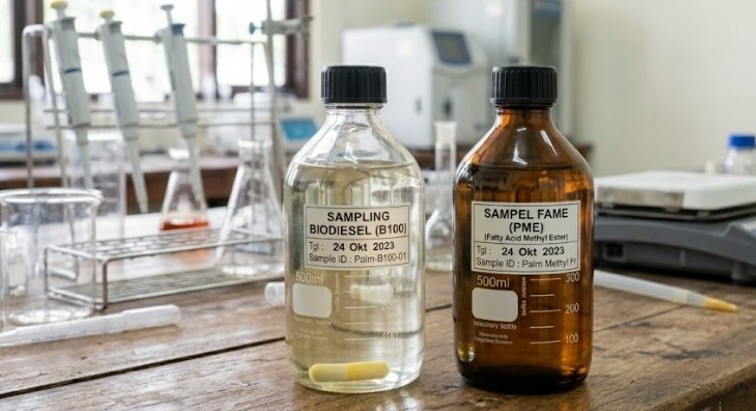
In fact, the palm biodiesel that is currently used in the national biodiesel program is basically palm oil-based FAME.
What is palm biodiesel?
Palm-based biodiesel is a biofuel produced from palm oil and used as a substitute for, or blend with, fossil-based diesel fuel. Biodiesel falls under the category of biofuels—fuels derived from biomass or renewable biological resources.
As a form of renewable energy, palm-based biodiesel plays a strategic role in supporting the energy transition toward a more sustainable energy system. Beyond its use in the transportation sector, biodiesel is also utilized in industries, heavy machinery operations, and power generation.
For Indonesia, the development of palm-based biodiesel is also a crucial part of efforts to enhance the value of palm oil products through domestic industrial down-streaming.
What is FAME?
FAME, or Fatty Acid Methyl Ester, is a fatty acid ester compound produced through the transesterification of vegetable oil using methanol and specific catalysts.
In this process, the triglycerides contained in palm oil are converted into FAME, which can be used as fuel for diesel engines. This technology is the most widely used method in the world in producing biodiesel because it is relatively mature, efficient, and commercially proven.
Consequently, when the public or industry players in Indonesia refer to palm biodiesel, they almost invariably mean palm oil-based FAME.
Palm biodiesel and FAME: What is the relation?
To understand the relationship between the two, it is important to note that “biodiesel” is a broader term than FAME.
Simply put:
- Palm-based biodiesel is a category or general term for diesel fuel derived from palm oil.
- FAME is a form of palm-based biodiesel produced through a transesterification process.
- HVO (Hydrotreated Vegetable Oil)—or Renewable Diesel—is another form of biodiesel produced through hydrogenation. It possesses characteristics distinct from those of FAME.
Thus, while all FAME can be classified as biodiesel, not all biodiesel is FAME.
This distinction is significant because advancements in biofuel technology continue to yield various new types of renewable fuels, each with unique characteristics and production processes.
The difference between FAME and HVO
Although both are derived from vegetable oils, FAME and HVO possess different chemical structures.
FAME fuel molecules still contain oxygen, as they are fatty acid esters. In contrast, the oxygen in HVO is removed through a hydrogenation process, resulting in hydrocarbons with properties that more closely resemble fossil diesel.
These differences affect several fuel characteristics, including:
- Storage stability.
- Oxidation resistance.
- Low-temperature performance.
- Combustion quality.
- Compatibility with various types of diesel engines.
Due to their differing characteristics, FAME and HVO are often viewed as complementary technologies in the development of renewable energy based on vegetable oils.
Why this understanding important?
Understanding the distinction between palm-based biodiesel and FAME provides a more accurate picture of evolution of the bioenergy industry.
In Indonesia, the mandatory biodiesel program—which has now advanced to the B50 stage—utilizes palm oil-based FAME as the primary blending component with the conventional diesel fuel. This program has proven effective in boosting domestic palm oil consumption while simultaneously reducing the need for fossil fuel imports.
Meanwhile, technological advancements such as HVO (or renewable diesel) demonstrate that innovation in palm-based bioenergy continues to evolve, opening up opportunities for broader application in the future.
Therefore, recognizing that “palm-based biodiesel” is a general term—whereas FAME is the specific form most widely used today—can help prevent misunderstandings in discussions regarding renewable energy and the palm oil industry.
Palm biodiesel as driver of down-streaming and energy resilience
The success of the biodiesel program has shown that palm oil serves not only as a source of edible oil and industrial raw material but also as a strategic source of renewable energy.
Through biodiesel development, Indonesia has successfully created a robust domestic market for palm oil products, enhanced domestic value-added, strengthened national energy security, and mitigated the impact of global oil price fluctuations on the economy.
Looking ahead, the development of biodiesel, bio-jet fuel, bioethanol, and various palm-based bioenergy innovations is expected to further strengthen the palm oil industry’s contribution to supporting Indonesia’s energy transition, economic growth, and sustainable development. (*)
WikiSawit. Biodiesel Sawit dan FAME: Apa Bedanya?. https://gapki.id/id/wikisawit/knowledge-base/biodiesel-sawit-dan-fame-apa-bedanya/