PONTIANAK – The Indonesian Palm Oil Association (GAPKI) held an event titled “Accelerating ISPO 2026 Implementation: Socialization and Certification Clinic for Indonesian Sustainable Palm Oil (ISPO)” at the Golden Tulip Hotel in Pontianak, West Kalimantan, on 19 – 20 August 2026.
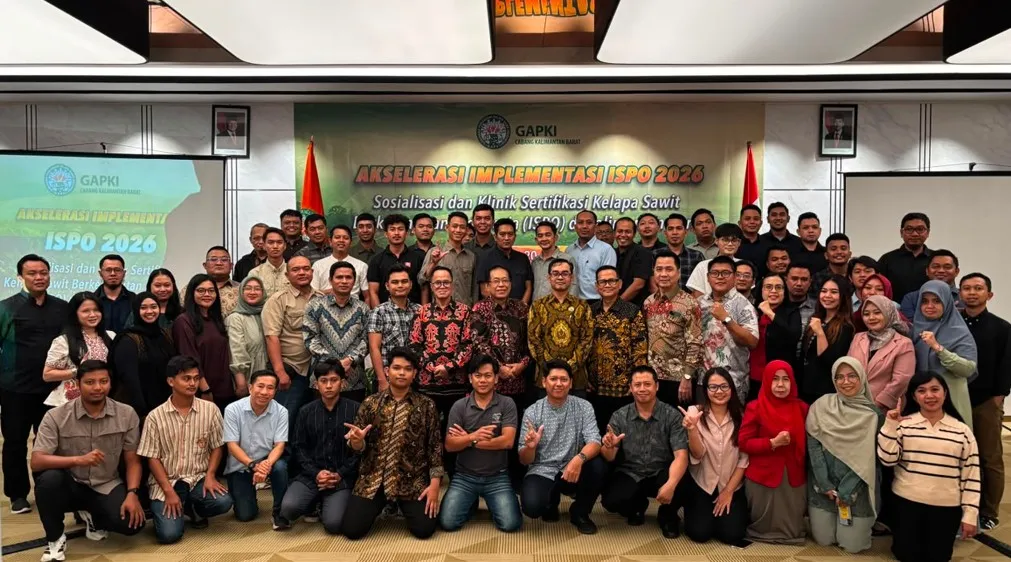
The event was attended by 110 participants, including representatives from GAPKI member companies, ISPO internal auditors, sustainability teams, legal and Occupational Health and Safety (SMK3) personnel, and related stakeholders, as well as participants from non-member companies. Speakers included members of the ISPO Team from the Directorate General of Plantations of the agriculture ministry and representatives from certification boards.
In his opening speech, Acting Head of the West Kalimantan Province Plantation and Livestock Agency, Rino Anteno Tengo, S.STP., M.Si, emphasized the importance of the ISPO Dissemination and Clinic session in accelerating the certification process and strengthening sustainable palm oil development in West Kalimantan.
According to Rino, West Kalimantan is one of Indonesia’s largest palm oil-producing provinces. As of 2025, the total palm oil plantation area in West Kalimantan reached 2,305,536.57 hectares, with Crude Palm Oil (CPO) and Palm Kernel (PK) production totaling 7,989,462.31 tons.
This significant potential must be matched by improved governance and the implementation of sustainability principles so that West Kalimantan’s palm oil products can better meet global market demands.
The government has also strengthened ISPO certification policies through Presidential Regulation Number 16 of 2025 concerning the Indonesian Sustainable Palm Oil Certification System and Minister of Agriculture Regulation Number 33 of 2025 concerning the Implementation of Indonesian Sustainable Palm Oil Plantation Certification.
These regulations expand the scope of ISPO beyond plantation operations to include downstream industries and palm oil-based bioenergy businesses.
The West Kalimantan Provincial Government hopes this event will enhance the understanding of companies and planters regarding the latest regulations and encourage the alignment of business operations with ISPO principles and criteria.
As of June 2026, 119 plantation companies in West Kalimantan were recorded as holding ISPO certification. Meanwhile, two organizations of smallholders in Sekadau Regency had also obtained ISPO certification.
Aris Supratman, Chairman of the West Kalimantan Chapter of GAPKI, emphasized that ISPO should not be viewed merely as an administrative obligation or a simple preparation for audits.
According to him, ISPO needs to serve as an instrument to improve corporate governance, strengthen management systems, enhance compliance, mitigate risks, and boost the competitiveness of the palm oil industry.
“We want this initiative to go beyond mere outreach. We want it to become a forum for learning, consultation, and problem-solving,” said Aris.
Through this activity, participants were encouraged to openly share the various obstacles and gaps their companies still face in meeting ISPO requirements, enabling collaborative solutions to be found.
The circumstances of each company vary, ranging from those that are already certified and undergoing surveillance audits to those currently in the certification process and others still making necessary improvements before certification.
During the event, participants received policy updates, in-depth insights into ISPO principles and criteria, and information on regulatory transition periods, audit and surveillance procedures, simulation audits, and implementation challenges, as well as shared experiences from companies that have already achieved ISPO certification.
GAPKI Targets 100% ISPO certification for members
GAPKI Chairman Eddy Martono said in his written speech, read out by Azis Hidayat, Head of GAPKI’s Plantation Division, that the association has been committed since 2019 to ensuring all its member companies to obtain ISPO certification.
As of July 2025, 587 GAPKI member companies approximately 79 percent of the total 743 members have secured ISPO certification. Consequently, accelerating the certification process remains a key priority for the organization.
Regulatory changes introduced via Presidential Regulation No. 16 of 2025 have expanded the scope of ISPO to encompass the upstream, downstream, and bioenergy sectors. These changes require companies to keep pace with regulatory developments while strengthening compliance with the principles of sustainable oil palm plantation management.
GAPKI hopes that the ISPO socialization and advisory session in West Kalimantan will lead to concrete actions at the company level. Participants are expected to leave not only with informational materials but also with action plans that identify specific gaps requiring remediation, assign responsibilities, and set completion timelines.
Collaboration among the government, GAPKI, certification bodies, companies, academia, and other stakeholders is essential to accelerating ISPO certification and building a West Kalimantan palm oil industry that is increasingly productive, competitive, responsible, and sustainable. (Eko Tamba)