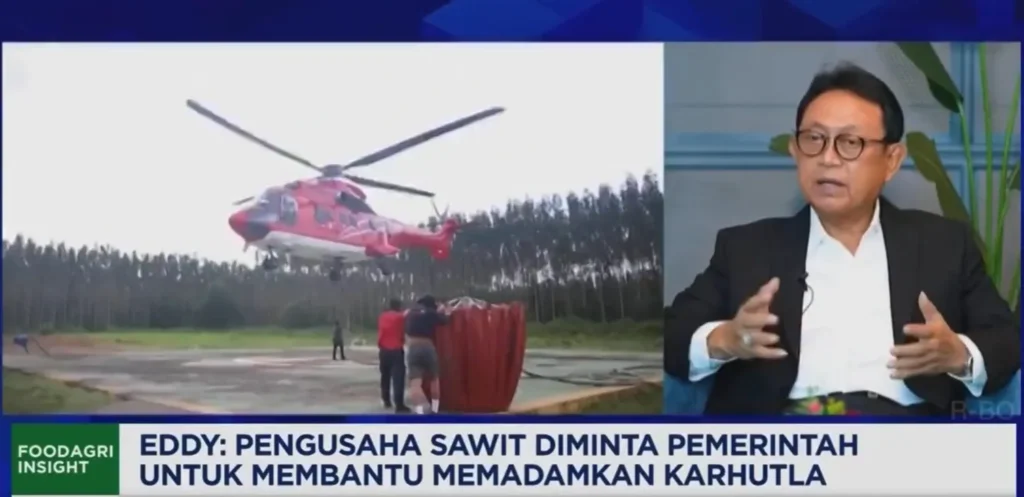
JAKARTA – The Indonesian Palm Oil Association (GAPKI) Chairman Eddy Martono has spoken out to address the perception of many people who attribute forest and land fires (Karhutla) to the expansion of oil palm plantations. He made such necessary clarification to dispel the public misconceptions during an exclusive interview with CNBC Indonesia journalist Aulia Wardani for the “Food Agri Insights” segment.
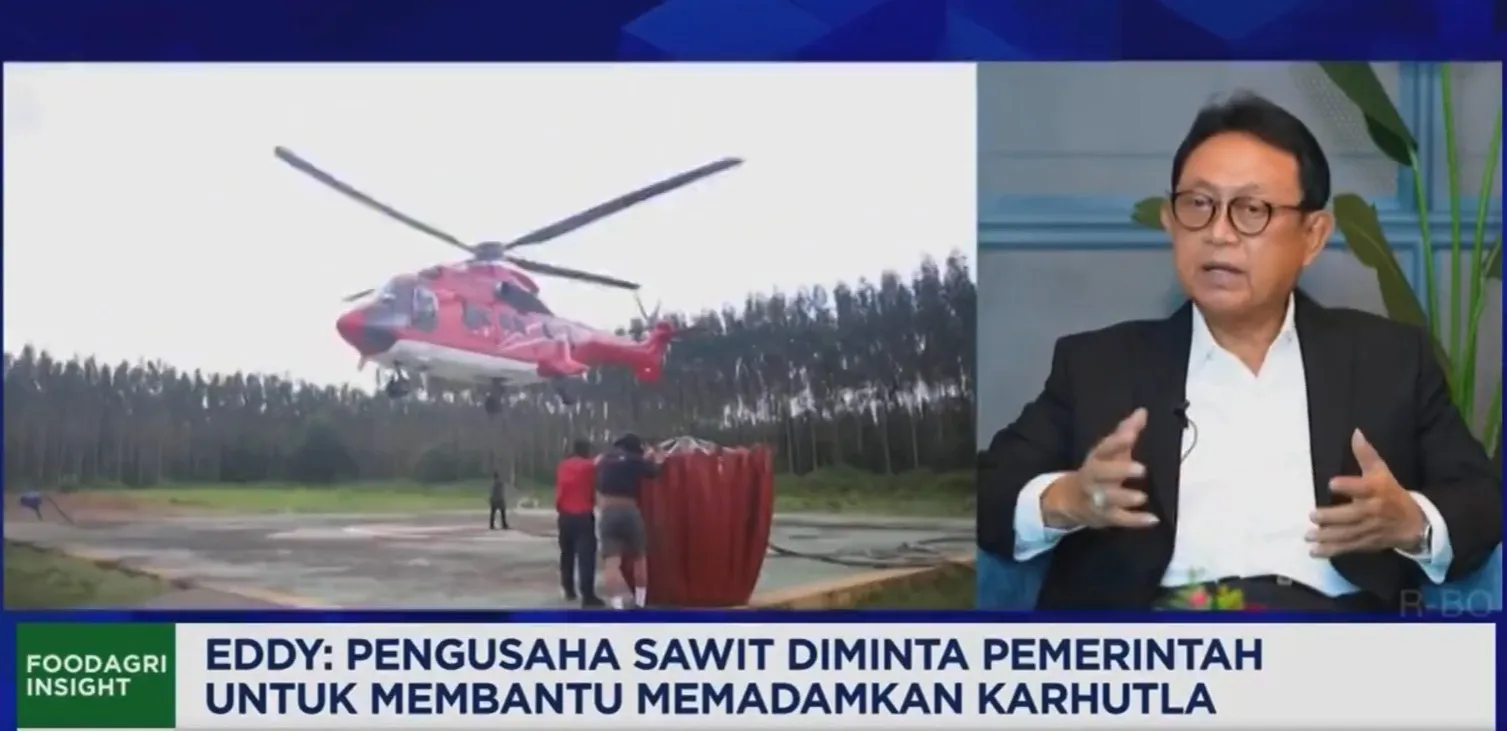
The interview took place amidst a warning from the Meteorology, Climatology, and Geophysics Board (BMKG) that identifies September 2026 as a critical period for forest and land fires in Indonesia, driven by El Niño conditions reaching “very strong” intensity—as indicated by atmospheric dynamics analysis from the third ten-day period of August 2026. The BMKG also detected rising concentrations of fine particulate matter and carbon monoxide emissions in Sumatra and Kalimantan, with the impact extending as far as Sarawak, Malaysia.
Clarification: Palm Oil as a Motive for Arson Makes No Sense
Eddy emphasized that allegations linking the palm oil industry to land-burning practices have persisted for a long time and need to be clarified. He explained that, currently, the approval process for both the renewal and issuance of new Cultivation Rights (HGU) permits remains stalled at the central government level. Therefore, he argued, it makes no sense for a company to deliberately order land to be burned for palm oil cultivation when the official permits have not yet been issued.
He also highlighted the significant legal risks companies face if proven to be involved in land burning ranging from environmental restoration fines that could potentially exceed the value of the company’s assets to criminal penalties. “So, I find it highly illogical that a palm company would intentionally order such an act in order to plant oil palm trees, while they haven’t yet got a license for land expansion,” Eddy said.
He also referred to Article 69, Paragraph 2 of Law Number 32 of 2009, which permits local communities to clear land by burning up to a maximum of two hectares per household based on local wisdom; a provision that, according to him, frequently sparks controversy within the community.
Palm Companies’ Role to Tackle Fires Outside Their Concessions
Beyond the need for clarification, Eddy explained that the involvement of palm oil companies in extinguishing fires outside their concessions is part of coordinated efforts requested by both central and regional governments. He noted that palm plantation companies are required to maintain fire prevention and preparedness equipment. Consequently, when there are no fires within their own concession areas, those resources can be deployed to assist surrounding regions. A recent example occurred in Banjarmasin, where GAPKI members helped extinguish fires near the airport to prevent disruptions to flight operations.
Nevertheless, Eddy urged GAPKI members to exercise caution when assisting with firefighting efforts outside their concessions, given the strict liability regulations applicable to their respective concession areas. He also revealed that GAPKI is currently coordinating daily with the Ministry of Forestry regarding detailed hotspot data including locations and coordinates which is then relayed to all members for on-the-ground verification.
Latest Condition of Hotspots: Only 8% Located Inside Concessions
Eddy stated that, based on the latest reports he received, the overall number of hotspots has begun to decline. However, he noted that Central Kalimantan remains a province requiring special attention due to its persistently high hotspot levels. Consequently, the Central Kalimantan chapter of GAPKI and its members have been urged to remain vigilant.
He emphasized that, according to the data, burned areas within company concessions account for only about 8% of all incidents, whereas the majority of fires actually occur outside these concessions. Eddy also pointed out that hotspots are categorized into three levels—low, medium, and high and that the presence of a hotspot does not automatically indicate an active fire.
Regarding the impact on plantation operations, Eddy explained that since concession areas have been minimally affected by fires, palm oil production by GAPKI members has generally not suffered significant disruption due to forest and land fires. However, he highlighted a different challenge arising in West Kalimantan: difficulties in transporting Crude Palm Oil (CPO) caused by drying river conditions, which led some companies to temporarily halt fruit intake from external sources in order to adjust production capacity.
Appreciation for Inpres No.11/2026
Eddy expressed appreciation for the issuance of Presidential Instruction (Inpres) Number 11 of 2026, which tightens restrictions on land-burning practices even those based on local wisdom by involving all ministries and local governments. He emphasized that the “local wisdom” argument can no longer be invoked during forest and land fire emergencies, noting that there is an absolute ban on such burning on peatlands.
Eddy reiterated GAPKI’s stance that tackling forest and land fires is a shared responsibility. The burden cannot fall solely on companies, the government, authorities, or the community in isolation, but rather requires the collaborative effort of all parties. “The community must also be involved. The community must also take precautions to prevent fires from occurring,” he said.
Hopes for Fair Application of Strict Liability
Regarding the application of strict liability, Eddy acknowledged that this provision poses a significant threat to companies, particularly in cases where a fire originating outside a concession is carried by the wind into the concession area. He drew an analogy to the eruption of Mount Anak Krakatau, where volcanic ash could be carried by the wind as far as Jakarta and Bogor. In his view, the application of strict liability must be accompanied by a clear investigation into the fire’s origin so that negligence is not automatically attributed to the company without regard for the facts on the ground.
“We hope that authorities and law enforcement officials will truly exercise discernment when applying strict liability. There must be an element of fairness involved,” Eddy said, concluding the interview. (*)
Live CNBC Indonesia. https://www.cnbcindonesia.com/tv. Squawk Box: Foodagri Insight. 9/9/2026. (Fresty Wuryasti)