What Are Kernel Shell and Boiler Ash?
- Definitions of kernel shell and boiler ash along with their origins at palm oil mills.
- Composition and calorific value that determine their roles as boiler fuels.
- Utilization of boiler ash in plantations, plus the economic value and prospects of both materials.
Kernel shell and boiler ash are two sides of the biomass energy chain at a palm oil mill: one becomes fuel, the other becomes ash that returns to the land. This article examines the definitions, composition, roles, utilization, and economic value of both concisely and neutrally [1][2].
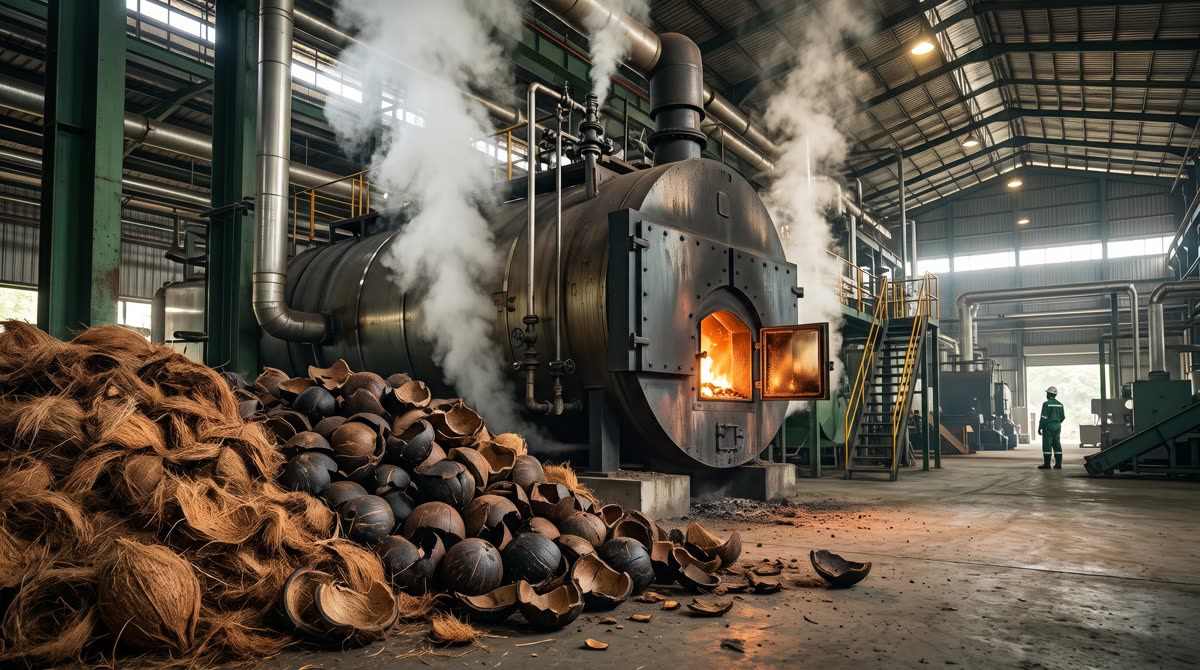
Table of Contents
Introduction
Kernel shell, or the shell of the palm kernel, is the hard layer wrapping the kernel inside the oil palm fruit, separated during the nut cracking stage at the palm oil mill (PKS). Together with mesocarp fiber, the shell is one of the main solid wastes produced in large quantities and available continuously as long as the mill operates [1].
Boiler ash is the ash left over from burning biomass fuel, mainly fiber and shells, in the mill’s steam boiler. This ash is no longer merely a residue: its relatively high potassium content means it still holds value when returned to the plantation [2][3].
Characteristics and Composition
Physically, kernel shell is small, dense, and lignocellulosic, so it is easy to stack and transport. Every mill produces 50–70 kg of shells per ton of fresh fruit bunches (FFB), equivalent to 5–7 percent of the feed, with a calorific value of about 4.000–4.500 kcal/kg, or roughly 60 percent of the value of low-rank coal [1][5].
Boiler ash forms from the combustion of that biomass and consists of bottom ash and fly ash. Laboratory analysis reports a potassium oxide (K2O) content in boiler bottom ash of up to 9,78 percent; on the other hand, silicates in the shells can form scale on the boiler, limiting the proportion of shells that can be safely burned [4][3].
| Aspect | Description |
|---|---|
| Origin | Kernel shell comes from nut cracking during FFB processing; boiler ash is the residue of burning fiber and shells in the steam boiler. |
| Main content | Boiler ash is rich in potassium oxide (laboratory report of 9,78% K2O); the shells are dominated by lignocellulosic compounds. |
| Calorific value | 4.000–4.500 kcal/kg, equivalent to about 60% of low-rank coal. |
| Availability | 50–70 kg of shells per ton of FFB (5–7% of the feed). |
| Main utilization | Boiler fuel, biomass electricity, environmentally friendly concrete aggregate, and activated carbon feedstock. |
Role as Boiler Fuel
Boilers fueled by fiber and shells produce hot steam used for FFB sterilization, drying, and driving power plant turbines. Having the fuel available in the same place makes palm oil mills generally energy self-sufficient [1][5]. The pressurized steam generated turns the turbine, so the electricity produced can be used for the entire processing machinery line as well as the mill offices [3][4].
A common practice at mills is mixing fiber and shells. Shells have higher density and carbon content, so their heat is stable, but their burning rate is slower than fiber; mixing is intended to balance ease of ignition and the stability of the energy produced [1][3].
Utilization of Boiler Ash
Boiler ash is commonly spread back onto plantation land as fertilizer or a soil ameliorant. Its application has been reported to raise soil pH, exchangeable potassium levels, and cation exchange capacity, while reducing the need for inorganic fertilizer and the waste burden on the environment [2][4].
Beyond direct application, the ash is also beginning to be studied for extraction into potassium carbonate compounds and for use as a catalyst support in biodiesel production, opening up added-value opportunities beyond mass utilization [4][2].
Economic Value for Mills
For mills, kernel shell replaces fuel oil and coal, thereby suppressing operational energy costs. Surplus shells can be sold to other biomass boilers; Indonesian shell exports were even recorded at one point under contracts worth US$138,2 million to Japan [5][1].
The zero waste concept estimates that all oil palm biomass has the potential to be worth US$150–200 per ton, reinforcing the argument that shells and ash are not an environmental burden but an asset that supports mill margins and the transition to renewable energy [1][2].
Challenges and Prospects
The main challenges in utilizing them are the silicate content that triggers boiler scale, difficulties in handling and non-homogeneous sizing, and shell price fluctuations that follow regional market dynamics [3][5].
The prospects remain broad, including the development of shell-based activated carbon, battery electrode research, and the expansion of co-firing at steam power plants. These options also support demand and improve the carbon footprint of the palm oil industry [1][5]. Thus, these two materials explain why palm oil mills deserve to be called a bioindustry that applies circular economy principles [1][5].
References
- Gabungan Pengusaha Kelapa Sawit Indonesia (GAPKI). Zero Waste, All Parts Of Oil Palm Trees Utilized. gapki.id.
- Gabungan Pengusaha Kelapa Sawit Indonesia (GAPKI). Palm Kernel Shells As Potential Oil Substitute. gapki.id.
- Malaysian Palm Oil Board (MPOB). The Malaysian Oil Palm Industry Performance. mpob.gov.my.
- Vijaya, H., et al. Life Cycle Inventory of the Production of Crude Palm Oil (Journal of Oil Palm Research). jopr.mpob.gov.my.
- Universitas Muhammadiyah Sumatera Utara. Jurnal Rekayasa Material, Manufaktur dan Energi (characterization of bottom ash from palm oil mill boilers). jurnal.umsu.ac.id.
- Food and Agriculture Organization of the United Nations (FAO). Small-Scale Palm Oil Processing: Environmental Considerations. fao.org.