What Is Decanter Cake in Palm Oil Processing?
- Heavy-phase solid waste from clarification sludge separation
- Rich in nitrogen and organic carbon, with a moisture content of 50-70%
- Has potential as organic fertilizer or boiler fuel
Decanter cake is a solid waste produced by palm oil mills at the oil clarification stage using a decanter machine. This article discusses its definition, composition, utilization potential, and management within the mill environment concisely and neutrally [1][3].
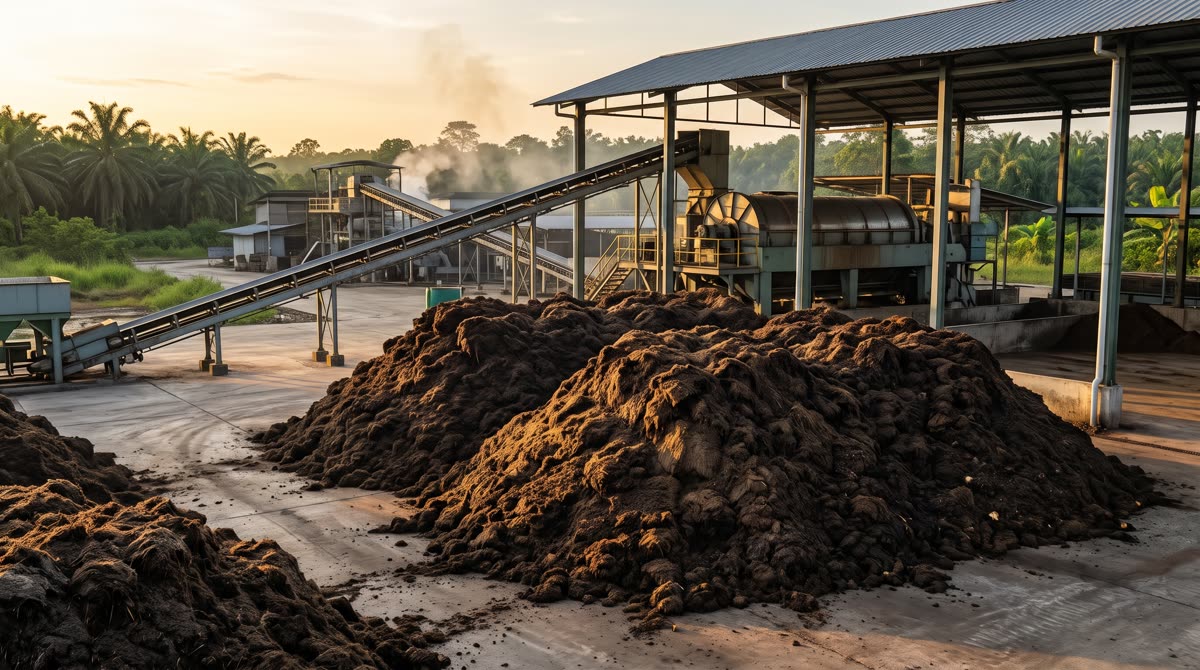
Table of Contents
Definition and Formation Process
Decanter cake (DC), also called decanter solid, is the solid phase (heavy phase) that separates from the clarification sludge when the sedimentation tank underflow is fed into a two-phase decanter. The separation uses high centrifugal force to separate components according to density differences [3].
This material originates from mesocarp or fruit fiber that has been processed in the mill, so it is no longer fresh material but a solid residue whose liquid has been separated [1]. Its presence is a consequence of efforts to increase oil recovery at the clarification station [2].
Composition and Characteristics
Judging from its nutrient content, decanter cake is classified as organic waste rich in nitrogen. Analysis results of a sample from Jambi recorded N 2.17%, total P2O5 0.22%, K2O 0.22%, organic C 16.82%, and pH 5.86 [4].
Its moisture content is still high, ranging from 50% to 70%, so it forms a thick sludge that easily decomposes and smells if left to accumulate [3]. This characteristic determines the handling method because the faster it is dried or processed, the lower the environmental impact [2]. Therefore, rapid initial handling is key so that its nutrient value is not lost and emissions remain controlled.
| Aspect | Description |
|---|---|
| Category | Solid phase resulting from clarification sludge separation (decanter solid) |
| Material origin | Mesocarp/fruit fiber that has been processed in the mill |
| Moisture content | 50-70% |
| Nutrients | N 2.17%; P2O5 0.22%; K2O 0.22%; organic C 16.82%; pH 5.86 |
| Production | Approximately 40 kg per tonne of FFB; a 90 t/h mill produces 160-200 t/month |
| Dry calorific value | 18-20 MJ/kg, comparable to palm fiber and shell |
Potential Utilization as Organic Material
The high nitrogen and organic carbon content makes decanter cake suitable as a base material for organic fertilizer. Unlike empty fruit bunches, this waste decomposes more easily in the field, generally within about six weeks [4].
Its use has been tested on vegetable crops and seedling growing media. In celery, a decanter cake dose of 15 tonnes per hectare combined with 50% of the NPK dose produced the highest number of leaves [4]. Adding decanter solid to Ultisol soil also increased pH, macro and micro nutrients, and aggregate stability, with the best composition being 40% decanter solid and 60% soil after 45 days of incubation [6].
Utilization as Fuel
After drying, decanter cake has a calorific value of 18-20 MJ/kg, equivalent to palm fiber and shell, so it has the potential to replace part of the boiler fuel within the mill [5]. Proximate analysis shows a moisture content of 5%, volatile matter 65%, fixed carbon 11%, and ash 19%.
The same study concluded that solid fuel from decanter cake is feasible as a substitute for biomass-based fuels and other coke-based fuels [5]. This utilization is increasingly attractive because boiler waste heat can be used to dry decanter cake, making the energy cycle more efficient [2].
Management at the Mill
Decanter cake management is usually integrated with the clarification station. By separating the solids, the volume and BOD of the liquid waste stream decrease, while oil recovery increases because suspended dirt is also discharged [3].
In terms of quantity, a mill with a capacity of 90 tonnes of FFB per hour is estimated to produce 160-200 tonnes of decanter cake per month [2]. Because the volume is large, the mill needs to arrange temporary storage, drying lines, and a utilization plan so that the waste does not accumulate and pollute the environment [1]. Scheduling transportation to plantations or processing partners also needs to be arranged so that storage capacity is not exceeded.
Challenges and Prospects
The main challenges are the high moisture content, transportation costs, and relatively low P and K content, so its use as a single fertilizer is not yet adequate [3][4]. Moreover, the quality of processed products still needs improvement, for example through fermentation or mixing with other nutrient sources. As a result, some utilization is still incidental and limited in scale.
Going forward, the circular economy concept positions palm solid waste as an opportunity rather than a burden; collaboration among business actors, research institutions, and farmers is needed so that decanter cake utilization becomes more measurable and sustainable [1].
References
- GAPKI. Palm Waste into Electricity, Fertilizer, and Even Animal Feed. gapki.id.
- Malaysian Palm Oil Board (MPOB). TT No. 412: Palm-Based Bio-Fertilizer from Decanter Cake and Boiler Ash of Palm Oil Mill. mpob.gov.my.
- Ropandi Mamat, Astimar Abdul Aziz, and Rohaya Mohamed Halim (MPOB). Waste Minimisation for Palm Oil Mills: A Case Study. mpob.gov.my.
- Agric Journal of Satya Wacana Christian University. Response of Celery Plants to Reduction of Inorganic Fertilizer with the Use of Decanter Cake. ejournal.uksw.edu.
- Jurnal Teknologi (UTM). Solid Fuels from Decanter Cake and Other Palm Oil Industry Waste. journals.utm.my.
- Food and Agriculture Organization (FAO). Environmental Considerations in Palm Oil Processing. fao.org.