Palm Fiber vs Empty Fruit Bunch as Boiler Fuel: What’s the Difference?
- Fiber: drier, higher calorific value, and already commonly used in mill boilers.
- Empty fruit bunch: larger in volume, but wetter and ashier, so it requires preparation.
- The two complement each other: fiber maintains the base firing load, while EFB adds reserves once processed.
Palm fiber and empty fruit bunch (EFB) are two solid wastes continuously generated by palm oil mills. Both can serve as boiler fuel, but their physical and chemical properties differ, so their roles inside the mill also differ.[1][2]
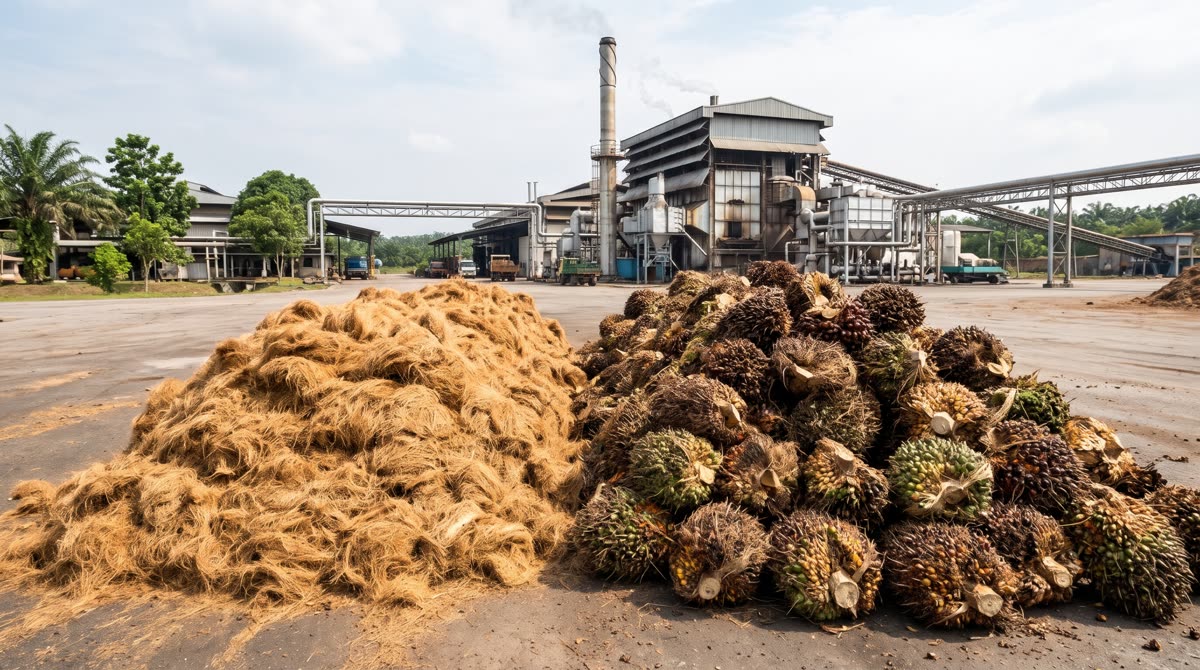
Table of Contents
Two Solid Wastes, Two Different Characters
Fiber, or mesocarp fiber, appears after the fruit flesh is recovered, whereas empty fruit bunch remains after the fruit loosens during sterilization and separation. Both belong to the main waste streams, with quantities proportional to the volume of fresh fruit bunch (FFB) processed.[1][2]
From a fuel standpoint, fiber is generally drier and has a higher calorific value, while fresh empty fruit bunch contains a lot of water. That difference directly affects furnace performance: high moisture absorbs heat for evaporation, so empty fruit bunch needs drying or additional processing before it can burn efficiently.[3][4]
| Aspect | Palm Fiber (Fiber) | Empty Fruit Bunch (EFB) |
|---|---|---|
| Raw material moisture content | about 12.5% [4] | about 62.3%; fresh can be 60-70% [3][4] |
| Calorific value | 17.2-20.6 MJ/kg [4][5] | 11.5-18.4 MJ/kg [4][5] |
| Ash content | about 4.1% [4] | 6.2% in the review; 7.55% in commercial pellets [3][4] |
| Availability per ton of FFB | about 13% [5] | about 20-23% [1][5] |
| General role in the boiler | already a common supplementary fuel [1][2] | potential, but some is returned to the plantation or upgraded first [1][3] |
Availability: Abundant, But Not in the Same Form
GAPKI records empty fruit bunch as the largest solid waste, averaging 21-23% of FFB weight, and every ton of FFB yields about 220 kg of empty fruit bunch.[1] The volume is large, but common utilization still consists of mulch, compost, and biomass pellets.[1]
Fiber is less abundant, about 13% of every ton of FFB, but it is produced continuously while the mill processes fruit.[5] Thus, the mill always has both of these energy feedstocks at the same time, only in unequal proportions.[1][5]
Use in the Boiler: Direct versus Requires Preparation
In mill practice, fiber is commonly used as boiler fuel together with shells to produce steam for processing and power generation.[2] Its presence helps maintain the mill’s energy efficiency and reduces the volume of solid waste that must be managed.[1]
Empty fruit bunch can also be utilized, but its high moisture content—which can reach 60-70%—makes direct combustion less efficient.[3] Commercial EFB pellets are indeed drier, but their ash content is still recorded as high, averaging 7.55% in one study, so fuel quality and ash handling must be maintained.[3]
Supply Balance Inside the Mill
Steam demand tends to be stable while the mill operates, while the output of both wastes follows the amount of FFB entering. Fiber is usually the portion already allocated for the mill’s base requirements, so its availability tends to be more certain and easy to schedule.[2][6]
Conversely, although EFB volume is larger, some of it always returns to the plantation for nutrient recycling and groundwater conservation. Therefore, the amount of EFB truly free to be diverted to the boiler is smaller than its theoretical potential; gross potential is not the same as feedstock ready to be handed over.[6]
Complementing Each Other, Not Merely Replacing
Therefore, palm fiber and empty fruit bunch complement each other. The drier fiber suits the base firing load, while EFB adds fuel reserves once it has been dried, compacted, or upgraded in quality.[3][4]
By treating EFB as a reserve, the mill can sustain boiler operation without excessively consuming fiber or fossil fuel; by using fiber optimally, the remaining EFB still has room to be developed into value-added products.[1][3]
Conclusion
The comparison shows that the two are not alternatives that cancel each other out. Fiber excels in ease of combustion and supply certainty, while empty fruit bunch excels in volume and utilization flexibility.[1][2][4]
The best use decision is to match the fuel composition to steam demand, feedstock quality, and the obligation to return some EFB to the plantation, rather than pursuing a single fuel.[3][6]
References
- Gabungan Pengusaha Kelapa Sawit Indonesia (GAPKI). Palm Waste into Electricity, Fertilizer, and Even Animal Feed. gapki.id.
- Malaysian Palm Oil Board (MPOB). TT No. 492: Palm Fruit Factory: Key Solution to Achieving Zero Greenhouse Gas Emission from Palm Oil Mills. tot.mpob.gov.my.
- Nasrin, A. B., et al. Quality Compliance and Environmental Impact Assessment of Commercial Empty Fruit Bunch (EFB) Pellet Fuel in Malaysia. jopr.mpob.gov.my.
- Zain, Faatin Nisriinaa, et al. Energy Efficiency in Palm-Based Food Production Processes in Margarine Industry through the Utilization of Palm Fiber as Solid Biomass in Boiler Systems: A Comprehensive Review. journal.unnes.ac.id.
- Ibrahim, Darwin Harun, and Muammar Saputra. Analysis of Calorific Value Testing of Palm Oil Solid Waste at PT. Syaukath Sejahtera for Boiler Fuel. jurnal.usk.ac.id.
- Malaysian Palm Oil Board (MPOB). Oil palm biomass: From waste to business. prestasisawit.mpob.gov.my.