The Role of Oil Palm in Regional Economies and Labor Absorption
- Oil palm plantations and mills support regional revenues through local taxes, levies, and plantation revenue-sharing funds.
- Around 16.5 million workers were absorbed in 2024, with 9.7 million of them working directly on plantations.
- Transportation, logistics, and local services grow alongside upstream-downstream activities, while 3.04 million smallholders serve as the backbone of the upstream segment.
Oil palm is a strategic plantation commodity that supports regional economies in a number of producing provinces. In 2023, the area of oil palm plantations in Indonesia was estimated at 15.93 million hectares with palm oil production of 46.99 million tons [1][2]. This industry absorbed around 16.5 million workers in 2024 [5][6]. This article describes its contribution to regional revenues, labor absorption, supporting sectors, and the role of smallholder oil palm farmers.
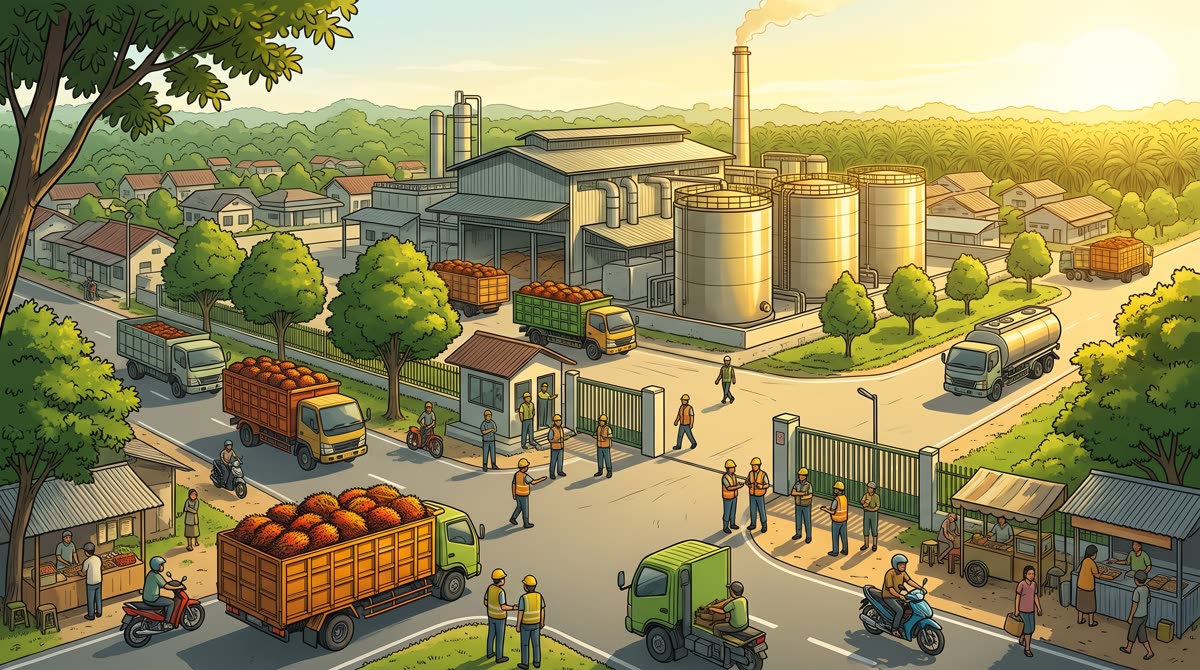
Table of Contents
The Position of Oil Palm in the Regional Economy
Oil palm has become a leading plantation commodity in a number of producing provinces and forms the economic base of rural areas. In 2023, the area of oil palm plantations in Indonesia was estimated to reach 15.93 million hectares, consisting of smallholder plantations, private large-scale plantations, and state-owned large-scale plantations [1].
This business scale makes oil palm an important indicator of regional economic conditions in producing regions. Industry data note that oil palm plantations reach 28 provinces with an economic value of around Rp775 trillion and palm oil production of 51.66 million tons per year [4]. This commodity also supports state foreign exchange earnings and the development of smallholder plantation areas in remote regions [3].
Contribution to Regional Revenues
Producing regions receive fiscal benefits from this sector through land and building tax, income tax, and levies on fresh fruit bunch weighing services. These local tax and levy channels are among the main components of locally generated revenue in regencies and provinces that depend on the plantation sector [1].
Processing added value strengthens the local tax base. In 2023, the oil palm commodity contributed 75.80 percent of the national plantation export value, amounting to USD 25.61 billion [3]. This large-scale economic flow crosses producing regencies and provinces, both at the processing and marketing stages [4].
| Aspect | Description |
|---|---|
| Planted area | 15.93 million hectares (2023) [1]; 16.83 million hectares (2023 preliminary figure) [2] |
| Cultivation status | Smallholder plantations, private large-scale plantations, and state-owned large-scale plantations [1] |
| Palm oil production | 46.99 million tons (2023) [2][3] |
| Export value | USD 25.61 billion, 75.80 percent of plantation export value (2023) [3] |
| Labor force | Around 16.5 million people (2024), 9.7 million of whom are direct workers [6] |
| Processing mills | More than 700 processing units [4] |
Labor Absorption
The oil palm industry is classified as labor-intensive. Based on Ministry of Agriculture data, the absorbed workforce increased from 12.5 million people in 2015 to around 16.5 million people in 2024 [6].
Of that total, 9.7 million people work directly on plantations, namely 5.2 million smallholder plantation workers and 4.5 million employees of state-owned or private plantation companies; the remainder are absorbed in supporting activities [6].
Supporting Sectors: Transportation and Services
Plantation and mill activities drive demand for transportation, logistics, and local services. The transport of fresh fruit bunches from estates to mills and the distribution of crude palm oil to ports absorb labor and sustain transportation businesses [6].
Downstream activities also support supporting services. GAPKI records more than 700 palm oil processing mills, each serving as a center of local economic activity along with loading and unloading, warehousing, workshops, and other supporting services [4].
The Role of Smallholder Oil Palm Farmers
Smallholder oil palm farmers play a central role in the upstream segment. GAPKI records 3.04 million oil palm smallholders with a planted area of 16.83 million hectares, so the majority of smallholder estates act as suppliers of fresh fruit bunches to processing mills [4]. Smallholder estates are generally managed on a small to medium scale and are spread across plantation centers on the islands of Sumatra and Kalimantan.
Support for smallholder oil palm farmers also has an impact on labor absorption, because smallholder plantation workers numbered 5.2 million people in 2024, most of whom work on family or farmer-group estates [6].
Prospects and Policy Implications
Opportunities to increase regional contributions lie in improving smallholder estate productivity and adding value through processing within the region. Industry data show national palm oil production of 46.99 million tons in 2023 and an export value of USD 25.61 billion for this commodity [2][3]. Productivity gains are directly proportional to the volume of fresh fruit bunches harvested by smallholders and absorbed by mills, so regional revenues and oil palm household incomes rise as well.
As an implication, regional policies that maintain the investment climate for plantations and mills while fostering smallholder oil palm farmers have the potential to expand regional revenues and labor absorption on a sustainable basis [4][6].
References
- Badan Pusat Statistik. Indonesian Oil Palm Statistics 2023. bps.go.id.
- Directorate General of Plantations. Plantation Statistics Book 2023-2025 Volume II. ditjenbun.pertanian.go.id.
- Directorate General of Plantations. Performance Report of the Directorate General of Plantations for 2023. ditjenbun.pertanian.go.id.
- Gabungan Pengusaha Kelapa Sawit Indonesia. Data & Statistics of the Indonesian Oil Palm Industry. gapki.id.
- Gabungan Pengusaha Kelapa Sawit Indonesia. Palm Oil Absorbs 16 Million Workers, Increases Product Added Value: That Is What the Coordinating Minister Said! gapki.id.
- Ministry of Manpower of the Republic of Indonesia. Minister of Manpower: Number of Workers in the Palm Oil Industry Continues to Rise. kemnaker.go.id.