Sterilization Methods in FFB Processing into CPO
- Sterilization pressurizes FFB with steam to release oil and inactivate lipase enzymes.
- Two main methods: batch (triple peak) and continuous.
- Pressure, temperature, and time parameters determine FFA, DOBI, and energy efficiency.
Sterilization is the step of boiling Fresh Fruit Bunches (FFB/TBS) with pressurized steam that releases oil while inactivating the lipase enzymes responsible for rising free fatty acid levels. This article reviews batch and continuous methods, pressure-temperature-time parameters, and their impact on CPO quality (FFA and DOBI) and energy efficiency.
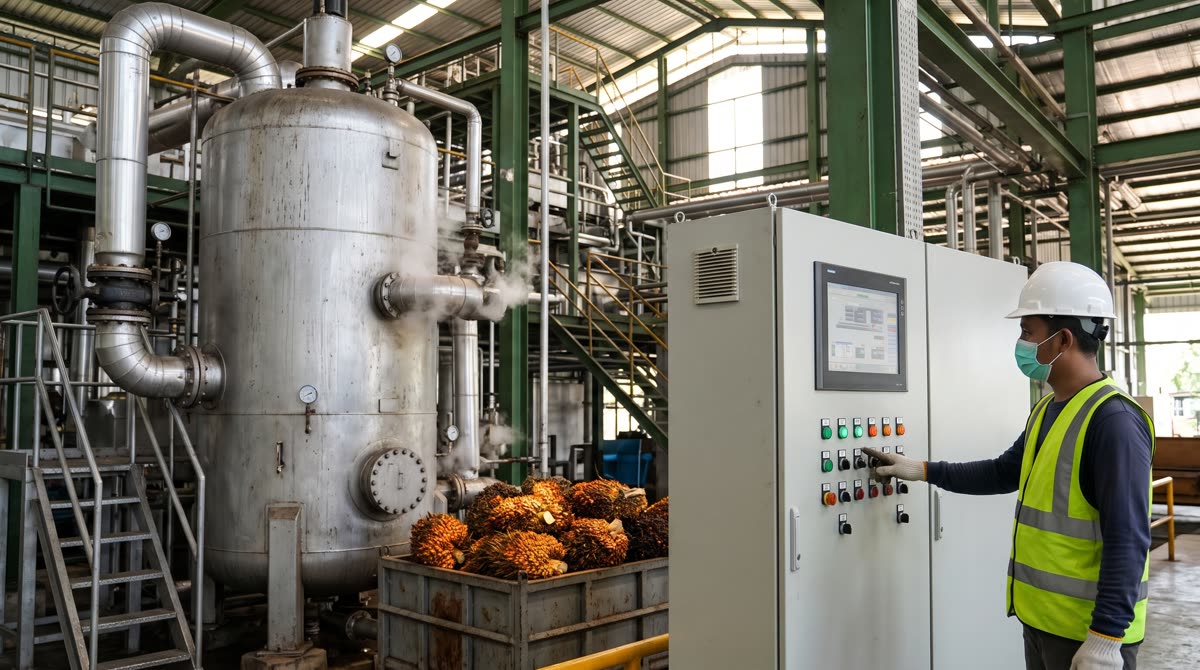
Table of Contents
Definition and Function of Sterilization
Sterilization is the stage of boiling Fresh Fruit Bunches (FFB/TBS) with pressurized steam inside a sterilizer vessel before the fruit is pressed into oil. This process aims to release oil from the fruit flesh while inactivating the lipase enzymes that can raise free fatty acid (FFA) levels [1].
Besides stopping enzyme activity, sterilization softens the fruit flesh (mesocarp) and eases the release of loose fruitlets from the bunch, reducing resistance during threshing and milling [1]. The FAO records sterilization as one of the core stages that separates the fruit before it is pressed into crude palm oil [3].
Batch Method (Conventional Sterilization)
The batch or conventional method uses two to six horizontal cylindrical vessels filled with FFB baskets and cooked with pressurized steam at about 3 bar for 70 to 90 minutes [2]. Each vessel works cyclically, namely filling, sterilizing, and discharging, so pressure and temperature tend to change according to its working stage [2].
In Indonesia, the batch system is often combined with the triple peak pattern: pressure is raised gradually at three peaks so that heating is uniform. This practice is carried out at a vessel temperature of about 140–145°C and a pressure of 2.5–3 kg/cm² with a total time of about 90 minutes [5].
Continuous Method
The continuous method channels FFB continuously through a closed sterilization line, rather than in batch baskets. The Malaysian Palm Oil Board studies continuous sterilization as an alternative that suppresses oil losses and improves heating uniformity [2].
Because it does not require baskets, an overhead crane, or transfer rails, the continuous method needs more compact space and handling infrastructure compared to the batch system [2].
Operating Parameters: Pressure, Temperature, and Time
The three main controlled parameters are pressure, temperature, and time. Sufficient pressure ensures steam penetrates the bunch, whereas excessive temperature and time can increase hydrolysis and FFA levels [1]. Non-uniform control between batches also causes some fruit to be underripe and other fruit to be overcooked [2].
The commonly practiced pressure range is around 1.5–3 bar; a direct steaming study at 1.5 bar shows that a time of 45 minutes gives fruit release of about 90.36 percent and FFA of no more than 1.25 percent, with an increasing yield trend in line with longer sterilization time [4].
| Parameter | Description |
|---|---|
| Pressure | Typically 1.5–3 bar; determines the ability of steam to penetrate the bunch. |
| Temperature | About 140–145°C in the triple peak batch system. |
| Time | Batch 70–90 minutes; continuous adjusted to the flow rate. |
| Pattern | Batch/triple peak or continuous. |
Impact on CPO Quality: FFA and DOBI
CPO quality is assessed, among other things, from FFA levels and the DOBI index (Deterioration of Bleachability Index). The lower the FFA and the higher the DOBI, the easier the oil is to refine [6]. High FFA and low DOBI generally also add refining costs.
DOBI was introduced by the Malaysian Palm Oil Board in 1981 as the ratio of absorbance at two wavelengths (446:269 nm) to predict refining ease, and it has become a reliable quality control tool for CPO [6]. The commonly applied pressure control, about 3 bar, needs to be matched with time and temperature so that FFA and DOBI remain maintained [2][5].
Energy Efficiency and Process Control
Sterilization is the largest steam consumer in a palm oil mill, so its efficiency determines production costs. The batch system with several vessels and basket-transfer equipment tends to cause heat losses and wastewater [2][4].
The combination of a boiler and sterilizer in a single direct steaming unit, as well as the application of continuous sterilization, is known to reduce energy consumption and wastewater production [4]. Therefore, the choice of method and parameter control is not only about quality, but also about mill economics and emissions [3][4].
References
- GAPKI. Processing of Fresh Fruit Bunches (FFB/TBS) into Crude Palm Oil (CPO). gapki.id.
- Malaysian Palm Oil Board. TT No. 148: Continuous Sterilization of Fresh Fruit Bunches. tot.mpob.gov.my.
- Food and Agriculture Organization. Palm Oil Processing (FAO Corporate Document Repository). fao.org.
- Hanifarianty, Pakdeechot, Wae-hayee. The Effects of Sterilization Time of FFB on Fruit-Bunch Separation and Crude Palm Oil Quality using Direct Steaming. akademiabaru.com.
- Mubarok, Sofwan, Bismantolo. Analysis of the Working Performance of a Crude Palm Oil Sterilizer. ejournal.unib.ac.id.
- Malaysian Palm Oil Board. TT No. 253: Deterioration of Bleachability Index. tot.mpob.gov.my.