Palm Oil Bioethanol
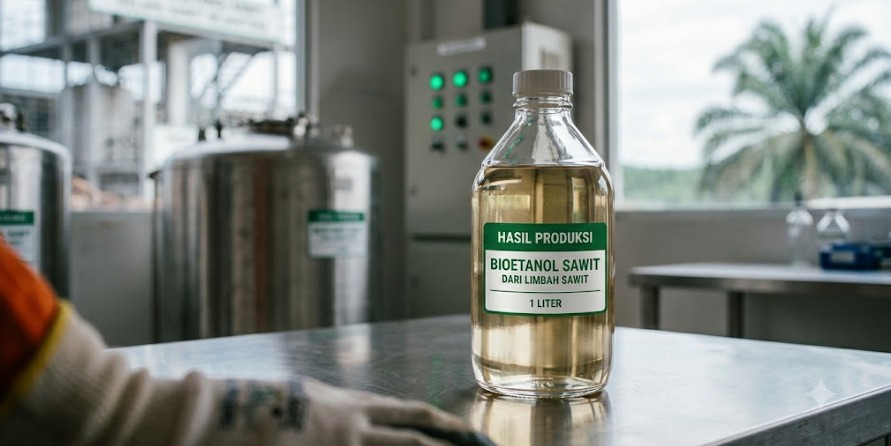
Palm oil bioethanol is an ethanol-based biofuel produced from oil palm biomass/waste not from the oil (CPO), but from the cellulose-rich parts of the oil palm plant, especially empty fruit bunches (EFB) and oil palm trunks. Unlike mainstream bioethanol in Indonesia, which is made from sugarcane, cassava, or corn, palm oil bioethanol is classified as second-generation (G2) bioethanol that utilizes agricultural waste rather than food crops.
Why From Biomass, Not From the Oil?
Palm oil (CPO) is a fatty compound (triglyceride), whereas ethanol is produced through the fermentation of sugar by microbes (the yeast Saccharomyces cerevisiae) so CPO cannot be directly fermented into ethanol. However, EFB contains around 4148% cellulose, 2534% hemicellulose, and 2733% lignin, which can potentially be converted into simple sugars through hydrolysis and then fermented into bioethanol. Oil palm trunks from replanting even have a higher cellulose content, reaching around 86%, and their sap itself contains around 10% sugar that could potentially be processed directly into first-generation bioethanol. The production process generally goes through three stages: hydrolysis, fermentation, and distillation.
Great Potential
As the world’s largest palm oil producer, Indonesia generates a very large amount of EFB waste estimated at around 50 million tonnes per year. According to a study by the International Council on Clean Transportation (ICCT), the potential ethanol production from palm residues alone is estimated to reach 2 million kiloliters per year and if combined with the processing of other agricultural residues such as straw, corn stover, and sugarcane bagasse, the production potential could jump to 50 million kiloliters per year.
Using palm waste for bioethanol has two important advantages over first-generation bioethanol: it is more environmentally friendly because it does not require opening new land, and it does not compete with food crops, so it does not trigger potential conflicts like those once seen in the cooking oil issue. In addition, empty fruit bunches left to pile up risk releasing emissions equivalent to 17.4 kg of CO2 per kilogram into the atmosphere so processing them into bioethanol also helps curb emissions from the palm oil sector.4
Current Research Development
Research on palm biomass-based bioethanol in Indonesia has so far been actively carried out by various research institutions and universities, one of which is BRIN through its Research Center for Chemistry, which has proven that its research-grade bioethanol qualifies as fuel grade meaning it is suitable for use as fuel. A number of researchers are also developing more efficient pretreatment technologies to reduce production costs, including an integrated biorefinery approach that produces G1 and G2 bioethanol simultaneously, plus other economically valuable derivative products such as lignin and glutathione (an antioxidant from fermentation residues).
Challenges Still Faced
Despite its great potential, the development of palm oil bioethanol has not yet been able to attract widespread industry interest, with the main challenges being:5
- Production costs are still high the hydrolysis of lignocellulose is far more complex and expensive than the direct fermentation of sugar/starch from sugarcane or cassava.
- Technical constraints in the production process a high lignin content can hinder the hydrolysis process, while the distillation process has not always been able to purify bioethanol to 99.5% as required by fuel standards.6
- No national-scale commercial implementation yet so far, development has stalled at the level of laboratory research and feasibility studies, although several plant-scale economic studies have already shown potential business viability.7
Why Has the National Program Not Prioritized Palm Oil Bioethanol?
The national bioethanol mandate program (E5, moving towards E10 and beyond) is currently focused first on first-generation bioethanol made from sugarcane, cassava, and corn because the technology is mature and production costs are far lower. Palm waste-based bioethanol, as second-generation bioethanol, still requires technological refinement and further reduction of production costs before it can compete commercially and enter the national energy policy roadmap significantly.
Relevance to the Indonesian Palm Oil Industry
Palm oil bioethanol opens up a great opportunity to convert EFB waste and oil palm trunks from replanting which so far have mostly been used only as fertilizer or left to pile up into energy products of high economic value.8 If the technology matures further and production costs can be reduced, palm oil bioethanol has the potential to become one of the downstream solutions for palm waste while strengthening the national biofuel portfolio, complementing palm oil biodiesel, which has already developed earlier.
References
GAPKI, “Energy of the Future! Bioethanol, Environmentally Friendly Gasoline from Palm Oil”, https://gapki.id/news/2023/03/15/energi-masa-depan-bioethanol-bensin-ramah-lingkungan-dari-sawit/
Trubus, “Utilization of Palm Biomass for Bioethanol Production”, https://trubus.id/pemanfaatan-biomassa-sawit-untuk-produksi-bioetanol/
The Conversation, “Technological innovation to reduce the production costs of waste-based bioethanol”, https://theconversation.com/inovasi-teknologi-untuk-mengurangi-biaya-produksi-bioetanol-berbasis-limbah-248678
4 The Conversation, “Indonesia can cut emissions from the palm oil sector through the use of bioethanol”, https://theconversation.com/indonesia-bisa-pangkas-emisi-dari-sektor-sawit-melalui-pemanfaatan-bioetanol-174291
5 The Conversation, “Technological innovation to reduce the production costs of waste-based bioethanol”, https://theconversation.com/inovasi-teknologi-untuk-mengurangi-biaya-produksi-bioetanol-berbasis-limbah-248678
6 Kompas, “Second-Generation Bioethanol”, https://nasional.kompas.com/read/2012/04/27/03381941/Bioetanol.Generasi.Kedua?page=all
7 Digilib UNS, “Pre-Design of a Bioethanol Plant from Empty Fruit Bunches with a Capacity of 50,000 KL/Year”, https://digilib.uns.ac.id/dokumen/detail/85982/Prarancangan-Pabrik-Bioetanol-dari-Tandan-Kosong-Kelapa-Sawit-Kapasitas-50000-KLTahun
8 Universitas Islam Indonesia, “Chapter I Introduction (Pre-Design of a Bioethanol Plant from EFB)”, https://dspace.uii.ac.id/bitstream/handle/123456789/13262/05.%201.bab%201.pdf