The Plasma Partnership Model for Oil Palm Smallholders
- The inti-plasma pattern connects plantation companies (inti) with farmers (plasma) in a single business chain that mutually strengthens each other.
- Plasma farmers gain access to technology, superior seedlings, and market certainty for Fresh Fruit Bunches (FFB).
- Policy frameworks and good practices determine whether the partnership delivers fair and sustainable benefits.
The plasma partnership is a model of oil palm plantation business that positions smallholder farmers as business partners, not merely raw material suppliers. This article describes the inti-plasma pattern, the roles of the parties involved, the benefits for farmers, the policy basis, and the good practices that support the welfare of oil palm farmers.
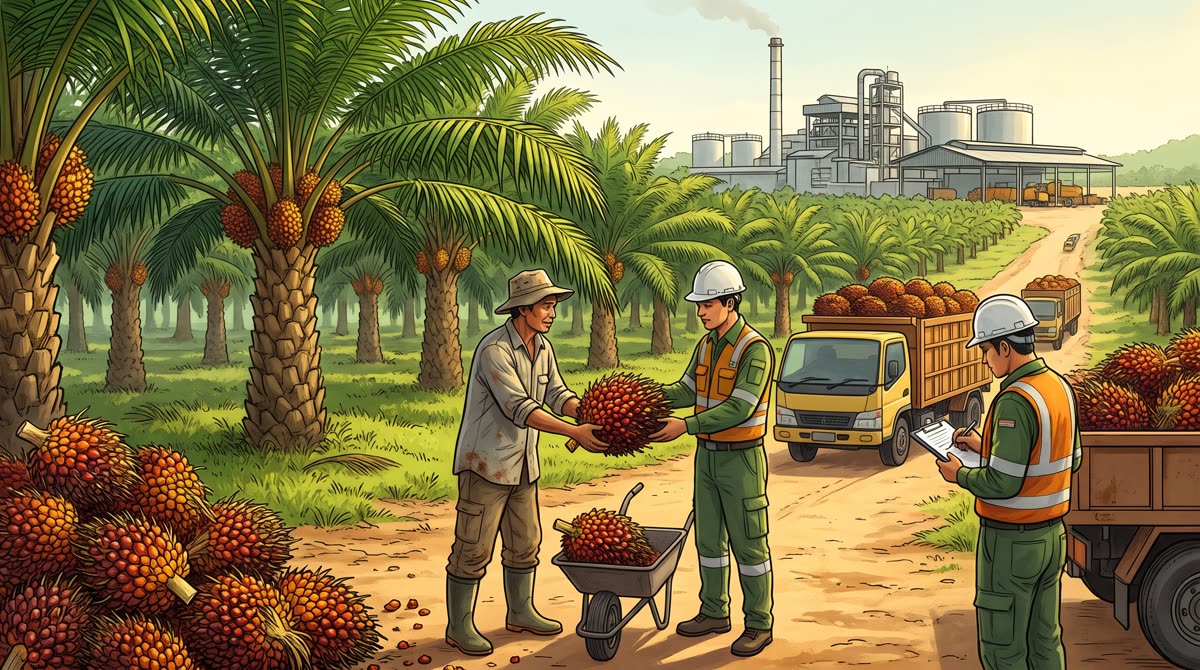
Table of Contents
Definition of the Inti-Plasma Pattern
The inti-plasma partnership is a pattern of cooperation in oil palm plantation businesses between a plantation company as the inti party and farmers as the plasma party [1]. The inti company generally develops, fosters, and processes the estate, while farmers manage the plasma estate and channel its produce to their partner [1][2].
Statistics Indonesia (BPS) defines a plasma estate as an estate developed by a plantation company (the inti estate), maintained by the inti estate until production, after which ownership and management are handed over to smallholder farmers [5]. Under this pattern, farmers are directly connected to the processing industry and the market [2].
The Roles of the Inti Company and Plasma Farmers
The inti company acts as a provider of production facilities, technical mentors, and a buyer of harvests. The scope of this support includes land preparation, certified superior seedlings, maintenance assistance, and guaranteed purchase of FFB at a price advantageous to both parties [1][6].
Plasma farmers act as estate managers who carry out cultivation according to standards and sell FFB to the partner company [1]. Farmer participation through farmer groups or cooperatives strengthens bargaining position and extension efficiency [2].
| Aspect | Description |
|---|---|
| Inti company | Develops and fosters plasma estates, provides superior seedlings, technical assistance, and purchases FFB |
| Plasma farmers | Manage the estate according to standards and channel FFB to the partner company |
| Financing | Estate capital support and access to financing, including facilitation of replanting funds |
| Marketing | Guaranteed absorption of FFB by the partner mill at a transparent price |
Benefits for Plasma Farmers
The main benefit of the plasma partnership is secure market access. Plasma farmers generally sell FFB directly to the partner mill, so they do not depend on middlemen and obtain a more structured price [1][4].
The partnership also opens access to technology and knowledge. Assistance in Good Agricultural Practices, the use of superior seedlings, and training in FFB pricing improve farmers’ skills and productivity [1][6].
On the income side, stable FFB prices have a positive impact on the income and welfare of smallholders [3][4]. Strong farmer institutions also accelerate technology adoption and access to replanting programs [2].
In addition, plasma farmers find it easier to access financing and replanting programs because their institutions are already established. Through the partnership channel, farmer groups or cooperatives can propose estate replanting with mentoring support and oil palm plantation fund facilities [3][4].
Policy Basis
The plasma partnership is supported by a strong policy framework, including Presidential Regulation Number 61 of 2015 concerning the Collection and Use of Oil Palm Plantation Funds, allocated for human resource development, research and development, promotion, replanting, as well as plantation facilities and infrastructure [3].
The Ministry of Agriculture, through the Directorate General of Plantations, opens a submission scheme for the People’s Oil Palm Replanting Program (PSR) through the partnership channel, as regulated in Minister of Agriculture Regulation Number 19 of 2023 [3]. Minister of Agriculture Regulation Number 13 of 2024 concerning the Purchase of FFB Produced by Partner Smallholders was strengthened to ensure a fair price for plasma and self-reliant smallholders [4].
Good Practices and Sustainability
Good practices in plasma partnerships emphasize the principles of mutual benefit, transparency, periodic evaluation, as well as coaching and coordination between smallholders and companies [6][3].
Strengthening farmer institutions through farmer groups, joint farmer groups (gapoktan), and cooperatives is an important factor in partnership sustainability, including in estate replanting [2][3]. Synergy between farmer associations and companies supports productivity, sustainability, and the welfare of all parties [1][6].
Conclusion
The plasma partnership offers an inclusive model of oil palm plantation development by connecting farmers to technology, financing, and markets [1][2]. With enforcement of the policy framework, transparency, and strong farmer institutions, this pattern can continue to contribute to the productivity and welfare of Indonesian oil palm farmers [3][4][6].
The sustainability of these benefits depends on consistent implementation of good practices, namely a fair, open, and mutually reinforcing business relationship between the inti company and plasma farmers [6].
References
- GAPKI. Oil Palm Plasma and Self-Reliant Oil Palm: Opportunities, Challenges, and Their Differences. gapki.id.
- GAPKI PalmWiki. The Role of Smallholder Oil Palm Farmers in Rural Economies. gapki.id.
- Directorate General of Plantations, Ministry of Agriculture. Partnership, an Effective Solution to Facilitate the Acceleration of Oil Palm Replanting for Smallholders. ditjenbun.pertanian.go.id.
- Directorate General of Plantations, Ministry of Agriculture. Strengthening Regulations: Government Measures to Ensure FFB Prices Do Not Harm Smallholders. ditjenbun.pertanian.go.id.
- Statistics Indonesia (BPS). Statistics of Indonesian Oil Palm 2023. bps.go.id.
- Directorate General of Plantations, Ministry of Agriculture. Partnerships Must Be Mutually Beneficial: Smallholders Gain, and Plantation Companies Also Gain. ditjenbun.pertanian.go.id.