What is G100 (Green Gasoline)?
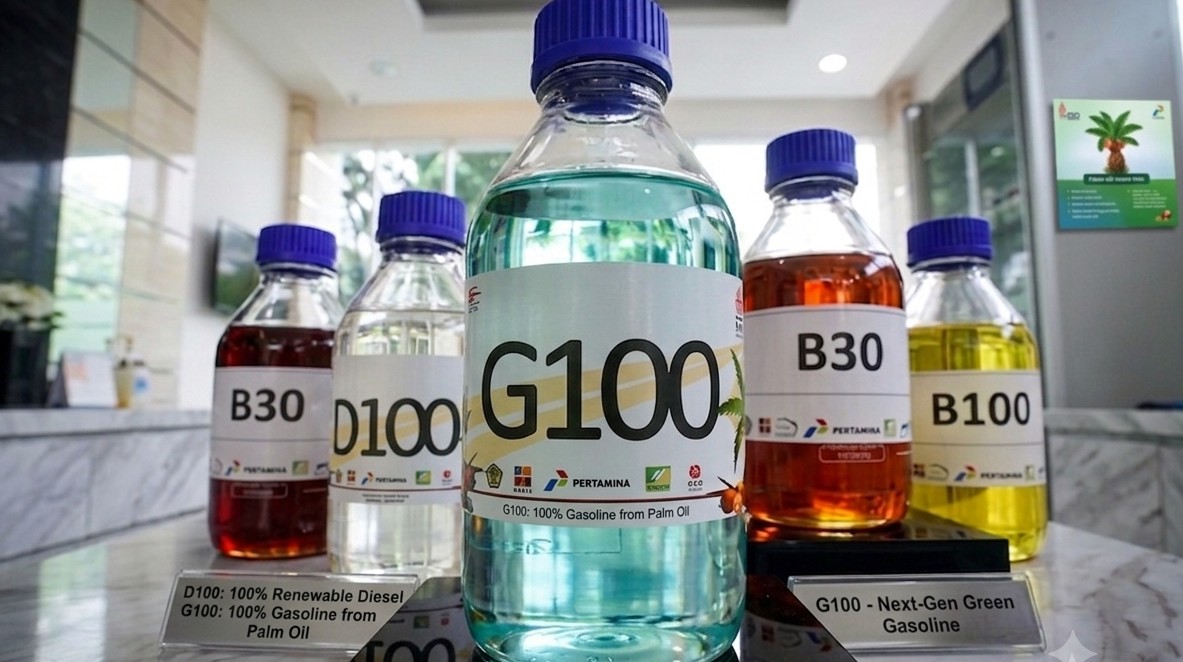
G100 is the term for gasoline fuel made 100% from palm oil also known as green gasoline or “palm gasoline”. Unlike D100 (100% palm oil diesel), which has already been successfully produced in full, G100 is still in a stage of gradual development through co-processing technology blending palm oil feedstock with fossil oil directly in the refinery.
How Is G100/Green Gasoline Made?
Its main feedstock is RBDPO (Refined Bleached Deodorized Palm Oil) palm oil that has been cleansed of gums and odors. This RBDPO is then blended with fossil fuel directly in the refinery processing unit, and processed through chemical reactions to produce gasoline fuel of higher quality, because its octane number actually increases.
The Trial Journey at the Plaju Refinery
The first trial of this technology was carried out by Pertamina at the Residue Fluid Catalytic Cracking Unit (RFCCU) of the Plaju Refinery in South Sumatra, with a capacity of 20 Million Barrels per Stream Day (MBSD), starting in late 2018. The results were quite promising:
- With base gasoline at RON 90.3, injecting 5% RBDPO produced gasoline with an octane rating of 90.7.
- Increasing the RBDPO injection to 7.5% produced gasoline with an octane rating of 91.3.
- Forward projection: a 10% RBDPO injection is estimated to yield an octane rating of 91.6, and a 12.5% injection is projected to produce gasoline equivalent to Pertamax at RON 92.
Since early December 2018, the Plaju Refinery has been producing 90-octane green gasoline at 405,000 barrels per month (equivalent to 64,500 kiloliters), while also producing green LPG at 11,000 tonnes per month as a by-product. The use of palm oil at this refinery also drives the Domestic Component Level (TKDN) of the fuel to be very high, while saving state foreign exchange through a reduction in fuel imports of around 7,360 barrels per day.4
Current Status: Still a Blend, Not Yet 100% Pure
Although called “G100”, what Pertamina has managed to realize so far is still a (co-processing) blend with a certain percentage of RBDPO not truly 100% pure from palm oil. Pertamina’s plan to process 100% CPO into fuel at the Plaju Refinery was announced by management in early 2019, but its full realization requires further facility development and policy support.5
The government, through the Ministry of Energy and Mineral Resources (ESDM), is also encouraging the expansion of this palm oil-based green fuel development to other refineries such as Cilacap, Balongan, and Dumai with an expanded product scope that also covers green diesel and green jet fuel.6
G100 vs the Gasoline Currently Available at Gas Stations
It is important to understand: the biofuel-blended gasoline currently available at gas stations Pertamax Green 95 and Pertamax Green 92 contains about 57% bioethanol derived from the fermentation of sugarcane/molasses, not from palm oil. Meanwhile, Pertalite, regular Pertamax, and Pertamax Turbo are still purely fossil-based, with no plant-based content at all. In other words, G100/palm gasoline is not yet available to general consumers its status remains research and refinery-scale trials.
Part of the National Biofuel Nomenclature
The government has drawn up an official nomenclature for 100% palm oil-based biofuels, consisting of: Biodiesel (B100), Bioethanol (E100), biohydrocarbon gasoline (G100), biohydrocarbon diesel (D100), and biohydrocarbon jet fuel (J100).7 Of these five categories, D100 has already been successfully produced in full, while G100 is still catching up.
Relevance to the Indonesian Palm Oil Industry
G100 opens up great potential for diversifying palm oil utilization into the gasoline sector a sector that has so far relied more on bioethanol from sugarcane. If its development is fully realized, G100 has the potential to open a new domestic market for Indonesian CPO, while completing the national biofuel portfolio, which has so far been dominated by biodiesel and is beginning to expand into bio-jet fuel and D100.
References
Katadata, “Pertamina Saves Rp 2.3 Trillion from Processing Palm Oil at the Plaju Refinery”, https://katadata.co.id/berita/energi/5e9a558b3acab/pertamina-hemat-rp-23-triliun-dari-olah-minyak-sawit-di-kilang-plaju
Kumparan, “Pertamina Trials Making RON 91 Gasoline from Crude Oil and Palm Oil”, https://kumparan.com/kumparanbisnis/pertamina-uji-coba-bikin-bensin-ron-91-dari-minyak-mentah-dan-sawit-1545902008791846393
BPDP (Palm Oil Plantation Fund Management Agency), “Pertamina’s Plaju Refinery Successfully Processes Palm Oil into Green Gasoline and LPG”, https://www-ng.bpdp.or.id/id/p/kilang-plaju-pertamina-sukses-olah-sawit-jadi-green-gasoline-dan-lpg
4 Katadata, “Pertamina Saves Rp 2.3 Trillion from Processing Palm Oil at the Plaju Refinery”, https://katadata.co.id/berita/energi/5e9a558b3acab/pertamina-hemat-rp-23-triliun-dari-olah-minyak-sawit-di-kilang-plaju
5 Detik Finance, “Pertamina Blends Palm Oil into Fuel at the Plaju Refinery”, https://finance.detik.com/berita-ekonomi-bisnis/d-4389196/pertamina-racik-minyak-sawit-jadi-bbm-di-kilang-plaju
6 Kompas.id, “After Plaju, Biofuels to Be Produced at Other Refineries”, https://www.kompas.id/artikel/setelah-plaju-bahan-bakar-nabati-diproduksi-di-kilang-lainnya/amp
7 Directorate General of Oil and Gas, Ministry of Energy and Mineral Resources, “Ministry of Energy and Mineral Resources Encourages Green Fuel Development”, https://migas.esdm.go.id/post/read/kementerian-esdm-dorong-pengembangan-green-fuel