Zero Waste Palm Oil: From A to Z, Everything Can Be Utilized
The oil palm is not just a producer of vegetable oilit is an integrated bio-industrial plant capable of converting 100% of its biomass into products of high economic value. Of every 1 ton of Fresh Fruit Bunches (FFB), only 22% becomes oil, while the remaining 78% is biomass that has long been considered waste, even though it holds an economic potential of up to USD 150-200 per ton.
With the zero waste concept, the oil palm becomes the backbone of the circular economy and a model of future agro-industrial sustainability.
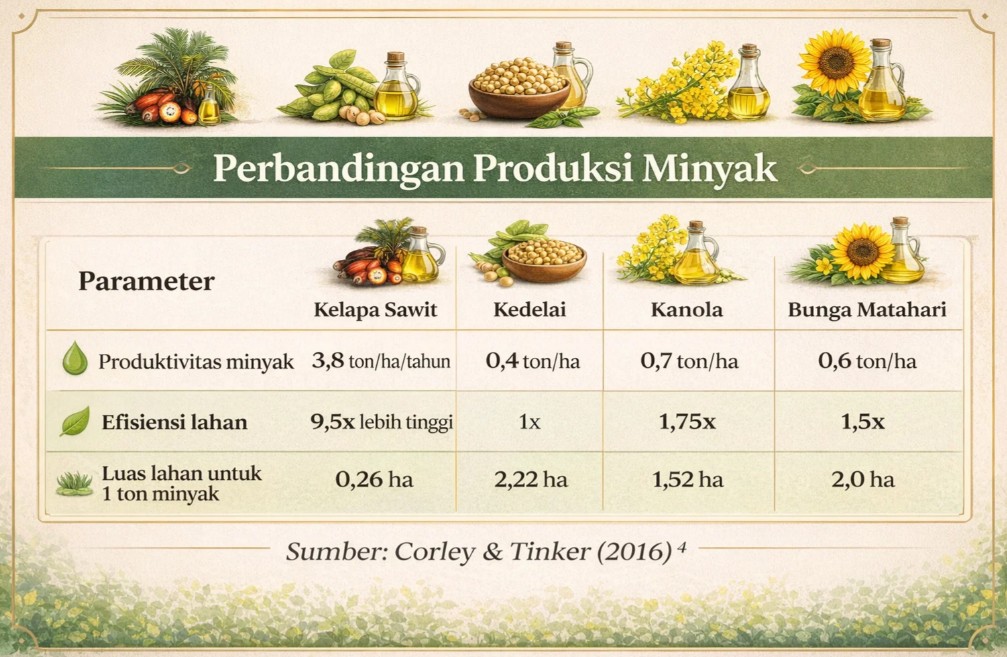
This means: to produce the same amount of vegetable oil, oil palm requires 9x less land than soybeanthis is the key to sustainability in an era of land scarcity.
The Zero Waste Concept in Oil Palm
Zero waste in oil palm means that all biomass from the plantation and mill is reprocessed into useful products. Nothing goes to waste. This concept is aligned with:
- Circular Economy – maximizing resource utilization
- Biorefinery – integrated biomass processing for various green products
- Sustainable Development Goals (SDGs) – particularly SDGs 7, 12, 13, and 15
Utilization of Every Part of the Plant: A to Z
OIL PALM BIOMASS TRANSFORMATION FLOW
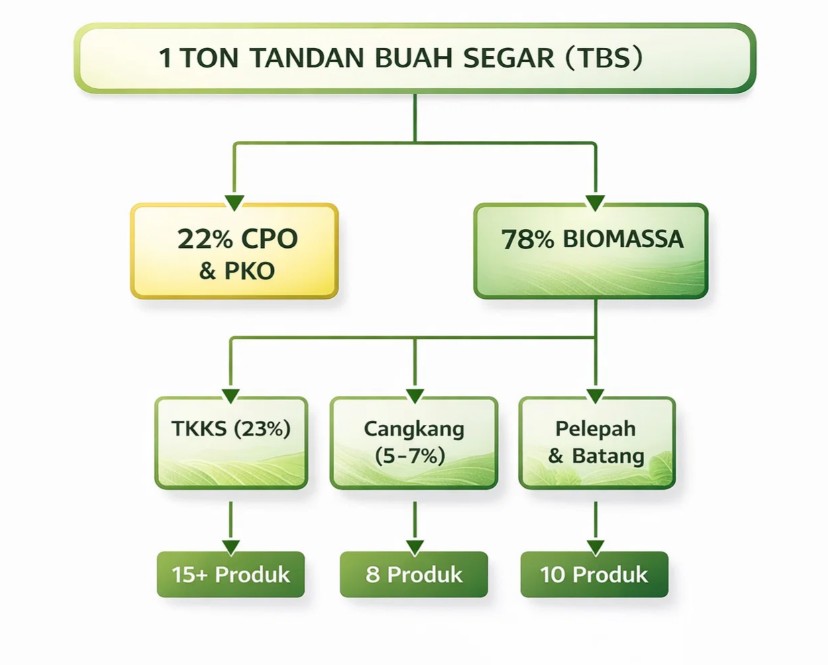
Fruit Flesh and Kernel: 22% of FFB
Processed Outputs:
- Crude Palm Oil (CPO) ? 200-220 kg per ton of FFB
- Palm Kernel Oil (PKO) ? 40-50 kg per ton of FFB
End Products:
- Food products – cooking oil, margarine, shortening
- Toiletries & cosmetics – soap, shampoo, lipstick, creams
- Biofuel – biodiesel B30, B40, up to B100
- Oleochemicals – fatty acids, glycerin, surfactants
Advantage: Palm oil has a productivity of 3.8 tons/ha/year, the highest in the world9.5x more efficient than soybean45.
Palm Kernel Shell: 5-7% of FFB
Potential: Every mill produces 50-70 kg of shell per ton of FFB
Utilization:
- Boiler fuel – calorific value of 4,000-4,500 kcal/kg (equivalent to 60% of coal)
- Biomass power generation – 1 ton of shell ? 800-1,000 kWh of electricity
- Eco-friendly concrete aggregate – substitute for gravel, reducing weight by 15-20%
- Activated carbon – adsorption capacity up to 1,000 mg/g, for water filters & industry
- Battery electrodes – research on lithium-ion anode materials
Environmental Impact: Replacing coal with palm kernel shell reduces CO2 emissions by up to 2.5 tons per ton of shell6.
Empty Fruit Bunches (EFB): 23% of FFB
Greatest Potential: Every mill produces 230 kg of EFB per ton of FFB = 15-20 tons of EFB per hectare per year
EFB Transformation:
A. Organic Fertilizer & Compost
- Direct application to the field (mulching) or composting
- Reduces chemical fertilizer requirements by up to 30-40%
- Increases soil carbon stock by up to 15 tons CO2e/ha7
B. Bioenergy
- Bioethanol – potential of 150-200 liters per ton of dry EFB
- Bio-crude oil – via pyrolysis, yield 35-45%
- Biogas – potential of 200-300 m per ton of EFB
C. Industrial Materials
- Bioplastics (PHA/PHB) – 100% biodegradable within 6-12 months
- Pulp & paper – quality equivalent to wood, yield 40-50%
- Paper bags & packaging – alternative to single-use plastics
- Particleboard & MDF – substitute for forest timber
Integrated Biorefinery
EFB is an ideal raw material for a cascade biorefinery, where a single material is processed in stages to produce multiple products:
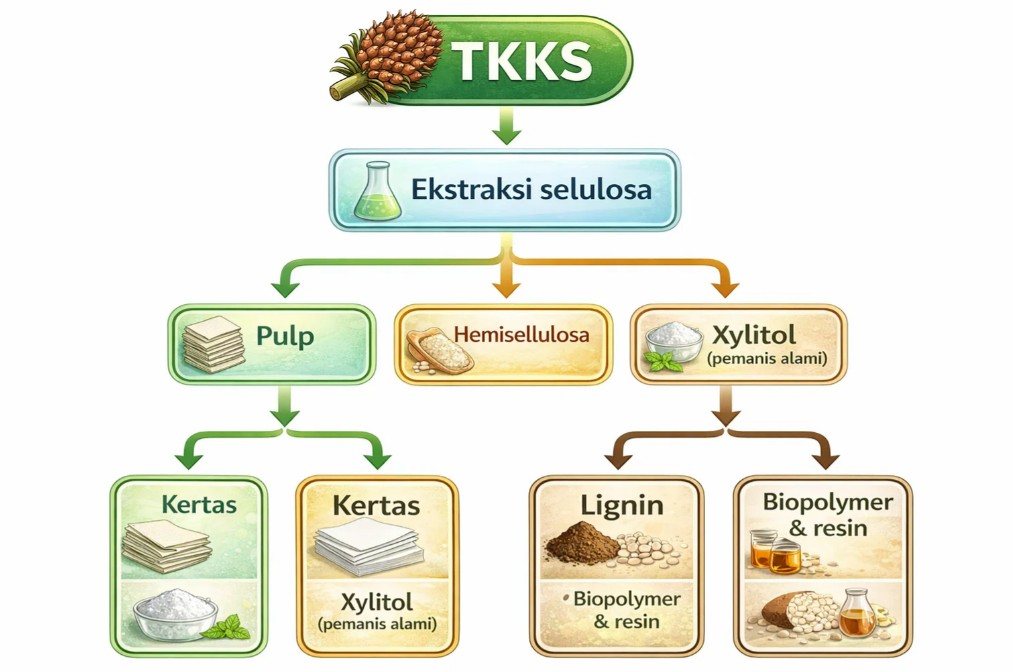
Economic Value: EFB that was once “waste” is now worth USD 15-25 per ton (compost) up to USD 150-200 per ton (bioethanol & bioplastics)7.
Oil Palm Fronds: Pruning Fronds
Potential: 22-24 fronds per tree per year 130-150 trees/ha = 2,800-3,600 fronds/ha/year ( 25-30 tons of biomass)
Utilization:
- Organic fertilizer – returned to the soil as mulch
- Bioenergy – charcoal briquettes with a calorific value of 3,500-4,000 kcal/kg
- Animal feed – after fermentation, crude protein rises from 4% ? 12%
- Woven handicrafts – bags, hats, decorations
- Particleboard – raw material for furniture
Social Impact: The utilization of oil palm fronds opens up micro-enterprises and village economies based on handicrafts and animal feed8.
Oil Palm Trunk: Replanting/Rejuvenation
Potential: Every replanting cycle (25 years) yields 200-250 tons of trunk per hectare
Oil Palm Trunk Transformation:
- Furniture & wood products – quality equivalent to sengon wood
- Construction materials – beams, boards, plywood
- Bioethanol – potential of 80-100 liters per ton of trunk
- Pulp & paper – yield 45-50%, brightness 70-75%
- Composite boards – OSB (Oriented Strand Board)
Environmental Significance: Using oil palm trunks reduces pressure on natural forests as a source of conventional timber. Indonesia rejuvenates 200,000 ha of oil palm per year = 40-50 million tons of trunk that can replace forest timber?.
Positive Impacts of Zero Waste Oil Palm
Environment
- Reduces greenhouse gas emissions by up to 3-5 tons CO2e per hectare per year
- Reduces mill waste by up to 90%
- Reduces dependence on fossil energy
- Increases carbon sequestration in plantation soils
Economy
- Biomass added value: from USD 0 ? USD 100-200 per ton
- Creates 15-20 new jobs per 1,000 tons of FFB
- Product diversification = lower market risk
- Global bioplastics market potential of USD 20 billion by 2030
Social
- Empowers local economies based on MSMEs
- Technology transfer to plasma farmers
- Improves the image of the sustainable palm oil industry
Innovation & Future Prospects
Emerging Technologies:
- Nanocellulose from EFB – ultra-strong material for composites & electronics
- Hydrogen production – gasification of oil palm biomass for hydrogen energy
- Biosurfactants – chemical detergent substitutes derived from PKO
- High-quality animal feed – high-protein frond silage
- Premium biochar – carbon capture & soil amendment
2030 Targets:
- 100% of oil palm biomass utilized (total zero waste)
- 30% of mill energy from its own biomass
- Biomass derivative product exports of USD 2-3 billion
- Carbon negative certification for sustainable plantations
The oil palm is a perfect example of the circular economy: nothing goes to waste, everything has value. From every ton of FFB, we get not only 220 kg of oil, but also 780 kg of biomass that can become energy, fertilizer, materials, and green products.
With continuous innovation, the oil palm is not just an oil producerbut a catalyst for Indonesia’s bioeconomy toward a net-zero emission future.
BPDP Sawit & PASPI – Product Innovation from Oil Palm Biomass (GRS BPDPKS)
https://www.bpdp.or.id/storage/app/media/Publikasi/GRS/GRS%20BPDPKS%20-%20Biomassa%20Sawit.pdf
Ellen MacArthur Foundation – Completing the Picture: How the Circular Economy Tackles Climate Change
https://ellenmacarthurfoundation.org/completing-the-picture
Palmoilina – The Amazing Oil Palm: Zero Waste
https://palmoilina.asia/berita-sawit/kelapa-sawit-ajaib-zero-waste/
4 Corley, R.H.V. & Tinker, P.B. (2016) – The Oil Palm (5th Edition), Wiley-Blackwell
Global reference on oil palm productivity and land efficiency
5 IPB University – Productivity and Efficiency of Palm Oil Compared to Other Vegetable Oils
https://repository.ipb.ac.id/handle/123456789/91877
6 University of Indonesia – Utilization of Palm Kernel Shell as Fuel and Adsorbent
https://lib.ui.ac.id/detail?id=20491243
7 Institut Teknologi Bandung – Potential of Empty Fruit Bunches as Biorefinery Feedstock
https://digilib.itb.ac.id/index.php/gdl/view/61734
8 Andalas University – Utilization of Oil Palm Frond Waste for Animal Feed and Woven Products
https://repo.unand.ac.id/21567/
? Wageningen University & Research – Utilization of Oil Palm Trunk as Wood Substitute
https://edepot.wur.nl/353330
University of Cambridge – Biomass, Circular Economy and Low-Carbon Development
https://www.repository.cam.ac.uk/handle/1810/296302